Get to know Idaho’s open meetings law

From the Coeur d’Alene Press

If they’re making a decision, make yourself at home.

If they’re holding deliberations, pull up a chair.

But if a government entity is discussing personnel issues, say, hiring an employee or disciplining an officer, the door will be shut to civilians.

No use complaining. It’s the law.

The open meetings law, specifically.

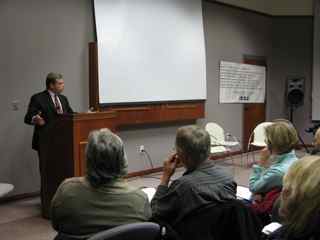
And it’s there for a reason, explained Idaho Attorney General Lawrence Wasden on Tuesday night.

“(The law) has helped us gain timely access to information,” he said, speaking to a crowd of citizens, reporters and government employees at the Spokesman Review building. “And it’s also protected information that the law ensures be restricted, like the investigative efforts of law enforcement.”

Idaho’s open meeting and public records laws might seem like dry subjects. But if anyone wants to hear a highway district deliberate on a tax increase, or wants a copy of an email between school board members, the information is useful.

That’s why the attorney general, with Idahoans for Openness in Government, held a seminar on the restrictions and allowances of the two recently updated laws on Tuesday.

“Everybody, even if you sing out of tune, you’ll recognize there’s a sheet of music,” Wasden said at the event, co-sponsored by the Coeur d’Alene Press and the Spokesman Review.

The state’s open meeting law, Wasden said, ensures that almost every discussion and decision by a governing agency is open to public viewing.

Officials discussing policy privately at a restaurant, for instance, is illegal.

“You’ve been trusted with the public’s right to watch you conduct your business,” he said.

Deputy Attorney General Brian Kane spelled out the rules: An agency must provide notice of a meeting five calendar days ahead, and notice of the agenda 48 hours ahead.

Policy making outside of a noticed meeting is null and void, he said.

The law allows folks to observe, he added, but not participate.

“If you want to give (government officials) a piece of your mind, make an appointment to meet with them,” Kane advised.

Meetings for executive sessions, where members of the public may be excluded, must be specified on an agenda 24 hours ahead, he noted.

Decisions can’t be made in executive sessions, Kane said. Discussions are limited to a very narrow scope of subjects, like personnel and litigation.

“(Governments’) approach to executive sessions should be they’re the exception, not the rule,” he said. “If you can’t do anything without going into executive session, you’ve got a problem.”

Members of the public can record meetings, he said, so long as it doesn’t hamper the process.

For more about Idaho’s open meeting law, go to www.openidaho.org.

Complaints about violations at the local government level should be taken to the prosecuting attorney, Kane said.

Violations by state agencies should be reported to the attorney general’s office.

Kane noted that though officials can be charged up to $500 for knowingly violating the open meeting law, they can avoid fees by admitting error and holding a meeting again properly.

“My advice is, it’s OK to make a mistake. Just own it and fix it quickly,” Kane said. “It’s a lot easier than the road of denial.”

As for Idaho’s open records law, Wasden said, the custodian of a government document can’t deny a record request or question its intent, unless about it being used as a mailing list.

“A public record is a public record,” Wasden said, adding that there are some exemptions like personnel and litigation documents.

Accessible records include handwritten and typewritten documents, photographs, photostats, emails, phone texts and Facebook pages, property tax records and government credit cards.

“If you’re spending public dollars, the public has a right to see what’s going on,” Wasden said.

Kane noted that an agency can grant or deny a records request within three working days, or within 10 working days if more time is needed.

Under the new statute, the first two hours of labor for obtaining a record, or the first 100 pages, are free.

Wasden had simple advice for government employees about not leaking embarrassing intel.

“Listen to your mother, ‘If you don’t have something nice to say, don’t say anything at all,'” he said. “And finally, listen to Mark Twain: ‘Never pick a fight with someone who buys ink by the barrel.'”

From the Coeur d’Alene Press

Big crowd, lots of interest at CdA open government seminar

From Eye on Boise/Spokesman-Review

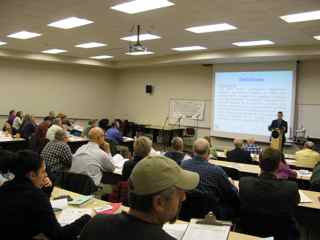
A whopping 92 people attended the open government seminar in Coeur d’Alene last night, sponsored by IDOG, Idahoans for Openness in Government, and co-sponsored by the Spokesman-Review and the Coeur d’Alene Press. Press Managing Editor Mike Patrick told the crowd it was the first time he could remember the two competing newspapers co-sponsoring an event. Among those attending were numerous local government officials and staffers, reporters for a variety of news media, political activists, several former state legislators and lots of interested citizens.


Idaho Attorney General Lawrence Wasden singled out an audience member, former state Sen. Gary Ingram, for special recognition: Ingram is the author of much of the Idaho Open Meeting Law, including the key wording in the preamble:

“67-2340. Formation of public policy at open meetings. — The people of the state of Idaho in creating the instruments of government that serve them, do not yield their sovereignty to the agencies so created. Therefore, the legislature finds and declares that it is the policy of this state that the formation of public policy is public business and shall not be conducted in secret.”

Said Wasden, “We owe a great thanks to give to Sen. Ingram for his work on this.”

Also recognized for traveling the farthest to attend: Bannock County Commissioner Howard Manwaring, who traveled from Pocatello to attend the session. It ran well into the evening because the audience had lots of questions, on everything from executive sessions to notice requirements to public records requests to minutes.

In interactive skits to demonstrate various nuances of the open meeting law and the Idaho public records law, actors included Kootenai County Prosecutor Barry McHugh, who portrayed an upset county commission chairman, and Kootenai County Commission Chairman Todd Tondee, who portrayed a county prosecutor. Coeur d’Alene Press reporter Maureen Nolan acted the part of “Trusty the city clerk,” opposite Coeur d’Alene Schools Superintendent Hazel Bauman, playing “Crusty, the reporter.”

Among the comments in the evening’s evaluations: From a school district clerk: “I learned some new information.” From another public employee: “How to keep my entity legal and in compliance.” Another attendee wrote that he learned: “Documents are meant to be public; give public officials a chance to provide them.” Wrote another, “My organization needs to change agenda format and will probably put minutes/agenda online.”

Every attendee got copies of the latest version of the Attorney General’s Open Meeting Law Manual and Public Records Law Manual; both also are online at his website here. Wrote a citizen who attended the Coeur d’Alene seminar, “The booklets will be a great help. There are ways to stay out of ‘trouble.’” Wrote another, “Be cooperative, be helpful, when in doubt check the book.” Tonight, the open government seminar will be in Moscow, and tomorrow, Lewiston; there’s more info here.

From Eye on Boise/Spokesman-Review

Sandpoint turns out for open government seminar

From Eye on Boise/Spokesman-Review

It’s a balmy 28 degrees in Sandpoint this morning, where last night more than 50 people packed the public meeting room at the Sandpoint Library to learn about Idaho’s open meetings and public records laws. “Open meetings and public records are very important to us as a citizenry,” Idaho Attorney General Lawrence Wasden told the group.

It was the first of four North Idaho seminars this week sponsored by Idahoans for Openness in Government, IDOG, in partnership with the Attorney General’s office and recommended by the Idaho Press Club, the Idaho Association of Counties and the Association of Idaho Cities. Last night’s seminar was co-sponsored by the Bonner County Daily Bee; publisher David Keyes said the turnout shows people here really want to know about these issues.

Among the points that got a lot of attention last night: The Open Meeting Law says the public can attend the meeting, but doesn’t say they can speak or participate; it just guarantees that citizens can observe. E-mails are public records. Agencies can’t take 10 days to decide whether or not to release a public record in response to a request; that decision has to be made within three days – the law only allows taking up to 10 days to provide the records when it takes longer than the specified three days to locate or retrieve them. And a new law passed this year makes the first two hours of labor and the first 100 pages of copies free of charge in public records requests, excepting only those records for which there’s a separate fee-setting statute, such as records in court files. “What this means is that 90 percent of your public records requests are going to be free,” Deputy Attorney General Brian Kane told the Sandpoint crowd.

Tonight, it’s on to Coeur d’Alene, where there’s been high interest, followed by Moscow on Wednesday and Lewiston on Thursday. Full disclosure here: I’m the president and a founding board member of IDOG. Last night was IDOG’s 20th open government seminar since 2004, and the first in North Idaho since 2005; Attorney General Wasden has led every seminar. There’s more info, including an online guide to these laws, at www.openidaho.org.

From Eye on Boise/Spokesman-Review

Idaho Supreme Court rules ISU prof had free speech protection for newspaper letters

From the AP/Idaho State Journal

POCATELLO, Idaho (AP) — The Idaho Supreme Court has upheld the dismissal of a lawsuit filed by an Idaho State University professor who claims he was wrongfully terminated, but ruled that a lower court wrongly found the former professor, Habib Sadid, had no First Amendment protection for his comments in a local newspaper critical of the university’s administration.

Faculty leaders at the southeastern Idaho school were pleased with the decision from the Supreme Court, which found that Sadid was not the victim of retaliation and that his employment with the public university did not strip him of his right to free speech as an individual.

“We view it as a massive win,” said biology professor David Delehanty, who holds a faculty leadership post at the university and is a member of the American Federation of Teachers. “The interest of all these organizations is free speech.”

Sadid was suspended from the university in August 2009 and terminated a month later for what administrators called unprofessional and insubordinate conduct. But Sadid said his history of speaking out about campus problems led to his termination; he had written letters to the editor and guest columns and ran a paid ad in the local newspaper with his criticisms.

His legal battle over his termination has gained financial support from groups including the American Association of University Professors, the American Federation of Teachers and the Foundation for Individual Rights in Education.

While the lower court Sadid’s criticisms of his employer did not involve issues of public concern, the Idaho Supreme Court found that the professor’s critique of plans to create a medical school at the university did constitute a matter of public concern. It also found that the published criticisms weren’t “pursuant to his official duties” as a public employee, which would have eliminated his free-speech protections against workplace retaliation.

“There is no evidence showing that Plaintiff’s official duties included making public statements on behalf of the University regarding the subject matter of his letters, nor is there evidence that his employment responsibilities included creating the statements that were published in the newspaper,” wrote Idaho Justice Daniel Eismann in the court’s unanimous opinion. “Therefore, his speech was as a private citizen.”

Sadid sued the university in state court in 2008 while he was still employed at the school, but the case was dismissed; he claimed then that he was retaliated against for publicly voicing his discontent with administration policies, including by not being appointed chairman of the university’s Department of Engineering. The court found no evidence that he was retaliated against at that point. Sadid has other state and federal lawsuits pending over his dismissal.

Officials at the Pocatello university lauded the decision of the high court to affirm the dismissal of the 2008 case. “We’re pleased with both the decisions of the Idaho Supreme Court and the district court,” Kent Tingey, vice president for university advancement, told the Idaho State Journal (https://bit.ly/qPO7Yr ).

From the AP/Idaho State Journal

Idaho restricts witness access to execution

From the Associated Press

The Idaho Department of Correction says it will not allow media witnesses to view the entire execution of Paul Ezra Rhoades, and two separate groups are protesting the policy, the Associated Press reports. Rhoades is scheduled to die by lethal injection Friday, making him the first person to be executed under Idaho’s new lethal injection guidelines.

Prison officials say to maintain Rhoades’ dignity, they won’t allow witnesses to view him being restrained or having the IVs inserted. They also said changing the procedure now could be disruptive. But a group of Idaho news organizations say that policy conflicts with a 2002 federal court ruling that found the public, through the media, must be allowed to view executions in their entirety. The news organizations have asked the state to reconsider. Click below for a full report from AP reporter Rebecca Boone.


Idaho restricts witness access to execution

By REBECCA BOONE, Associated Press

BOISE, Idaho (AP) ? The Idaho Department of Correction says it will not allow media witnesses to view the entire execution of Paul Ezra Rhoades, and two separate groups are protesting the policy.
Rhoades is scheduled to die by lethal injection Friday, making him the first person to be executed under Idaho’s new lethal injection guidelines.

Prison officials say to maintain Rhoades’ dignity, they won’t allow witnesses to view him being restrained or having the IVs inserted. They also said changing the procedure now could be disruptive.
But a group of Idaho news organizations say that policy conflicts with a 2002 federal court ruling that found the public, through the media, must be allowed to view executions in their entirety. The news organizations have asked the state to reconsider.

In a separate effort, the American Civil Liberties Union of Idaho is also protesting the restricted access. The ACLU contends that if the execution can’t be carried out in compliance with federal court rulings, it must be postponed.

Rhoades was sentenced to death for the 1987 kidnappings and murders of 34-year-old Idaho Falls teacher Susan Michelbacher and 21-year-old newlywed and Blackfoot convenience store clerk Stacy Dawn Baldwin. He was also sentenced to life in prison for the 1987 murder of 20-year-old Idaho Falls convenience store clerk Nolan Haddon.

The Associated Press first learned late last week that the Department of Correction intended to restrict witness viewing to after the IVs were inserted. The organization asked department director Brent Reinke to allow the media to view the entire execution process. On Tuesday, Correction Department spokesman Jeff Ray said the state had considered the request but decided against it.

“The procedures were developed so that we would preserve the dignity of the offender,” Ray said in an email to the AP. “After discussing the matter with Director Reinke and legal counsel we have chosen to follow the procedures as they are written.”

The AP then joined with the Idaho Press Club, the Newspaper Association of Idaho, the Idaho State Broadcasters Association, The Post Register, the Blackfoot Morning News, the Idaho State Journal, the Idaho Statesman, the Idaho Press-Tribune and the Lewiston Morning Tribune to formally urge the department to reconsider. In a letter to Reinke and state attorneys, the news organizations’ attorney, Charles Brown, pointed out that the public holds a First Amendment right to view all aspects of the execution.

Brown noted a 9th U.S. Circuit Court ruling arising out of a lawsuit between the First Amendment Coalition and Jeanne Woodford, the warden of San Quentin prison in California. The federal appeals court found that allowing the public to view executions, through the media, plays a significant role in the functioning of capital punishment.

“To determine whether lethal injection executions are fairly and humanely administered, or whether they ever can be, citizens must have reliable information about the ‘initial procedures’ which are invasive, possibly painful and may give rise to serious complications,” the 9th Circuit wrote in that opinion.

Wednesday evening, Reinke sent a formal response, again declining to allow the media witnesses to view the full execution.

“The changes you requested at this late hour to IDOC’s execution procedures would have a potentially disruptive effect on the entire process. Among other things, it could compromise the anonymity of members of IDOC’s execution team,” Reinke wrote in the email.

The director said his department was aware of the 9th Circuit’s ruling but contended it was based on facts unique to California.

“In the months to come we shall review every aspect of Friday’s execution. As we do, we shall welcome your clients’ input on how we can improve this process,” Reinke wrote.

The 9th Circuit ruling addressed California prison officials’ concerns that allowing viewing of the entire execution in that state would allow reporters to figure out the identity of execution teams. In that case, the court found that surgical garb including facemasks could effectively conceal the identities of the team, and the judges noted that even if media witnesses were kept out of the room until the execution team left the area, a condemned inmate could easily reveal their identities by giving their names in his final statement.

In its separate effort, the ACLU of Idaho sent a letter to the Idaho Department of Correction on Tuesday citing the same 9th Circuit case. The letter said the “initial procedures,” such as bringing a condemned inmate into a death chamber, strapping him or her down and inserting IVs, are “inextricably intertwined with the process of putting the condemned inmate to death.”

In the letter, ACLU of Idaho staff attorney Lea Cooper called on the department to postpone all executions until they can “be brought in line with existing federal law.”

“The First Amendment rights of prisoners and of the public cannot be sacrificed at the whim of IDOC or any persons involved in administering executions,” the ACLU wrote.

It was unclear late Wednesday whether the ACLU or the news organizations planned to take further action, such as a filing a lawsuit, to challenge the Correction Department’s policy.

From the Associated Press

Open Government Means Informed Citizenry

Op-ed from the Moscow-Pullman Daily News

By Betsy Z. Russell

When residents of U.S. Highway 12 started hearing rumors about giant megaloads rolling past their homes, they found out what was really going on by filing public records requests.

When a state senator wouldn’t talk about his DUI arrest after he was found in a stolen jacknifed SUV and trailer, the public records did the talking for him, and the whole story came out.

When new legislative district lines were drawn this year, public records requests yielded information that showed people what direct impact the new lines would have on their representation: Which incumbents landed in the same districts and would have to face off for a chance to remain in office.

And reporters around the state have been combing through thousands of public records about the former University of Idaho professor, Ernesto Bustamante, who shot a graduate student to death and then killed himself, trying to help people make sense of how it happened and how the university dealt with the events leading up to the tragedy.

All these things were possible because laws protect citizens’ rights to know what’s going on in the government they fund with their tax dollars and participate in with their votes. In Idaho, the Idaho Open Meeting Law and Idaho Public Records Law play key roles in ensuring that our government remains open to us. Best case: An open government, supervised by an informed and engaged citizenry. That’s how we get government of, by and for the people.

All are invited to a one-day symposium on Nov. 9 entitled “Open Access: Citizens, Media & Government,” sponsored by the University of Idaho School of Journalism and Mass Media, with support from the McClure Center for Public Policy Research and the Society of Professional Journalists.

A new documentary film by UI students Hans Guske and Ilya Pinchuck, “Fighting Goliath: Megaloads & the Power of Protest,” will debut at 3 p.m.; a panel including megaloads opponents Lin Laughy and Borg Hendrickson, Lewiston Tribune reporter William Spence and myself will discuss “In the Sunshine: Holding Government Accountable” from 4-5 p.m.; and I’ll give a lecture entitled “Open Government: Why it Matters” at 7 p.m. in Room 106 of the Iddings Agricultural Sciences Building on the corner of Rayburn and Sixth streets; a reception will follow.

There’s more: In December, Idahoans for Openness in Government, known as IDOG, will bring Idaho Attorney General Lawrence Wasden to town for a seminar on exactly what is, and isn’t, covered by the open meeting and public records laws and how everyone can comply with them. That seminar, co-sponsored by this newspaper, will be Dec. 7 from 6-8:30 p.m. at Moscow City Hall in the city council chambers; like the UI’s symposium, it is free and open to the public. Local and state government officials and their staffers, reporters, and interested citizens all are invited.

Sure, as a reporter who covers state government, open government makes it easier – possible, really – for me to do my job. But it also does more than that: It enables all of us to be informed, effective participants in what happens in our public life – and that matters.

Betsy Z. Russell is a Boise-based reporter for The Spokesman-Review, and is president of the Idaho Press Club and president and a founding board member of IDOG.

Op-ed from the Moscow-Pullman Daily News

Bustamante told University of Idaho he was bipolar

From the Associated Press

University of Idaho President Duane Nellis said the psychology professor who gunned down Katy Benoit of Boise and then took his own life two months ago had disclosed his disorder shortly after he was hired in 2007.

Ernesto Bustamante, 31, was found dead in his hotel room Aug. 23 with six guns and medications for bipolar disorder and severe anxiety.

Moscow police a day earlier had found the body of 22-year-old Benoit, who was shot nearly a dozen times outside her Moscow home.

Bustamante disclosed to the psychology department that he managed his mental illness with medication after starting his employment on Aug. 12, 2007, the university said in a timeline it released Wednesday.

“We, as an institution when we hire people, we’re not allowed to ask for medical conditions, or anything like that,” Nellis said at a news conference on the Moscow campus. “Bipolar is something that’s certainly treatable.”

As early as Bustamante’s first semester, three or four students went to psychology department chair Ken Locke to express concerns about his behavior, saying he was “flirtatious” and showed favoritism to students.

Bustamante, who is originally from Venezuela, was confronted about the complaints and told Locke that his interactions with a student who was also Hispanic had been misunderstood, the university said.

Benoit met Bustamante last fall when she took a psychology course with him. By the end of the semester, they were dating.

In December 2010, Bustamante met with administrators to discuss a complaint that an anonymous caller had put into a university hotline, saying Bustamante was having sexual relationships with students and had been abusive toward one of them. The student at the center of the abuse allegations was not Benoit and denied that Bustamante had exhibited improper behavior, refusing to file a complaint against him.

Bustamante denied any violations of university policy.

Benoit’s relationship with Bustamante ended in May, when he put a gun to her head and told her how he would use it to kill her. She told others he had threatened her with a gun twice before. That month, he informed Locke he was experiencing withdrawal symptoms due to a change in his medication.

Bustamante had been known to alternately refer to himself as a “psychopathic killer” and “the beast,” according to police. After the couple split, Benoit alerted school officials that she was becoming increasingly concerned for her safety and filed a sexual harassment complaint with the university on June 12.

Bustamante denied the allegations and filed his own complaint against her on July 8, claiming defamation of character. Bustamante resigned his position as assistant professor Aug. 19, and police say he was in the process of moving to New Jersey for another job.

The quickest way for the university to remove Bustamante from campus was for him to sign a separation agreement.

“I’m not sure the university had knowledge about his employment anywhere else,” said Nellis, who was also unsure whether administrators in the psychology department had been contacted by the New Jersey employer.

School officials had contact with Benoit more than a dozen times to discuss the situation and urge her to take safety precautions. The final meeting came Aug. 22, the first day of the fall 2011 semester and the same day police said Bustamante shot Benoit 11 times with a .45-caliber handgun outside her home.

Nellis announced Wednesday that the university would take action to bolster its consensual relationship policy and expand sexual harassment training.

“We’ve come together in the wake of an unthinkable tragedy,” Nellis said. “Going forward, we’ll be stronger and wiser.”

Media outlets were expected to receive Bustamante’s personnel documents Thursday.

A judge ordered the documents released Oct. 3 after the university and several media outlets petitioned the court to rule they were a matter of public record.

From the Associated Press

UI to release Bustamante records

From the Lewiston Tribune

MOSCOW — The employment records of former University of Idaho psychology professor Ernesto Bustamante will be released Wednesday, two months after he killed graduate student Katy Benoit.

UI President Duane Nellis will discuss the records at a 1 p.m. news conference at the Student Union Building.

A judge cleared the way Oct. 3 for the release of Bustamante’s records after several news organizations including the Idaho Statesman, the Lewiston Tribune, the Spokesman-Review and the Associated Press filed formal requests for their release.

In his ruling, 2nd District Judge John R. Stegner cited an overriding public interest in disclosing the documents to allow people to make their own judgments about how the university handled the Benoit case.

Bustamante shot Benoit Aug. 22 at her off-campus residence three days after he resigned from the university, then killed himself early the next morning.

Benoit had been in a romantic relationship with Bustamante, but filed a sexual harassment complaint with the university after he made several violent threats against her.

The UI already has released Benoit’s student records, which included a detailed timeline of the events and actions around her case. A similar timeline is expected to be included in Wednesday’s release.

The Bustamante records may reveal the nature of his resignation, whether other students filed complaints against him, whether the university knew about his apparent mental health issues and whether it knew that he reportedly carried concealed weapons on campus.

From the Lewiston Tribune

Judge puts the public’s interests first

Editorial from the Idaho Statesman

Ernesto Bustamante left in his wake a premeditated and violent crime.

And a voluminous virtual paper trail: an estimated 70,000 emails over the course of four years teaching psychology at the University of Idaho.

These documents may answer the most nagging questions about Bustamante, the assistant professor who left the U of I’s staff on Aug. 19, murdered Boise native and U of I graduate student Katy Benoit on Aug. 22, and turned a gun on himself on Aug. 23.

These documents may reveal what U of I administrators knew — and when they knew it:

* Did Bustamante have affairs with other U of I students, aside from Benoit? Since sexual relationships between faculty and students violate university policy, was Bustamante disciplined?

* When did the U of I know that Bustamante had threatened Benoit with a gun on numerous occasions following their breakup? And since Bustamante was still on the payroll at the time, did he face disciplinary action?

* Were U of I officials aware of Bustamante’s mental condition — his multiple personalities, including one he called a “psychopathic killer” and one he named “the beast”? Did they know that Bustamante openly discussed his mental conditions with his students?

The public deserves answers. Every student who attends the U of I, every parent contemplating sending a son or daughter to the Moscow campus, has an unyielding right to know. (In the interest of full disclosure, Editorial Page Editor Kevin Richert’s oldest son is a U of I student, and he took a class from Bustamante.)

These answers may indeed cast the U of I in a negative light. The Bustamante e-mails may raise a new and troubling set of questions about due diligence, about red flags unheeded.

The facts may be revealed, in the weeks ahead, because of a ruling in a Moscow courtroom Monday. District Judge John R. Stegner authorized the release of the e-mails. Media outlets, including the Statesman, sought their release. Significantly, so did the U of I — the entity that has the most to lose from their release.

The university says it will release the records as soon as possible. Clearly, full and prompt disclosure is in the university’s best interest.

Stegner ruled on a narrow ambiguity in the law: Does a public employee’s right to privacy live on after death? Common sense rendered this one an easy call. The public interest clearly overrides the privacy concerns of a deceased public employee.

Stegner’s broader message transcends the issue at hand. Under state sunshine laws, government records are presumed to be open. Disclosure is the default position. Said Stegner, according to the Lewiston Tribune: “The overriding purpose of the (public records law) is to foster openness in government.”

A good reminder.

Editorial from the Idaho Statesman

Judge orders Bustamante records released

From Eye on Boise/The Spokesman-Review

2nd District Judge John Stegner has ordered the personnel records of former UI Professor Ernesto Bustamante released, in a court case in which the University of Idaho and media organizations from across the state appealed to the court to see if privacy protections for state personnel records persist after the employee is dead; Bustamante shot himself to death after police say he fatally shot UI student Katy Benoit outside her Moscow home. “This provides us with what we sought: a clear path forward,” University of Idaho general counsel Kent Nelson said in a statement. “It has always been the university’s intention to be as open and transparent as the law allows in this matter.” Click below for a full report from the Lewiston Tribune and the Associated Press.

Judge Stegner, ruling from the bench, held that the definition of “former official” does include one who is dead, but then applied a balancing test and ordered disclosure of the records, determining that the public’s right to know outweighed the privacy right of the “former official.” The UI doesn’t plan to appeal the ruling, which sets precedent for such cases in the future.


Idaho judge orders release of professor’s records

MOSCOW, Idaho (AP) — A judge has ruled the University of Idaho should release the personnel records of a former professor who police say killed a 22-year-old graduate student and then committed suicide after their relationship ended.

The Lewiston Tribune reports (https://bit.ly/nZ8xCn ) 2nd District Judge John R. Stegner ordered the records of Ernesto Bustamante released on Monday.

In his ruling, Stegner decided the mandatory confidentiality of public employee personnel records ends with the death of the individual.

Bustamante resigned from the university three days before police say he shot Katy Benoit nearly a dozen times outside her Moscow home on Aug. 22 and then committed suicide in a hotel room.

Attorneys for the University of Idaho and several media outlets petitioned the court to rule that the former professor’s records were a matter of public record.

The university said it was discussing a timeline to release public material with lawyers for the media outlets that include The Associated Press, Idaho newspapers and the Idaho Press Club.

“This provides us with what we sought: a clear path forward,” University of Idaho general counsel Kent Nelson said in a statement. “It has always been the university’s intention to be as open and transparent as the law allows in this matter.”

Nelson added that the university is currently complying with a search warrant from the district court as the law enforcement investigation into the deaths continues. Under the warrant, the institution is gathering and turning over university documents related to Bustamante and Benoit.

As the university makes this material available to law enforcement officials, it said it is also making copies of the records in response to public records requests from media outlets.

The records including emails number “in the tens of thousands,” Nelson said.

From Eye on Boise/The Spokesman-Review