Crowd turns out for open government workshop in Lewiston


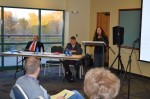
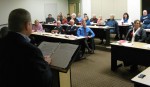
More than 45 people gathered at Lewis-Clark State College in Lewiston the evening of Dec. 8, 2014 for the first of four open-government workshops in North Idaho this week featuring Idaho Attorney General Lawrence Wasden. The free sessions, sponsored by Idahoans for Openness in Government, or IDOG, cover how to comply with Idaho’s two key open government laws, the Idaho Open Meeting Law and the Idaho Public Records Act, and are for local and state government officials and employees, reporters, editors and photographers from all media, and interested citizens.

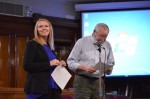
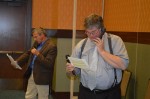
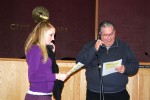
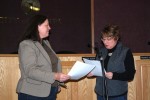
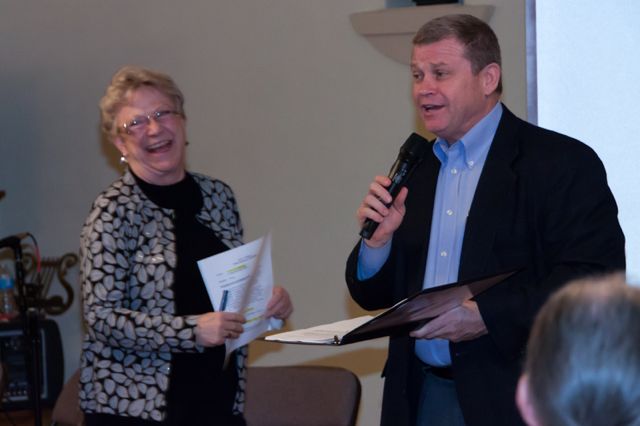
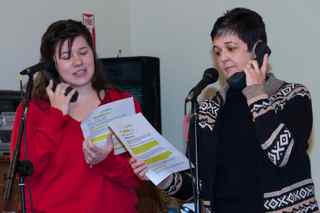
Monday night’s session, co-sponsored by the Lewiston Tribune, included interactive skits in which audience members took on roles, including one in which Doug Bauer of the Tribune portrayed a county prosecutor and Jaynie Bentz of the Port of Lewiston a county commissioner, helping illustrate the do’s and don’ts and generating laughs along the way. Lewiston Tribune Publisher Butch Alford guaranteed the session would be worth the price of admission, or he’d refund double the price – it was free.

Among the issues that came up during the session: Chief Deputy Attorney General Brian Kane noted that members of public boards shouldn’t be texting one another during meetings. “We’ve actually had cases of folks texting during a meeting and not having the discussion,” he said. “If you’re texting during the meeting, you’re robbing the public of the purpose of the Open Meeting Law.” Plus, he noted, those texts become public records and the public’s entitled to see them.

He also emphasized a line in the Open Meeting Law that says the “mere presence of legal counsel” does not justify a closed executive session; the law requires more than that. “The corollary to that is folks will send an email and copy it to their attorney, and claim it’s attorney-client privilege” to evade the public records law, Kane said. “It doesn’t work that way.”

When an audience member asked where notice should be posted if a board meeting is held at a board member’s home, the answer was: That’s not advised. A public meeting means anyone can come in, even to that home. But if that’s the place, notice must be posted somewhere prominent, like on the front door or the mailbox out front.

In evaluations, participants gave the session high marks. One public agency employee wrote that he learned something he can put to use right away: Information on what really qualifies under the “labor negotiations” exemption from the Open Meeting Law, and on how to “cure” open meeting violations by redoing the meeting in public. The labor negotiations exemption is for formal negotiations between the agency and a union representing its employees; not for general discussion of employment issues.

A citizen who attended said he learned how to be more watchful of local events – something he really wants to do. A local official said she learned to watch agenda changes, and follow the proper procedures for them. A reporter called the session “informative.” Another member of the news media wrote that his takeaway was: “Public process is our ticket to democracy!”

The IDOG workshops are funded in part by a grant from the John S. and James L. Knight Foundation through the National Freedom of Information Coalition.
Learning the ins and outs of Idaho’s open meeting law

From Eye on Boise/The Spokesman-Review

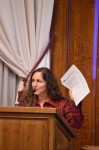
Moscow’s historic, wood-paneled City Council chambers was the scene of some hilarity last night, as City Councilman Walter Steed, left, played the part of a lucky reporter overhearing his local county commissioners illegally conducting public business over breakfast at a local café – while Latah County Prosecutor Bill Thompson, second from right, played the county commission chairman, throwing in some zingers at Steed while he was at it. The skit was part of a workshop on Idaho’s open meeting and public records laws that drew nearly 30 people last night; additional sessions are set tonight in Coeur d’Alene and Thursday afternoon in Sandpoint.

In the skit, the fictional county commissioners ended up with $500 apiece fines for knowingly violating the Idaho Open meeting Law. “An important note with the penalties,” Deputy Idaho Attorney General Brian Kane told the crowd, “Those are to you as a person, meaning that your government entity doesn’t pick up the tab for you violating the open meeting law.”

Idaho Attorney General Lawrence Wasden was the lead presenter at the workshop, sponsored by Idahoans for Openness in Government and co-sponsored by the Moscow-Pullman Daily News. Wasden said all sides need to understand what the rules are. Lee Rozen, Daily News managing editor, said, “These laws are often misunderstood in the details and in the intent – either by the public, by the press, by government staff and by elected officials.” That’s why all those groups are invited to the IDOG sessions.

There’s more info here about IDOG and the workshops, which Wasden and the group have been holding around the state since 2004; the Moscow session was the 31st.

From Eye on Boise/The Spokesman-Review

Moscow workshop: ‘It’s the public’s business’

Moscow, Idaho’s historic, wood-paneled City Council chambers was the scene of some hilarity on Tuesday night, Dec. 9, 2014, as City Councilman Walter Steed played the part of a lucky reporter overhearing his local county commissioners illegally conducting public business over breakfast at a local café – while Latah County Prosecutor Bill Thompson played the county commission chairman, throwing in some zingers at Steed while he was at it. The skit was part of a workshop on Idaho’s open meeting and public records laws that drew nearly 30 people, ranging from local elected officials to reporters, records clerks, lawyers, civic volunteers and interested citizens.

In the skit, the fictional county commissioners ended up with $500 apiece fines for knowingly violating the Idaho Open meeting Law. “An important note with the penalties,” Deputy Idaho Attorney General Brian Kane told the crowd, “Those are to you as a person, meaning that your government entity doesn’t pick up the tab for you violating the open meeting law.”

Idaho Attorney General Lawrence Wasden was the lead presenter at the workshop, sponsored by Idahoans for Openness in Government and co-sponsored by the Moscow-Pullman Daily News. Wasden said all sides need to understand what the rules are. Lee Rozen, Daily News managing editor, said, “These laws are often misunderstood in the details and in the intent – either by the public, by the press, by government staff and by elected officials.” That’s why all those groups are invited to the IDOG sessions.

Moscow’s session was the 31st that IDOG and Wasden have presented around the state since 2004, visiting all parts of the state on a three-year cycle; the sessions last came to North Idaho in 2011.

Attendees in Moscow gave the session high marks. “Should have done this 12 years ago,” commented an elected official. “Good material.”

“Thanks for doing this,” wrote a member of a state commission. She said she learned something she’ll put to use right away: “How to handle executive sessions.”

A government employee said he came away with a “much better sense of what I need to pay attention to in my job.”

A local attorney offered this as the takeaway: “Proceed cautiously – serve the public.” Wrote another attendee, “As a newly elected legislator, a great overview of the process as well as explanation of the history and background for the open meeting and public records laws.”

Wrote a reporter: “It is the public’s business.”

The IDOG sessions are funded in part by a grant from the John S. and James L. Knight Foundation through the National Freedom of Information Coalition.

Yes, we can cooperate for the public good

Editorial from the Coeur d’Alene Press

Those of us in the news media often think public officials are clueless or worse when it comes to open meeting and public record laws.

Some of those public officials have a pretty good idea what they’d like us media lunkheads to do with our opinions about their diligence.

Outside of a courtroom or a dark alley, how do the two sides settle their differences so the laws are obeyed, the citizens have government information they’re entitled to, and the media and public official camps can work respectfully with each other?

Betsy Russell and Lawrence Wasden have your answer. And it will all be revealed this Wednesday evening at 6 at the Best Western Plus Coeur d’Alene Inn.

Going back several years, Russell, the Boise-based star reporter for the Spokesman-Review, and Wasden, Idaho’s esteemed attorney general, devised a great way to increase understanding of the state’s public records and open meeting laws, while magically improving mutual respect and even compassion at the same time. How? Through skits, of course.

Through engaging role-playing and other devious methods, journalists and public officials will see how the public records/open meetings world looks from the other side’s perspective. It’s not just enlightening; it’s entertaining.

Invitations went to Kootenai County-area public officials already, but we’re reminding them to please RSVP right away to Camie Wereley if they can attend. Also, though space is limited, there will be some room for members of the general public also to attend. If you’re interested, please RSVP to cwereley@cdapress.com, or leave a message at 664-8176, ext. 2016.

Thanks go to AG Wasden, a good sport if ever there was one; to Betsy Russell, who also serves as president of Idahoans for Openness in Government; and to Jerry Jaeger, JJ Jaeger and the crew at Coeur d’Alene Inn, who were kind enough to donate the banquet room for the evening.

Editorial from the Coeur d’Alene Press

Idaho Attorney General Holds Public Records Workshop

From the Twin Falls Times-News

The IDOG open government seminar in Twin Falls on Tuesday evening included interactive skits like this one, in which members of the audience portrayed reporters, citizens, or local government officials correctly - or incorrectly - following the Open Meeting Law or Public Records Law.

The IDOG open government seminar in Twin Falls on Tuesday evening included interactive skits like this one, in which members of the audience portrayed reporters, citizens, or local government officials correctly – or incorrectly – following the Open Meeting Law or Public Records Law.

By Joe Cadotte jcadotte@magicvalley.com

TWIN FALLS • One of the most common arguments between reporters and public officials is what information the public can see. Turns out, reporters and public officials are both wrong half the time about the laws, said Idaho Attorney General Lawrence Wasden.

Reporters, citizens and public officials from throughout south-central Idaho gathered Tuesday night to iron out some of those wrinkles.

“If I was playing the National League, batting 500 would be a great big deal. But in open meeting, public record issues, its dismal,” Wasden said. “So if we can walk out of here tonight improving our batting average on issues of open records and public meetings, then we will have succeeded.”

Two skits early in the event portrayed a reporter getting his facts wrong about a city council executive session.

Twin Falls spokesman Joshua Palmer played Crusty the reporter, and Times-News reporter Brian Smith played Trusty the city clerk.

“They still in there talking about Lyle’s lawsuit?” Crusty asked.

“Yeah, the city council is having a meeting, and no, you can’t go in there,” Trusty said.

“I don’t know about these closed meetings, Trusty. It seems a little illegal,” Crusty said.

“C’mon Crusty, you know as well as I do that open meeting laws allows executive sessions with the city attorney with impending litigation, and it says right on the agenda that they’re talking about Lyle’s lawsuit,” Trusty said.

In the second skit, a group of city council members made budget decisions in a restaurant while a reporter secretly listened.

Smith, KMVT Anchor Aimee Burnett and Twin Falls Councilwoman Suzanne Hawkins played the council members.

“We’ll pave County Line Road to Maple before the first frost. You two OK with that?” Smith asked.

“I can go along with that if we take it another half mile past Maple,” Hawkins said. “That way, we’ll get some nice new pavement in front of my brother-in-law’s house.”.

“I think we need to stop at Maple,” Smith said.

“C’mon Craig, work with me on this. I think I can help with the zoning problem with the nuclear power plant by the wildlife sanctuary. No one needs to know it’s your dad behind this,” Hawkins said.

“What I’m interested in, though, is what we’re going to do about the county prosecutor,” Burnett said. “I think he’s getting a little big for his britches. I think he’d get a little smarter if we cut $50,000 out of his budget.”

After the scene, Wasden explained to the crowd of about 75 that’s it’s not illegal for city council members to hang out with each other outside of work. But it is illegal for a governing body to conduct its business outside of a public meeting.

Events such as the public records forum in Twin Falls help the media and government work together to better inform the public.

“The open meeting law and the public records act are really important to us as citizens, because it’s what opens the doors and allows you and I to observe what government does and to obtain information from our government,” Wasden said. “That is critical to a democracy. It’s critical to our republican form of government. It’s really important that we know and understand what our government is doing. That’s why those laws are important.”

The forum is part of an effort between the attorney general and the group Idahoans for Openness in Government to raise awareness about public record laws. The Times-News sponsored the event.

From the Twin Falls Times-News

Crowd gathers for eye-opening session in Rexburg

More than 50 people gathered in the spacious Conference Room at the Development Center in Rexburg on Thursday evening, Oct. 17, 2013, filling the room, to learn about Idaho’s public records and open meeting laws. They ranged from reporters and editors to college students to elected officials to employees of school and hospital districts, cities, counties and interested citizens.

Asked to sum up what he learned from the evening, a city councilor wrote in his evaluation of the session, “A lot!” Wrote a newspaper editor, “Very helpful and informative.”

An elected official wrote that he learned, “If you think you know everything, ha – you may be surprised.” Another elected official wrote that she had learned something she’d immediately be able to put to use: “Draft minutes must go out before formally adopted by the board – label as draft.”

A citizen wrote, “I have rights as a citizen to records I never knew I could access.”

Said another, “I went to a city council meeting, and this explains a lot of the rules they have to abide by.”

The crowd snacked on refreshments supplied by IDOG and co-sponsors the Rexburg Standard Journal and the Idaho Falls Post Register, while learning about the laws and their real-life, practical application through interactive skits, stories, a slide show, and presentations from Idaho Attorney General Lawrence Wasden, Deputy Attorney General Brian Kane, and IDOG President Betsy Russell, with assistance from communications director Bob Cooper of the Idaho Attorney General’s office.

The well-attended session sparked lots of questions, all of which were answered. There were plenty of laughs, and a few heated moments.

Wrote one media member who attended, “I learned that Jefferson County has problems.”

A planning and zoning administrator wrote, “The information about executive session was very helpful.” What she plans to put to use from the session: “Making sure that we follow the open meeting law.”

A student at BYU-Idaho had this comment: “If you want to be an educated citizen, which you should, this is an integral component of that education.”

A city clerk called the session a “great refresher course,” and a reporter wrote, “The meeting minute information was especially helpful.”

A county employee said this is what she plans to put to use from the seminar: “How to better assist the public.”

Laughs and learning at IDOG session in Fort Hall

FORT HALL, Idaho – The beautiful new Sho-Ban Hotel & Event Center was the setting for a highly entertaining and very well-attended IDOG seminar on Idaho’s open meeting and public records laws on Wednesday, Oct. 16, 2013, co-sponsored by the Blackfoot Morning News, the Idaho State Journal and the Post Register.

More than 60 people attended, including representatives of five cities – Idaho Falls, Roberts, Shelly, Blackfoot, and Aberdeen – several counties, numerous districts ranging from school to hospital to sewer to cemetery districts, state agencies, reporters and editors for news media from the Blackfoot Morning News to the Idaho State Journal to the Sho-Ban News, interested citizens, elected officials, political party representatives and more.

A highlight of the evening was when a clerk for a small district comically and despairingly asked if it was good enough for a public meeting agenda to simply say, “New business, old business, adjournment,” and the answer was a clear “no.” The crowd laughed with her as she resolved to do better.

There were also entertaining moments in the interactive skits, as Sen. Jim Guthrie, R-McCammon, took a turn portraying a blustery citizen, and Monsanto Corp. official and former Idaho GOP Chairman Trent Clark acted the part of a snoopy reporter.

Through it all, there was lots of learning going on, and the crowd took it in good spirits.

Asked to sum up what he’d learned, one elected official wrote, “Learn the rules – then think.”

“You must know your stuff when serving on public boards/councils,” wrote a city councilor.

“I’m a new employee with the city, so it helped with my training,” wrote another attendee.

A government worker wrote, “This has been a good, common-sense approach to a sometimes difficult law.”

“This presentation has answered my questions,” wrote a citizen.

“I’ve looked at the material before, but this put it in perspective,” wrote a citizen activist.

A reporter wrote, “I need to quit being lax and do a better job asking for records. I needed the refresher course on the state laws.”

Strong turnout at Hailey open government workshop

Idaho Attorney General Lawrence Wasden discusses the Idaho Public Records Law with a super-engaged crowd in Hailey on Monday evening.

Idaho Attorney General Lawrence Wasden discusses the Idaho Public Records Law with a super-engaged crowd in Hailey on Monday evening.

HAILEY, Idaho – A super-engaged crowd of 45 gathered in the Old Courthouse in Hailey on Monday evening, Oct. 14, 2013, to learn about Idaho’s open meetings and public records law, and those attending – government officials and staffers, reporters from the news media, and interested citizens – had plenty of questions.

By the time they left, the crowd gave the session top reviews, saying they’d learned plenty. Plus, each attendee left with numerous handouts, including the Idaho Attorney General’s handy Open Meeting Law Manual and Idaho Public Records Law Manual.

The Hailey session, co-sponsored by IDOG and the Idaho Mountain Express, featured a hearty buffet provided by the Mountain Express to help everyone through the evening.

It was the first of four open government seminars planned this week in southern and eastern Idaho, featuring Idaho Attorney General Lawrence Wasden, Chief Deputy Attorney General Brian Kane, and IDOG President Betsy Russell. Tuesday night, the sessions come to Twin Falls; Wednesday, Fort Hall; and Thursday, Rexburg.

In reviews of the session, the Hailey crowd was highly impressed – and not just with the food (but that, too).

“I refined what I already know,” wrote a local prosecuting attorney.

“I learned that the public is owed openness and information,” wrote an elected school board trustee.

A reporter wrote that a top lesson was “Ask for what you need,” and as for something she’ll put to use right away at work: “Narrow requests.”

A county employee said after attending the seminar, his task is clear: “Trying to put more public record information online to provide easy access to the public.”

A citizen who attended came away with this lesson: “Your public work is PUBLIC. All of it.”

Lots of lessons learned about open meetings, records at Nampa IDOG seminar

NAMPA, Idaho – It was a cold winter night in Nampa, but more than 75 people filled the Nampa City Hall Council Chambers for an open meeting/public records workshop Jan. 9 led by Idaho Attorney General Lawrence Wasden, along with Deputy Attorney General Brian Kane and IDOG President Betsy Russell.
Attendees ranged from citizens to elected officials, local district secretaries to newspaper reporters, and representatives of the cities of Nampa, Caldwell and Eagle, fire and irrigation districts, school districts, libraries, health districts, the Greater Middleton Parks & Rec Department, the Western Canyon Chronicle, the Messenger Index and more. The Idahoans for Openness in Government seminar was co-sponsored by the Idaho Press-Tribune.

“I learned how to request public records, which will help in my reporting,” wrote a reporter for a small newspaper in her evaluation of the session, adding that she learned, “Tons! This will make doing my job much easier.”

An elected official from a fire district called the session “extremely helpful and totally worth the time to help understand the laws.” Among things he learned that he’ll be able to put to use: “Open meeting laws, executive session rules, and documenting.”

A school board member reported learning, “Subcommittees are supposed to be OPEN,” and noted that is something that will be put to use in the school district.

Another reporter wrote of learning a surprise: “Attorney General Wasden has a sense of humor!” adding that the reporter came away “understanding open meeting laws much better.”

An elected official took away this lesson: “As a government-employed individual, remember everything is public.”

Wrote a citizen: “Every citizen should attend.”

The Nampa session was the 26th IDOG seminar held around the state since they started in 2004; it and the preceding sessions in December in Boise and Payette marked the first time the sessions have returned to the Treasure Valley since 2007.

Just in time for the Nampa seminar and hot off the press were newly updated copies of IDOG’s DVD, “Open Idaho: A User’s Guide to Idaho’s Open Meeting and Public Records Laws.” The DVD, which 35 of the evening’s attendees took home, contains much of the information presented at the seminars; it also includes a version of the interactive skits that audience members helped present at the seminar, presented this time with great flair by actors from the Idaho Shakespeare Festival.

The full content of the “User’s Guide” DVD – plus additional features – is available on IDOG’s website, www.openidaho.org.

The Nampa seminar went late into the evening, due to its 7 p.m. start time. There were lots and lots of questions, but it was all wrapped up by 10 p.m. The later start time for this session was due to legislative activities in Boise the presenters were involved in that day; Kane, for example, was training Idaho’s entire state Legislature on ethics laws for much of the afternoon.

Fortunately for all, a big snowstorm that snarled traffic and made travel conditions hazardous the next morning didn’t hit until long after midnight – well after all session attendees were safe at home.

IDOG’s seminars are funded by a grant from the John S. and James L. Knight Foundation through the National Freedom of Information Coalition. The three Treasure Valley sessions in December and January drew a total of nearly 200 people.

Learning about open meetings, records

From Eye on Boise/The Spokesman-Review


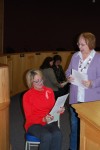
There was an excellent turnout last night in Payette, where more than 35 folks filled the historic Portia Club to learn about Idaho’s open meetings and public records laws at the latest IDOG seminar – that’s Idahoans for Openness in Government. Idaho Attorney General Lawrence Wasden was the featured speaker, along with Assistant Chief Deputy Brian Kane and myself as president of IDOG. Those attending ranged from local government officials to interested citizens to news reporters and editors. They participated in interactive skits to learn how to comply – and how not to comply – with the laws, received handouts including the Attorney General’s manuals on both laws, and had the opportunity to have all their questions answered after detailed presentations from Kane on how the laws work.

Among the questions from the audience: Is this meeting tonight legal under the Open Meeting Law? The answer: Yes, and it’s not a meeting under the law’s definitions – which define a meeting as the “convening of a governing body of a public agency to make a decision or to deliberate toward a decision on any matter.”

More than 60 people attended a similar session in Boise last week; the next one is scheduled for Nampa on Jan. 9th, at 7 p.m. at Nampa City Hall; there’s more info here and here.
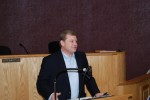
From Eye on Boise/The Spokesman-Review