RECORDS SHED LIGHT ON BARBIERI’S CALL FOR LESS TRANSPARENCY

From the Coeur d’Alene Press

by Maureen Dolan

COEUR d’ALENE — Rep. Vito Barbieri didn’t want to talk about his plan to change Idaho’s public records law to shield most state lawmakers’ communications from public disclosure.

Ironically, it took a public records request for the Dalton Gardens Republican’s email messages to find out what he was thinking when he proposed this legislation.

Through that public records request, I gleaned some other interesting information showing an existing lack of transparency when it comes to state lawmakers’ email messages.

“It should be noted that the Idaho Legislature has no email retention policy and members may delete emails at any time and at their discretion, except when a public records request has been made. At that point, emails related to that public records request may not be deleted until the request is fulfilled,” wrote Terri Kondeff, Idaho Legislative Services’ chief operations officer, in a message sent with the records I requested.

Now that’s a public records policy Idaho lawmakers should be working to change.

But instead, we have House Bill 233, a measure that would alter Idaho’s Public Records Act to exempt a good chunk of legislators’ emails, text messages and other forms of correspondence from public disclosure. For example, all communications between lawmakers would be exempt.

Rep. Barbieri didn’t return phone calls or respond to email messages I sent him March 1 after he pitched the idea to the Idaho Legislature’s House State Affairs Committee.

My request for copies of email messages related to public records that were sent or received by Barbieri since Jan. 1 returned 80 pages that included 60 messages from people opposed to his bill.

A blend of unique messages and form letters, the sentiment was the same throughout the emails:

  • “The public’s business should be public, with very few exceptions. The communications of our elected officials should not be subject to special privileges that allow them to keep secrets from their constituents.”
  • “We rely on openness in government and public records to keep people informed about their government. Law making is a public business and this bill is restrictive.”
  • “The Idaho Legislature should be increasing transparency with the public rather than hiding from it.”

I received one email response sent by Rep. Barbieri to one of the constituents who contacted him with concerns.

He told the writer he realizes his bill appears to limit transparency in government, but “nothing nefarious is occurring with respect to communications between legislators.”

Rep. Barbieri argued that transparency is necessary when it comes to enforcing policy and law, but not so much for “arriving at a consensus on creating public policy.”

“Ideas are shared and discounted. Ideas are sometimes half-baked. Reaching a consensus necessarily requires brainstorming, and critical analysis of wording, and just as importantly the freedom to speak one’s mind without the concern of public disclosure of the substance of, for example, the critical analyis,” he wrote.

The making of policy, the process of drafting, discussing and finalizing it, need not be transparent, but the process of passing legislation through debate, argument and amendment should be, Barbieri wrote.

He wrote he will not be bringing the bill forward this year because the “particulars of the wording need plenty of work,” and this year’s legislative session is coming to a close.

In the meantime, perhaps we should be ready before the 2018 legislative session to submit a public records request for every email message sent or received by an Idaho lawmaker during the session, before they’re deleted.

From the Coeur d’Alene Press

Judge rules East Idaho lawmaker’s secret recording is public record

From the Idaho Falls Post Register

BY BRYAN CLARK

Portions of a transcript from a secretly recorded meeting between Rep. Ron Nate, R-Rexburg, and Senate Pro Tem Brent Hill, R-Rexburg, will be made public following a public records lawsuit filed by the Post Register against Nate.

Nate secretly recorded the private meeting with Hill, which occurred shortly after the Republican primary in May.

Judge Joel Tingey reviewed a transcript of the recording under court seal and concluded that portions of the recorded conversation constitute public records and must be released.

“It is the court’s opinion that statements made with regard to proposed or enacted legislation do relate to the conduct or administration of the public’s business,” Tingey wrote.

Tingey also ruled that portions that deal with “electioneering, campaigning, and supporting or not supporting a candidate for a particular office do not rise to the level of conducting the public’s business.”

Hill publicly supported Nate’s challenger Doug Ricks during the Republican primary, and Tingey said that was the main topic of the conversation.

Tingey ruled he would redact the portions of the transcript which do not deal with public business and release it. Tingey also indicated that most of the transcript deals with matters other than public business.

“We still haven’t seen the transcript yet, so we are still evaluating the ruling, and will need to review the transcript before we decide whether or not to appeal (in order to get more of the transcript released),” said Steve Wright, the Post Register’s attorney.

Bryan Smith, Nate’s attorney, has filed a motion asking Tingey to reconsider his decision. Instead of redacting the portions of the transcript which are not public records, Smith argued, Tingey should only release those portions of the transcript which are public.

“If this court shows redacted portions of the transcript, such redaction will improperly disclose private information such as how long the private conversation lasted, how much of the total discussion was private versus how much was subject to disclosure, and perhaps other clues into (Nate’s) private business,” Smith wrote.

Wright filed an objection to the motion Monday, arguing that releasing snippets of the conversation wouldn’t amount to disclosing the public record.

Tingey has yet to rule on Smith’s motion to reconsider, which was filed Friday.

House Speaker Scott Bedke, R-Oakley, previously told the Post Register that a member of the House secretly recording a private meeting with a Senate leader was “misconduct” and “conduct unbecoming” a representative.

Conduct unbecoming is a formal ethics violation that could be reviewed by the House Committee on Ethics if a member of the House makes a written complaint.

Majority Leader Mike Moyle, R-Star, Majority Caucus Chairman John VanderWoude, R-Nampa, and Senate Majority Leader Bart Davis, R-Idaho Falls, also condemned the practice of secretly recording private meetings in prior interviews with the Post Register.

From the Idaho Falls Post Register

Idaho’s Sunshine laws need reform

Editorial from the Twin Falls Times-News

Idaho Secretary of State Lawerence Denney told a reporter last week that he hopes to overhaul parts of the state’s Sunshine Laws — those that promise transparency in government — when the Legislature reconvenes next month.

It’s a long time coming.

Among Denney’s plans are adding serious penalties to those who violate the laws, boosting fines 10-fold from $250 to $2,500. He wants to require candidates and political-action committees to report contributions of more than $1,000 within 24 hours. And he wants all campaign-finance reports posted online, a move that would greatly increase transparency when it comes to determining how money influences state politics.

The proposed changes were first reported by IPTV’s Melissa Davlin, a former Times-News reporter.

Perhaps the best suggestion by Denney is more transparency to help identify those in PACS who spend the political contributions, and crackdowns on so-called “gray money” — cash that moves from PAC to PAC, making it difficult to determine where the cash originated.

Another great proposal: a requirement for any candidate or cause to report contributions of $500 or more, greatly expanding requirements for who would have to disclose political contributions, such as school board candidates.

Denney also hopes to speed up the reporting for political expenditures. Under current law, a campaign doesn’t have to report an expenditure over $1,000 until it is billed, which sometimes occurs after an election. Denney wants those bills reported as soon as the money is committed.

As Davlin pointed out in her report, many of the ideas come from Democratic Secretary of State candidate Holli Woodings. We’re not too troubled. A good idea is a good idea, and Denney, a Republican, should be commended for recognizing one when he sees it, even if it did come from a Democrat.

Denney is shopping his ideas to lawmakers before the session, and so far he said he’s received mostly positive feedback.

The secretary’s proposals haven’t received much press yet, but get ready to hear plenty more when lawmakers gather in Boise next month.

In the meantime, contact your lawmaker and tell him residents deserve a more transparent government. Denney’s plans are a good start.

It’s in lawmakers’ best interest to listen to you. Voters are much more likely to trust their elected leaders when they can easily understand who is backing them.

Simply put, it’s good for democracy.

Editorial from the Twin Falls Times-News

IDOG open government seminars draw crowds in Pocatello, Idaho Falls

Close to 100 people gathered at open government seminars in Pocatello and Idaho Falls in October, to learn in detail what can and can’t be done under Idaho’s Open Meeting Law and Public Records Act.

“I learned how to serve the taxpayers within the law,” wrote a Power County official, in her evaluation of the Pocatello session. Wrote a Minidoka County records deputy, “Don’t ask why or what do you need it for.”

An interested citizen who attended the Idaho Falls session wrote, “Nice variety – slide show, lecture, booklets, role playing.”

Bannock County Prosecutor Stephen Herzog summed up the session like this: “Great and informative and fun.”

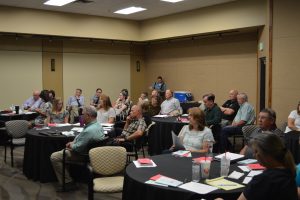
Idaho Attorney General Lawrence Wasden was the leader of both sessions. In Pocatello, the group gathered at Idaho State University’s Pond Student Union, where ISU Associated Vice President Stuart Summers welcomed the crowd, and sponsors ISU and the Idaho State Journal provided a much-appreciated light dinner of sandwich wraps, fruit, soda and cookies during the break. In the spacious room at the Student Union, seminar participants gathered at tables in the back to visit, share impressions and eat before reconvening for the second half of the evening’s program.

In Idaho Falls, Monte LaOrange, managing editor of the Post Register, welcomed the crowd, which, as in Pocatello, included reporters, photographers, editors, public officials and employees, law enforcement officers, clerks, deputies, state legislators and interested citizens. The Post Register co-sponsored the Idaho Falls session, which was held in the multi-purpose room of Longfellow Elementary School; a spread of hearty snacks was laid out during the mid-session break.

Deputy Attorney General Brian Kane and IDOG President Betsy Russell also helped lead the program, and members of the audience participated as well, taking on roles in interactive skits, often with comic results.

Amid questions about how to avoid open meeting law violations, Kane suggested that public boards designate an “executive session ogre” who will vigorously object if a closed session veers away from the narrowly designated purposes for which one can be held.

Russell noted that twice in the month prior to the Oct. 19-20, 2016 sessions, state agencies had run into issues with closed meetings, from questions over notice of a special meeting of the state Board of Education to agenda issues at the Idaho Transportation Board – and both times, reporters were watching and called attention to the matter. “Nothing arouses more interest than secrecy,” Russell said.

In Idaho Falls, participants ranged from the mayor to local TV anchors.

“We are fortunate to have IDOG and the AG’s office committed to sunshine,” wrote a citizen who attended. “Thank you!”

Wrote another, “This was a solid investment of time, money and talent.”

A board secretary wrote, “Great refresher course!”

A reporter wrote that he learned something he can immediately put to use: “How to more precisely craft requests.”

A local prosecutor said she’d sum up the session as “what the public is entitled to know for government to work.”

Wrote a citizen, “I learned that almost all aspects of government meetings are open to the public.”

These sessions, made possible in part by grants from the John S. and James L. Knight Foundation and the Best of the West Foundation, have been held around the state since 2004. More are planned, including in the Magic Valley this spring, and in North Idaho next fall.


Open government seminars set in Pocatello, Idaho Falls

From IDOG

The public is invited to attend either of two upcoming free seminars on Idaho’s key open government laws – the Idaho Open Meeting Law and the Idaho Public Records Law – Oct. 19-20 in eastern Idaho, led by Idaho Attorney General Lawrence Wasden.

It’s a chance to learn what is covered by these important laws and how to comply, in a fun and accessible format. Presenters in addition to Wasden will include Deputy Attorney General Brian Kane and IDOG President Betsy Russell. Government agency employees, public officials, reporters, editors and photographers from all media, and interested citizens all are invited.

These sessions are recommended by the Office of the Attorney General, the Association of Idaho Cities, the Idaho Association of Counties and the Idaho Press Club. They are free and include refreshments; because space is limited, attendees are asked to RSVP:

?WED. Oct. 19, POCATELLO – Co-sponsored by the Idaho State Journal and Idaho State University. Wood River Room, Pond Student Union, ISU, 921 W. 8th St., 6-9:30 p.m. RSVP to Courtney Lee, clee@journalnet.com

?THURS. Oct. 20, IDAHO FALLS – Co-sponsored by the Post Register. Longfellow Elementary, 2500 S. Higbee, 6-9:30 p.m. RSVP to Monte LaOrange, 542-6795 or mlaorange@postregister.com

A third session will be scheduled in TWIN FALLS before the end of the year.

IDOG and Wasden have been holding these sessions around the state since 2004. They are funded in part by grants from the John S. and James L. Knight Foundation through the National Freedom of Information Coalition, the Best of the West Foundation, and the Idaho Media Project at Boise State University.

IDOG is a non-profit coalition for open government whose mission is to promote open government and freedom of information. There’s more information, plus an online “User’s Guide” to Idaho’s open government laws, available at IDOG’s website, www.openidaho.org.

From IDOG


School district gave secret $94K payout to administrator

From the Twin Falls Times-News

by Drew Nash

TWIN FALLS — The Twin Falls School District hid its decision to give one of its top administrators a $94,108.26 payout this summer as part of a highly unusual separation agreement.

The district wrote a check June 27 to director of support services Clara Allred, payroll documents show. She announced her retirement a week later, and it was accepted by the school board during a meeting on the Fourth of July.

The reason for the massive payout and the cause of Allred’s departure remains unclear, even after the Times-News sued the district to obtain a copy of the separation agreement. It’s also still unclear why the district agreed to a clause that bars it from talking about the deal — an arrangement so unusual, district officials said they can’t remember ever signing something similar.

“I’m sorry that it is of the confidential nature it is and we can’t comment,” Superintendent Wiley Dobbs said in one of two meetings Monday with the newspaper. After consulting with district attorneys, Dobbs later added that deals like this sometimes come about after doing a “cost-benefit analysis.”

An employment attorney not connected to the deal said districts will sometimes pay an employee to go away rather than battle the person in court. But it’s not clear if that’s what happened in Allred’s case. Her attorney, Shelly Cozakos, wouldn’t answer questions for this story, instead issuing a statement that read:

“Clara Allred served the special needs children in the Twin Falls School District for 15 years, both as a teacher and the Director of the Special Needs program. She even continued serving the kids while undergoing treatment for breast cancer, with the full support of the District. Clara made the difficult decision to retire from the District and has no ill will for the District of any of its employees, and wishes them well. She desires to move on and help special needs children in a different capacity.”

The agreement

Allred oversaw many of the district’s education programs, including special education, gifted and talented education, paraprofessionals, school counseling, and services for students such as mental health services, psychology, audiology, speech therapy, occupational therapy and physical therapy. She made $101,464 under her contract for the 2015-16 schoolyear.

The day after its July 4 meeting, the district announced Allred submitted a letter of retirement effective June 30, the day before the start of a new fiscal year. School boards rarely meet on federal holidays. And typically, trustees approve employee retirements in batches, not one at a time as it did for Allred.

The school district issued a brief statement July 5 about Allred’s departure: “The board wishes to thank Allred for her dedicated years of service to the District.”

Dobbs told the Times-News last week the board met on the holiday not to secretly approve the agreement but because he was leaving on vacation and the timing was also best for school trustees. But “if I could do it over, I would,” he said about the meeting date.

Citing the confidentiality clause in the agreement, the superintendent declined to answer specific questions about the deal. But Allred’s departure, he said, isn’t connected to any malfeasance or underlying problems in the district. And he noted: “She did retire.”

As part of the payout, Allred received $81,500 from the school district, plus $12,228.26 — the cash value of 242 accumulated hours of vacation leave. She will also receive post-employment group health insurance coverage.

The district also agreed not to take any civil action directly against Allred and will “forgo any further process relating to concerns that Allred has not fully or properly performed her duties with the District.”

If the district faces any “audit activities” by the Idaho Department of Health and Welfare, Idaho Department of Education or other government agency related to the district or Allred’s handling of special population students, she agreed to make herself available to inquiries. Officials from those agencies said they can’t confirm or deny whether an investigation has been opened.

Dobbs told the Times-News there haven’t been recent or upcoming audits related to special population students. And he said there aren’t any allegations regarding Allred’s conduct toward students.

The separation agreement states the school district would release an announcement about Allred’s retirement and open the search for a new director. The language in the announcement would reflect she “chose to retire for personal reasons and through the use of the Joint Statement,” according to the agreement, and no further comments would be issued to reporters.

Allred is allowed to seek letters of recommendation from coworkers. She’s prohibited from disparaging the district or employees, but “will respond to any subpoena or investigation by any agency in a truthful manner.”

The agreement states the district and school board won’t “state or in any manner imply that there was any form of a ‘pay-off’ in order to obtain Allred’s retirement.”

The lawsuit

After Allred’s departure, the Times-News immediately sought to obtain a copy of the separation agreement under Idaho’s open records laws. The district turned over a heavily redacted copy of the document, and the newspaper sued to obtain a complete copy. In court, district lawyers said the district was reluctant to turn over an unredacted copy of the agreement because it feared it would be sued by Allred for disclosing the arrangement.

In Twin Falls County Fifth District Court, Judge Randy Stoker ruled Sept. 14 the district had to turn over an unredacted agreement, with the exception of one paragraph and one attachment he said were related to Allred’s job performance. The portions still available to the newspaper did not specify why Allred was “retiring” or why the district was paying such a hefty sum to a retiring employee.

Even after the suit, district spokeswoman Eva Craner said the district is bound by legal constraints in what it can say about the case. In the separation agreement with Allred, the district agreed not to speak about the arrangement, and it is still under a legal obligation not to discuss the case.

The fallout

Since Allred left the job, the school district has made changes in the support services department. In addition to hiring new director Mike Gemar, it bid out services for special population students.

Services were previously contracted with a company called SMB Center, a company Allred contracted early in her tenure to provide special services to disabled and other special students in the district.

“Through that process, other companies were selected for this year,” Dobbs said.

Just before cutting ties with the company, in July school trustees approved an approximately $30,000 contract extension with SMB Center from Aug. 1-11.

It set the company’s pay at $32 per hour for individual students and $8 per hour for group services. A representative from the company signed the agreement June 28, the day after the school district wrote the payout check to Allred.

During a September meeting, trustees approved contracts with a handful of private service providers for this school year. SMB Center wasn’t included.

Dobbs said the school district has a positive relationship with the company. “Again,” he said, “we’ve had audits and those have come up clean.”

The district paid nearly $2.1 million to SMB Center in 2015, tax documents show. SMB Center doesn’t have a website or listed business phone number.

On Saturday, the district sought to preempt concern about this report by issuing a statement to other media and district staff about the Allred case.

“We want to make you aware of an article the Times-News plans to publish in their Sunday edition this weekend,” the statement read. “This article focuses on a personnel matter within the Twin Falls School District. As you may know, personnel matters are confidential in nature so that staff members have a reasonable right to privacy within their work environment. As always, we strive for transparency with our stakeholders and community. However, the TFSD is limited by legal constraints regarding personnel decisions.”

The district continued: “Districts often work with personnel and legal counsel to enter into various types of agreements after undergoing a cost-benefit analysis that takes into account all factors and possible outcomes of a specific circumstance including the consideration of student needs and interests.”

In the statement, the district confirmed that it had bid out services previously controlled by Allred and apologized for the “vagueness surrounding this matter.”

From the Twin Falls Times-News

Dietrich School District attorney seeks to seal court documents

From the Twin Falls Times-News

by Alex Riggins

DIETRICH — An attorney for the Dietrich School District filed a motion Tuesday in a civil lawsuit seeking to seal documents related to student conduct that were made publicly available Monday.

An affidavit supporting the motion cited a story published Tuesday in the Times-News that detailed the school district’s investigation last year that found it was “more likely than not” that a black, mentally disabled football player was sexually assaulted with a hanger by several teammates following an Oct. 22 football practice.

The investigation included 30 interviews with football players, coaches, and parents, according to district officials, and found “evidence of misconduct among students that (included) sexual harassment, bullying behavior, and sexual assault.”

The alleged victim of that assault sued the district for $10 millionclaiming school administrators and football coaches “were aware of or should have been aware of” months of harassment, discrimination and abuse that culminated in the locker room assault. The school district denies the claims.

In the affidavit supporting the motion to seal the school investigation and other documents detailing student conduct, attorney Brian Julian of Anderson, Julian & Hull said the need to seal documents in this case “is especially acute given the fact that the local news outlets repeatedly and routinely report on issues related to this litigation.”

Julian also insinuated the victim’s attorney tipped off the Times-News, saying the documents should be sealed because of “Plaintiff’s counsel’s propensity to speak with local news media and to share with them information obtained in the course of discovery.”

The Times-News routinely checks the status of the case and on Monday discovered the documents relating to the district’s investigation. The plaintiff’s counsel did not share with the paper any documents or “information obtained in the course of discovery.”

A reporter sought comment and spoke with Lee Schlender, an attorney who represents the alleged sexual assault victim in the civil case, after finding the publicly available documents in the federal court repository.

Julian argued that sealed documents should include all that fall under the Family Educational Right to Privacy Act, known as FERPA, and the American Health Insurance Portability and Accountability Act of 1996, known as HIPAA.

“This order shall apply to all documents, regardless of form, including portions of deposition transcripts, which contain information related to confidential student educational records,” Julian wrote in his motion for protective order.

He said the protected materials should be marked “confidential” and only be made available to the attorneys and others involved in the case.
Schlender included the school district’s heavily-redacted investigation findings in his own motion last week in which he argued he should be granted access to the pure, unredacted reports. All student names, except the victim’s, were blacked out in the version Schlender received from the school district’s attorneys.

“We were given copies of the investigation’s findings, but all the important info — who made the statements, who was there — it’s all been wiped out,” Schlender told the Times-News on Monday. “We told the court, ‘no, no. We’re entitled to get that material because it’s evidence.’ The school district’s attorneys have the entire file in its pure form … We’re just as entitled to those as anyone.”

Julian included in his motion a string of emails between the two attorneys in which Julian tried to seal the documents through a stipulated agreement rather than a motion to the judge. But Schlender rejected the agreement, thus the documents were made public Monday on the federal repository.

Also included in the motion as an exhibit was a copy of the Times-News‘ story from Tuesday. Julian argued that “had the names of the students been supplied in the Initial Disclosures, all of the information would likely had been published by the Times-News in a subsequent article.”

But the heavily-redacted investigation findings were made public only because they were part of a motion asking for the unredacted version. Schlender would have had no reason to make his publicly accessible motion seeking the unredacted documents if he would have initially received the unredacted version.

As of 7:30 p.m. Wednesday, the documents were still available publicly on the federal repository. It’s unclear if or when a judge will issue an order sealing certain documents, though Julian said in an email to Schlender he believes a protective order for the documents “will be well received by the federal court.”

From the Twin Falls Times-News

State Ed Board to re-do hastily called meeting in the interest of ‘transparency and openness’

From Idaho Education News

by Jennifer Swindell

The State Board of Education plans to rescind decisions made during a “special board meeting” Monday — and re-do the meeting in an effort to be more transparent.

“We’d rather make sure it’s right and that everybody fills like we did it on the up and up,” said State Board Executive Director Matt Freeman. “Transparency and openness is important to us.”

On Monday, the board gave preliminary approval to language that would crack down on bad teacher evaluation data and tighten Idaho’s dual-credit policy.

Those two decisions will be reconsidered, Freeman said, because board officials are concerned the meeting was not properly publicized and the agenda lacked detail.

“We’ll take a mulligan and do it again so everyone has full and fair disclosure,” Freeman said. “It was a perfect storm of events. I don’t think we did anything wrong (legally), but we’re going to hold another meeting.”

The 10 a.m. Monday meeting was posted on the State Board’s website Friday morning before 10 a.m., just at the required 24-hour notice mark. Typically, board officials alert the media with an email when meeting notices are published. In this case, the email to the media was not sent until Monday at 5:11 a.m., just five hours before the conference call.

Board Chief Communications Officer Blake Youde was on the road in a different city every day last week, and said the late notice to the media was “simply an oversight.”

Board members received their 52-page packet on Saturday because staff was working on last-minute language, Freeman said.

The posted agenda said only that the board would hold a “special board meeting” to discuss its 2017 legislative agenda, with no evidence that action would be taken. Youde said the reason the detail was missing on the agenda was because he simply used a template agenda from a 2015 meeting and changed the date.

“Lesson learned. We will be more specific on the cover page of the agenda,” Freeman said.

Idaho Education News was the first to report about the sparse notification, and the meeting itself. This coverage prompted a meeting between Board President Emma Atchley, a deputy attorney general and board staff. The group decided to re-do Monday’s meeting — possibly on Friday.

“We want this to be beyond reproach,” Freeman said. “The only way for us to deal with it is to say, ‘Fine, we’ll do it again.’”

Betsy Russell of the Spokane Spokesman-Review said on her blog Monday afternoon that the meeting appeared to violate Idaho’s open meetings law. State law allows agencies to hold a “special meeting” with less than 24 hours’ notice, she wrote, but only in an emergency. The open meetings law defines an emergency as “a situation involving injury or damage to persons or property, or immediate financial loss, or the likelihood of such injury, damage or loss.”

But Youde argued the board did not violate open meeting laws, saying a 24-hour notice is all that is required for a special meeting “unless an emergency exists.” Monday’s meeting was deemed a “special board meeting,” he said, because it was held “in addition” to regular board meetings.

“We have a dozen special meetings a year, especially during the legislative sessions,” Youde said.

From Idaho Education News

Public officials must answer reporters’ questions

Editorial from the Idaho Press-Tribune

By Scott McIntosh

It’s been a bad couple of weeks for public officials here in the 2C. The city of Middleton has been going through some rough patches with some developers over what the developers say are unfair and at least inconsistent applications of codes and ordinances. Then, last Sunday, we documented in previously unreported detail the specific accusations against Canyon County Sheriff Kieran Donahue, which included using taxpayer-paid employees to do errands for the K. Donahue Foundation, which runs a very worthy effort, the Man Up Crusade.

We consider ourselves advocates for the taxpayers. We represent the people, as we keep an eye on what the government is doing. That’s the essence of watchdog journalism. And Middleton Mayor Darin Taylor is the government. Sheriff Kieran Donahue is the government.

Don’t you want to know why Taylor cut a check of $24,000 in taxpayer money to Coleman Homes? Should we just place our trust in Taylor and accept that it must be a wise decision?

Don’t you want to know that Donahue had taxpayer-funded employees making copies of CD’s and picking up dry cleaning and arranging flights to Oklahoma for a rodeo for Donahue? And about that $200 change order — was that taxpayer money?

We still don’t know. That’s because Taylor and Donahue did not comment on these facts for our stories, despite our repeated attempts.

And that’s a shame, because they have a duty and a responsibility as elected officers and caretakers of the public trust and public money to answer to the public, which means us, “the media,” who are asking the questions on behalf of the taxpayers.

It’s not a witch hunt. It’s not trying to get someone out of office. We’re not “picking on” anyone. It’s an attempt to bring accountability to the government.

To me, there are still a lot of unanswered questions that the public has a right to know.

For example, are county employees still doing work for the Man Up Crusade while being paid by taxpayer dollars?

It’s not about the Man Up Crusade. The Man Up Crusade is a terrific and worthy cause. People should donate money to the cause and people should volunteer to do things like pick up dry cleaning, burn CD’s and book flights to Oklahoma for rodeos. But should employees of the sheriff’s department do that work on the taxpayer dime? Is that an appropriate use of tax dollars?
I reserve judgment. But I would like to hear an explanation or a justification. That’s what our reporter Ruth Brown was hoping to get from Donahue when she called him multiple times. But he didn’t respond.

You see, that’s part of what we do, too. We get both sides. We present facts to our readers and then we let all sides have their say to explain the situation, to persuade, to convince, so that you, the reader, can make up your own mind. After hearing an explanation from Donahue, you may be persuaded that what he’s doing is good and right.

Unfortunately, when someone clams up and hides from the media, their side never gets told. It’s unfortunate, but it’s also an abdication of the responsibility of a public official, who must answer to the public, to the taxpayers, to the people who elected them.

Taxpayers have a right to know, and elected officials who get a paycheck from tax dollars have a duty to respond to a reporter’s questions.

So just a warning to public officials: When the caller ID says it’s the Idaho Press-Tribune, pick up the phone. It’s part of your job.

Editorial from the Idaho Press-Tribune

Idaho judge orders records disclosed in trade secrets case

From The Spokesman-Review

By Betsy Z. Russell

BOISE – An Idaho 4th District judge has ordered a Florida dental services contractor to disclose nearly 100 pages from its successful bid for an Idaho Medicaid contract that the company had claimed was exempt from public disclosure as trade secrets.

The order came in a lawsuit filed by Blue Cross, which had the state contract but lost out to Florida-based MCNA Dental, which has been winning similar contracts around the country.

Blue Cross contended that the Florida firm claimed much of its bid consisted of trade secrets – preventing Blue Cross from reviewing it to decide whether to challenge the bid award.

Judge Samuel Hoagland wrote, “The court finds that much of MCNA’s redacted information was previously disclosed publicly and was freely available on its own website, on various other state websites, and by simple Google searches.” Information that has been publicly disclosed, he wrote, “cannot now be claimed as a trade secret. If the information has been made public, then by definition it cannot and is not a trade secret.”

Hoagland wrote that for a public record to be exempt from disclosure under the trade secrets exemption, the party claiming the exemption must demonstrate two things: That the information has independent economic value from being kept secret; and that reasonable means have been taken to keep that information secret.

“MCNA asserts that the balancing act in this case is between the importance of keeping the proprietary information protected and Blue Cross’ need for information,” the judge wrote. But the Idaho Public Record Act, he wrote, “stands for the proposition that the balancing act is between governmental transparency and individual protection of trade secrets.” The reason why someone wants the records is irrelevant, he wrote, citing a 2014 Idaho Supreme Court decision, Wade vs. Taylor.

Under Idaho law, “All public records are open unless expressly provided otherwise by statute,” the judge wrote. “Therefore, we narrowly construe exemptions to the disclosure exemption.”

In his 33-page decision, the judge meticulously went through individual page numbers from the bid and determined whether the information redacted was appropriate or not. He found that roughly 250 pages, plus eight attachments, were appropriately redacted from the MCNA bid. But nearly 100 other pages weren’t, he ruled.

MCNA argued in court that Blue Cross was just after its trade secrets for competitive reasons, and as the third-place finisher in the bid process, likely couldn’t successfully challenge the bid. The contract award, which was supposed to take effect Sept. 2, was put on hold by the lawsuit; Blue Cross and the state agreed to extend their existing contract until it was resolved.

Blue Cross also challenged redactions by the second-place bidder, Liberty Dental Plan of Nevada, but the judge ruled that those were appropriate under the Idaho Public Records Act.

MCNA’s original submission redacted all or part of 507 of the 709 pages in its bid proposal and attachments. Blue Cross redacted only a few pages. After Blue Cross protested to the state, state officials asked the bidders to rethink their redactions, and MCNA reduced them, but they remained substantial.

“The major argument that MCNA advances is that if a competitor was to see the bid in its entirety, then the competitor would have an advantage in future bids,” Hoagland wrote in his ruling. But he said MCNA enjoyed that advantage itself in the Idaho bid process. “MCNA further argues that businesses will be disinclined to come to do business in Idaho if such trade secrets were not protected. The court is not persuaded. First, it didn’t stop MCNA. Second, these are policy arguments for the Legislature. … Third, as seen here, true trade secrets are protected, but information that is not a trade secret is not protected.”

“If a company wants to engage in public contracting,” the judge wrote, “it must follow our Public Records Act, be transparent in its dealings, and recognize the public’s right to know, even if the public includes a competitor.”

There’s little case law testing the limits of Idaho’s trade secrets exemption from the Idaho Public Records Act, but there is for the Idaho Trade Secrets Act, which has nearly identical wording.

From The Spokesman-Review