Hundreds learn about Idaho’s open meetings, public records laws

From the Idaho Press

By BETSY Z. RUSSELL

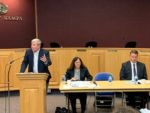
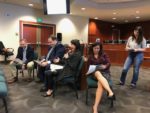
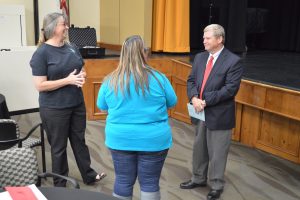
A ripple of apprehensive laughter spread through the audience, as Nampa school trustee Allison Westfall, playing the role of a fictional city council member, read her line: “This isn’t on the agenda tonight, but since we’re all together, let’s straighten out this budget issue.” Her fellow “council members” leaned in close.

Westfall and her fellow actors, gathered at Nampa City Hall, were showing what NOT to do under the Idaho Open Meeting Law, as part of an open government seminar put on by Idaho Attorney General Lawrence Wasden and Idahoans for Openness in Government, or IDOG. In this case, it was “executive session drift” — when a public board goes into a closed-door executive session for a legitimate reason, but then “drifts” on to other topics. That violates the law.

In this interactive skit, one of numerous ones presented during the evening, the fictional Watertown City Council was in a closed session to discuss a pending lawsuit, but strayed off into discussions of the city budget, staffing, and the city attorney’s salary.

Wasden, playing the role of a referee, threw a flag. “Holding on the government!” he called out. “I’m throwing a flag for holding — holding an illegal executive session!”

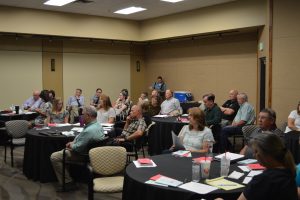
“The Open Meeting Law allows executive sessions, but strictly limits the circumstances under which an executive session is permissible and requires proper notice on the agenda,” Wasden explained to a full house of 80 local and state government officials, reporters, lawyers and interested citizens, once the laughter died down. “An executive session must remain focused on the top of the specific exemption that was noticed and voted upon.”

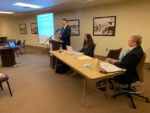
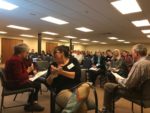
The Nampa session on Thursday evening was the third held in the area in October by Wasden and IDOG; it was co-hosted by the Idaho Press and KTVB-TV. An earlier session in Boise, co-sponsored by Ada County, Boise State Public Radio, the Idaho Press and the Idaho Statesman, drew 114 people; another in McCall, co-sponsored by The Star-News, drew 73.

That means a total of more than 265 people across the region learned in depth about the requirements of the Idaho open meetings and public records laws, how important they are, and how to comply.

Deputy Attorney General Brian Kane said it was executive session drift that got the Idaho Public Charter School Commission in trouble earlier this year. It also didn’t help that that board was holding a lengthy executive session stretching for two hours, he said. In order to stay on track and limited to the precise topics for which executive sessions are allowed, Kane said, they’re best kept short.

Other topics addressed included that texts are public records — because Idaho is a “content-based state,” that bases the definition of a public record on the record’s content. If it’s transacting public business, it doesn’t matter what form the record takes or on whose device it’s created or sent — it’s public.

Kane also covered the dangers of using the latest “disappearing” or self-destructing message apps for government business. That could potentially violate agency retention policies and create legal issues if litigation ensues, he said, in addition to creating public record and open meeting law issues.

While some people on public boards or commissions say they’d rather not air their “dirty laundry” in public, Kane said there’s no “dirty laundry” exemption under the Idaho Open Meeting Law. “The open meeting law is there because the public needs to see that discussion, they need to see that debate,” he said.

Full disclosure here: I’m the president of IDOG, which is a 501©(3) non-profit coalition for openness in government. IDOG and Wasden have been holding these educational sessions around the state since 2004. They’re funded by grants; there’s more information at IDOG’s website, www.openidaho.org, including much of the material presented at the seminars.

Here are some of the comments participants in the sessions wrote in their evaluations:

“Outstanding information — clarified many issues,” wrote a member of a local board.

“Eye opening,” wrote a school trustee.

“Presumption of openness,” wrote a reporter, citing that as the top lesson of the session.

“I learned a great deal about open meetings laws, that will be helpful in understanding the work of committees I serve on,” wrote a participant.

An editor wrote that he’d gained a “deeper, more detailed understanding of open meetings and records laws.”

“Pertinent information, very helpful,” wrote an elected official.

“The explanation of new provisions of the law was worth the time,” wrote a public records custodian.

“I have been denied draft minutes … because they weren’t yet approved by the board members. Now I know that’s a violation,” wrote a citizen.

Summing up what they learned, a government employee wrote, “Transparency leads to confidence in government.”

Asked if they’d learned something they can put to use, a participant wrote: “Yes! Everything!”

IDOG open government seminars are on a three-year cycle to reach each region of the state. Next year, they’ll head to eastern Idaho, and the following year, northern Idaho.

Nampa Seminar


Boise Seminar

McCall Seminar

From the Idaho Press

Crowds in Lewiston, Moscow, Coeur d’Alene learn about open meetings, records

By Betsy Z. Russell

This article also appeared in the Idaho Press-Tribune and The Spokesman-Review, June 3, 2019

Idaho Attorney General Lawrence Wasden addresses a crowd of more than 60 in Moscow, Idaho on Tuesday, May 29, 2018, about Idaho’s open meetings and public records laws.

The Idaho Open Meeting Law has no “dirty laundry” exception.

That’s right – government board members who say they want to meet behind closed doors to avoid airing their “dirty laundry,” then come back smiling and agreeing in their public meetings are violating the open meeting law.

And believe it or not, the “dirty laundry” excuse and one other – holding a closed executive session to “collect our thoughts” – are the most common reasons the Idaho Attorney General’s office hears for why public boards wrongly think they’re entitled to conduct the public’s business in secret.

And no, there’s also no open meeting law exception for board members to collect their thoughts.

After informing an audience of more than 50 in Lewiston last week that there is no “dirty laundry” exception in Idaho’s law now, Deputy Idaho Attorney General Brian Kane joked, “But we’ve got a couple of legislators here tonight…”

At that, Idaho Attorney General Lawrence Wasden interjected, “I’m not bringing such legislation, I want you to know.”

And Rep. Mike Kingsley, R-Lewiston, who was in the audience along with Sen. Dan Johnson, R-Lewiston, quickly added, “Neither are we!”

The Lewiston session was one of three North Idaho open government workshops held last week by Wasden and Idahoans for Openness in Government, as part of a continuing series of interactive educational presentations around the state that started back in 2004. It will continue next year with sessions in the Treasure Valley.

Full disclosure here: I’m the president and co-founder of the nonprofit IDOG, and I also help lead these sessions. They’re about how to comply with Idaho’s open meeting and public records laws, and are aimed at reporters, government officials, lawyers and citizens alike. They’re also free, thanks to grant funding and generous local co-sponsors for each session.

Last week, more than 100 people gathered at the Coeur d’Alene Resort, more than 50 at Lewis-Clark State College in Lewiston, and more than 60 at the federal building in Moscow for the workshops. There were people from newspaper and radio stations, cities and counties, school districts and fire districts, TV stations, colleges and universities, airport and port districts, online news outlets, state boards and more. There were city attorneys, local and state officials, lawyers, students and just plain interested folks.

Many found themselves assigned parts in skits to act out the right ways – and the wrong ways – to go about following Idaho’s two key open government laws. There were lots of laughs. And by the end of the three-hour-plus sessions, everyone had learned something – including me.

Highlighted at these sessions were new laws passed by the Legislature this year that will take effect July 1, and each of the changes has the effect of requiring more openness under either the public records law or the open meeting law.

One change means that boards or commissions created by executive order of the governor now will fall under the Idaho Open Meeting Law.

Another requires agencies to designate on their agenda all “action items” to be voted on during their meetings, and not to vote on any other items unless an emergency is declared. “Identifying as an action item does not mean you’re required to take action,” Kane noted.

He said lawmakers were reacting to complaints from citizens that from the agendas, they assumed various items at public meetings were informational – but then votes were taken, before any chance for public input. “Things are in the law the way they are because someone did something,” Kane noted.

Though some officials have expressed concerns about the new requirement, Kane said it shouldn’t be hard to comply with, and noted that entities including the state Board of Examiners already routinely separate their agendas into portions for action items and for information only.

“These are new provisions, and so with any new provision there’s going to be a little bit of growing pain, and there’s going to be a learning curve,” Kane said. “They’re not meant to be onerous.”

Another new law passed this year requires agencies to designate a “custodian” of their public records, so citizens know where to submit public records requests, to avoid what Kane called the “custodian shuffle,” where citizens are shuffled from one official to the next in search of who has the records, when what they want is clearly supposed to be publicly available. That designation also includes all delegates for the designated custodian, he said, “everyone underneath him.”

And another legislative change this year makes certain items in personnel files, including bonuses, severance packages, and vouchered or unvouchered expenses for which reimbursement is paid by a public agency, fully disclosable under the public records law. Social security and driver’s license numbers are exempted.

Sen. Mary Souza, R-Coeur d’Alene, sponsored that new law and the custodian provision, and was recognized for it at the Coeur d’Alene workshop, where she was among the attendees.

The sessions are light-hearted, but the subject matter is serious: The rights of the people to know what their government is doing. There’s more information online at IDOG’s website, www.openidaho.org.


The People’s Right to Know

From the Coeur d’Alene Press

By BRIAN WALKER

Staff Writer

COEUR d’ALENE — Government officials, attorneys and journalists went at it for three hours together Wednesday afternoon in Coeur d’Alene.

But in this round of the traditional tug-of-war over public records and open meetings, the players kept their eyes on the prize: The people’s right to know.

They even stepped into each other’s shoes in skits to gain a better understanding of those laws.

About 115 people from throughout North Idaho witnessed and heard how keeping public records in the public eye benefits everyone during an entertaining workshop at The Coeur d’Alene Resort held by the Idaho Office of the Attorney General and the nonprofit Idahoans for Openness in Government.

“Agendas, minutes, budgets, audits should be routinely released and that goes for cities, counties, school and highway districts and mosquito abatement districts,” said Attorney General Lawrence Wasden. “If you’re spending money, the public has the right to see what’s going on. It is important that we recognize that the public has a right to see these and that we respond accordingly.”

Forty-five of these sessions have been held statewide since 2004, and this was the fourth time one was held in Coeur d’Alene.

“We believe they’re making a difference, and that’s why we’re doing them,” said Wasden, adding that there are constantly new journalists interested in reviewing public records and new public employees and officials tasked with maintaining them. “Instead of us trying to train government employees and talk to the press, we believe it’s best to put everyone in the same room so everyone is on the same page of music even if we don’t always sing the same tune.”

The workshops typically draw between 40 to 100 attendees, so Wednesday’s turnout was among the best-attended.

“The strong turnout reinforces the idea that the people’s right to know is just as important to many public officials here as it is to journalists,” said Mike Patrick, managing editor for The Press, a co-sponsor of the workshop with The Resort.

“From the Kellogg school superintendent and the Sandpoint city attorney to members of local urban renewal agency boards and highway districts, we’re all after the same thing: Understanding the law so citizens will have the information they need to make good decisions.”

When journalists and public officials often cross paths, trust can be built, but other times conflicts arise and attorneys are sometimes called upon to settle public records disputes. The Press and the Coeur d’Alene School District, for example, disagreed last year whether the outgoing contract the district’s former superintendent received should be revealed. After two refusals, the district agreed it was information that should be shared with the public.

“What I really appreciate about these workshops is the spirit of cooperation they bring out in people who don’t always see eye to eye,” Patrick said. “Instead of being upset about that, the school board’s leader, Casey Morrisroe, was here today participating in one of the skits.”

Wasden estimates the media and governments are both right about half of the time in public records disputes.

“If you’re batting .500 in the majors, you’re doing a great job, but if you’re batting .500 in public records (disputes) that’s not good so we want to increase that batting average,” he said.

Brian Kane, Wasden’s chief deputy, said he sees Idaho’s open meeting law as the “ticket to the show” and the show is government at work.

“You have the ability and right to observe your government in action,” he said. “It is not necessarily your right to participate. I often hear from citizens that boards did not let them speak, but, unless there’s an open forum you don’t have the right to speak.”

Notices of regular meetings must be posted at least five calendar days in advance and agendas 48 hours in advance. A new provision that takes effect July 1 calls for meeting notices and agendas to be posted electronically if the public agency has a website or maintains a presence on social media.

Another new provision requires that meeting agenda items that may be voted on during a board, council or commission meeting must be identified on the agendas as “action items.”

Executive sessions, which are not open to the general public, need to be authorized by at least a two-thirds vote and there must be specific reasons cited for holding them, including, but not limited to, when hiring a public employee, considering the evaluation, dismissal or disciplining of a public employee, acquiring property and to communicate with an attorney about pending litigation. Decisions can’t be made in executive sessions.

“I’m a little suspicious about some of the stuff that goes on behind closed doors,” said, Betsy Russell, a newspaper reporter, IDOG co-founder and workshop presenter.

Russell said, when it comes to understanding open meeting and public record laws, “We’re all in this together.”

Failure to comply with the open meeting law can result in a civil penalty of up to $250, up to $1,500 for “knowingly” not complying and up to $2,500 for subsequent violations within a year.

Kane said the hardest part of not complying with the law is to admit a mistake was made. If an admission is not made, a complaint may be filed in district court and the matter could then escalate into a story in the newspaper.

“We don’t expect you to be perfect, but we expect you to comply,” he said.

Kane shared a tale of two boards that had violated the open meeting law. In one case, a confession was made and another meeting was held to rectify the mistake. That matter drew a short blurb in the newspaper.

Another case, in which the governing board erred in following the law but would not admit it, resulted in a court complaint being filed against the board. The filing prompted a front-page story, and another story when the district judge declared the board had violated the law, and yet another story when it was appealed to the Idaho Supreme Court. Then, there was a story about how much taxpayer money was spent by the board fruitlessly defending its position.

“Sometimes the learning curve is steep,” Kane said.

Kane equated the public record law as the public’s fishing license.

“It’s your license to find what you’re looking for — and maybe not find what you’re looking for,” he said.

The state defines a public record as “any writing containing information relating to the conduct or administration of the public’s business.”

Public records requests must be granted or denied within three working days, according to Idaho law.

Kane encouraged public employees to keep in mind they are working in the customer service business, so responding before the three days, if possible, is common courtesy.

“If I get a request, my goal is to get that off my desk as fast as humanly possible,” he said. “If I don’t, there’s a chance it could get buried.”

If a public record is not released, the sole remedy is to go to court.

“I understand that’s a hurdle, and maybe the Legislature will consider a non-judicial remedy,” Kane said.

There are more than 100 exemptions under Idaho’s public records law, including personnel records, trade secrets, emergency response plans and library records.

The Idaho Attorney General’s Office publishes manuals with the state’s open meeting and public records laws. They can be found online under “Office Publications” at www.ag.idaho.gov.

From the Coeur d’Alene Press

50 gather to learn about open meetings, records in Twin Falls workshop

From IDOG

Fifty people gathered in a Twin Falls meeting room on the afternoon of July 18, 2017 to learn about Idaho’s open meeting and public records laws, in a session led by Idaho Attorney General Lawrence Wasden and sponsored by Idahoans for Openness in Government and the Twin Falls Times-News.
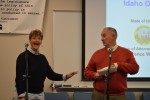
Deputy Attorney General explained that the Idaho Open Meeting Law is “your ticket to the show,” with the show being government. It allows the public to be there and observe the meeting, he noted, but not necessarily participate in the meeting. “So just as you couldn’t go to your child’s play or a show on Broadway and jump up on the stage – though that might be fun – it doesn’t provide for that.”

And Kane said agencies sometimes complain to him about public records requests they receive: “This is just a fishing expedition.” But, he said, “The public records law gives them that right – to fish around. You may have to pay for it, but you have the right to those documents.”

Rules for charging fees for public records requests; how the content determines whether something’s a public record, whether it’s on a government computer or an official’s personal phone; and the need to be in open, public session to make decisions all were among topics explored. This was the 40th open government workshop conducted by IDOG and Wasden since 2004; it was the fourth in Twin Falls.

The first half of the session, held at the Center for the Arts Auditorium, focused on the Idaho Open Meeting Law, and included interactive skits in which members of the audience were called upon to play roles as reporters, government officials and more doing some of the right – and some of the wrong – things needed to comply with the open meeting law.

The second portion of the program focused on the Idaho Public Records Act. Again, audience members were called upon to take on roles in skits to help illustrate what is and isn’t allowed and how the law is supposed to work.

Wasden shared stories from his career that helped highlight the role of the two laws and how they play out in Idaho, as did Betsy Russell, reporter for The Spokesman-Review and president of IDOG. Travis Quast, publisher of the Times-News, welcomed the crowd and served as host.

Attendees gave the experience high marks. In evaluations, a city clerk said the session gave her “information everyone needs.” A school board member said he learned “draft minutes = public record.” “It was quite informative,” wrote a highway district employee. “Great overview of doing the public’s business in public,” said a city worker.

“Every time I attend I learn something more!” wrote one attendee. “So glad I came!”

“Do your homework and know the laws,” was what an elected official said she learned. Plus, something she plans to put to use right away: “Remember that electronic records are public.”

A TV station news director came away with something he plans to put to use: In a public records request, the first two hours of labor and 100 copies are free. And a county commissioner summed up his takeaway from the program like this: “The public has the right to know.”

IDOG is planning additional seminars this year in North Idaho in October in Sandpoint, Coeur d’Alene and Lewiston.

From IDOG

IDOG open government seminars draw crowds in Pocatello, Idaho Falls

Close to 100 people gathered at open government seminars in Pocatello and Idaho Falls in October, to learn in detail what can and can’t be done under Idaho’s Open Meeting Law and Public Records Act.

“I learned how to serve the taxpayers within the law,” wrote a Power County official, in her evaluation of the Pocatello session. Wrote a Minidoka County records deputy, “Don’t ask why or what do you need it for.”

An interested citizen who attended the Idaho Falls session wrote, “Nice variety – slide show, lecture, booklets, role playing.”

Bannock County Prosecutor Stephen Herzog summed up the session like this: “Great and informative and fun.”

Idaho Attorney General Lawrence Wasden was the leader of both sessions. In Pocatello, the group gathered at Idaho State University’s Pond Student Union, where ISU Associated Vice President Stuart Summers welcomed the crowd, and sponsors ISU and the Idaho State Journal provided a much-appreciated light dinner of sandwich wraps, fruit, soda and cookies during the break. In the spacious room at the Student Union, seminar participants gathered at tables in the back to visit, share impressions and eat before reconvening for the second half of the evening’s program.

In Idaho Falls, Monte LaOrange, managing editor of the Post Register, welcomed the crowd, which, as in Pocatello, included reporters, photographers, editors, public officials and employees, law enforcement officers, clerks, deputies, state legislators and interested citizens. The Post Register co-sponsored the Idaho Falls session, which was held in the multi-purpose room of Longfellow Elementary School; a spread of hearty snacks was laid out during the mid-session break.

Deputy Attorney General Brian Kane and IDOG President Betsy Russell also helped lead the program, and members of the audience participated as well, taking on roles in interactive skits, often with comic results.

Amid questions about how to avoid open meeting law violations, Kane suggested that public boards designate an “executive session ogre” who will vigorously object if a closed session veers away from the narrowly designated purposes for which one can be held.

Russell noted that twice in the month prior to the Oct. 19-20, 2016 sessions, state agencies had run into issues with closed meetings, from questions over notice of a special meeting of the state Board of Education to agenda issues at the Idaho Transportation Board – and both times, reporters were watching and called attention to the matter. “Nothing arouses more interest than secrecy,” Russell said.

In Idaho Falls, participants ranged from the mayor to local TV anchors.

“We are fortunate to have IDOG and the AG’s office committed to sunshine,” wrote a citizen who attended. “Thank you!”

Wrote another, “This was a solid investment of time, money and talent.”

A board secretary wrote, “Great refresher course!”

A reporter wrote that he learned something he can immediately put to use: “How to more precisely craft requests.”

A local prosecutor said she’d sum up the session as “what the public is entitled to know for government to work.”

Wrote a citizen, “I learned that almost all aspects of government meetings are open to the public.”

These sessions, made possible in part by grants from the John S. and James L. Knight Foundation and the Best of the West Foundation, have been held around the state since 2004. More are planned, including in the Magic Valley this spring, and in North Idaho next fall.


‘Ticket to the Show’: Boise crowd learns about Idaho’s open meeting, public records laws

Deputy Idaho Attorney General Brian Kane held up a copy of the light-blue Idaho Open Meeting Law Manual. “This is your ticket to the show, the show being government,” he told a crowd of nearly 60 people gathered at Boise State Public Radio’s riverfront public meeting room on Tuesday evening. “It doesn’t give you the ability to participate in the meeting,” he noted.

So if a board or council has 50 angry people show up at its meeting wanting to say their piece, “That’s not an open meeting problem. You might have a pretty significant customer-service problem.” But the Open Meeting Law guarantees all those folks the chance to be there and watch their government in action, he said. “That oversight is important – we’re here to do the public’s business in public.”

Tuesday’s Boise session was the latest in a round of free public workshops on Idaho’s open meetings and public records laws organized by Idahoans for Openness in Government, or IDOG; recent sessions have been held in Nampa and McCall. Idaho Attorney General Lawrence Wasden has led all the sessions, along with Kane and IDOG president Betsy Russell. The audience participated in interactive skits that helped highlight how to comply with the laws – and how not to. There were stories, laughs, lots of questions and plentiful refreshments, thanks to co-sponsors Boise State Public Radio and the Idaho Statesman.

Among the issues that came up at the Boise session: Idaho Statesman Managing Editor Bill Manny asked, “So going into an executive session is not a vow of secrecy?” If a board member thinks the closed session was inappropriate or feels the topic is too important to keep secret, there’s no penalty in the Open Meeting Law for that member speaking out? The answer was no. “You could be subjecting your entity to some significant legal liability,” Kane said, so a board member would want to think carefully before doing that. “It could be a pretty expensive blab.” But, he said, “The First Amendment is probably your best protection for your right to blab.”

Idaho’s public records law is “content-based,” Kane explained to the group. “The test is not whether or not you made the record on a public machine. The test is whether you transact the public’s business.”

In addition, public agencies can’t ask a requester why they want the information – they can only ask what the requester is looking for, in an effort to help them find it. Kane said some government agencies complain that people are just on “fishing expeditions,” but holding up the bright-red Idaho Public Records Law Manual, he said, “The public records law is your fishing license.”

When the group discussed the “sole remedy” for challenging an improper denial of a public records request – going to court – audience members said there should be some easier, less costly way to appeal. “We’ve got a great law, however I think it’s a boon for attorneys,” said one member of the audience. “We need help from our elected officials. … Help citizens be able to implement and use this law without being stonewalled.”

Several elected officials were in the audience, and Kane noted that Gov. Butch Otter’s public records ombudsman, Cally Younger, has been looking at just that; she’s convened a stakeholders group to examine that issue on which both Kane and Russell serve, along with representatives of cities, counties, courts and more. That work still is ongoing.

“You have raised a valid governmental criticism,” Kane said. “We’re working on it. Unfortunately, government work moves slowly sometimes.”

Wasden said, “Most agencies are really trying to do the right thing. There are some that are recalcitrant.”

In their evaluations of the session, attendees gave it high marks. One elected official summed up what he learned as: “Conduct public business in public.” Others noted specific points, from needing to post meeting agendas at the agency or place of meeting as well as on the internet; to how to make minutes better; to a reporter’s comment she learned useful information about public records requests including “what I can ask for and how to ask.”

“Great job and fun evening!” wrote a state employee. “It’s a great knowledge base for anyone regarding public records and open meeting laws,” wrote another. Wrote a local elected board member, “I think now I’ll keep out of jail,” noting that he’ll avoid Facebook discussions of items pending before his agency to keep from starting a “serial meeting” that could run afoul of the Open Meeting Law. Another elected official wrote of learning “how watchful we need to be, and that we should just review our practices.”

Wrote a citizen, “It’s nice to know the public’s rights.”

Crowd in Nampa learns about open meetings, public records

From Eye on Boise/The Spokesman-Review

A lively crowd of more than 80 gathered in Nampa on Wednesday evening to learn about Idaho’s open meeting and public records laws, and the group had lots of questions – all of which were answered. Among them: What if a city signs a non-disclosure agreement for information that’s not exempt from the Idaho Public Records Law? Do they have to disclose it?

The answer, from Deputy Attorney General Brian Kane: He’d advise against any government entity entering into a non-disclosure agreement unless an existing public records exemption applies. “You can’t create a law, you can’t create anything that has greater confidentiality than the public records law,” Kane said.

Another question from the audience, this one from a reporter: What if I submit a public records request, then three days letter, I get a response back with a form the agency wants me to fill out? Does the three-day deadline start ticking again? Kane’s answer: “I would advise against that practice.” He said, “To me, you’ve probably got a foundation for a legitimate bad-faith claim, if push comes to shove.” Idaho law requires a response to a public records request within three days, unless the records take longer than that to find and assemble, in which case the agency can respond within three days that it’ll take up to 10 days.

Kane also advised agencies against sending a 10-day extension letter, then denying the request. Nothing makes people madder, he said. The 10 days are not time to think about whether or not to grant the request; they’re time to get the records together, separate exempt from non-exempt information, and the like. If an agency is going to deny a request, just do it within the three days, he advised.

Idaho Attorney General Lawrence Wasden joined Kane and myself to lead the session; it’s one of a series sponsored by IDOG, Idahoans for Openness in Government, in the Treasure Valley area this fall. (Full disclosure here: I’m IDOG’s president.) The first was a well-attended session in McCall last month, and the next is one set for Boise on Oct. 20; there’s RSVP information here.

Wednesday’s session was co-sponsored by the Idaho Press-Tribune and the City of Nampa, and was held in the council chambers at Nampa City Hall. These sessions, made possible in part by grants from the John S. and James L. Knight Foundation and the Best of the West Foundation, have been held around the state since 2004; last year, well-attended workshops were held in North Idaho, and next year, they’ll return to eastern Idaho.

Scott McIntosh, editor of the Press-Tribune, told the crowd that he’s had people come to his newspaper over the years asking if the paper will file a public records request for them, in the mistaken belief that only the news media can do that. Actually, the public records law is for everyone, he said, and citizens can use it too.

The audience participated in interactive skits, learned about the laws through stories of actual and sometimes odd instances of compliance and non-compliance here in Idaho, and enjoyed hearty refreshments provided by the Press-Tribune. They also received Idaho Open Meeting Law and Public Records Law manuals and other resources to take with them.

Attendees gave the session high marks in their evaluations. “I didn’t realize what was considered public records,” wrote a citizen. “Very informative,” wrote a city employee. A school district employee wrote, “Got some explainin’ to do with the boss!” A state agency employee wrote that she learned much she’ll put to use at work right away. “I learned I don’t know more than I thought I didn’t know!” she wrote.

An elected official wrote, “It was good info for open meeting law that was needed,” and added that he learned “both the how-to and what to have on agendas for both open meetings and executive sessions.” Another elected official wrote that she learned, “Public records are public, you can do with them what you want. Don’t ask why.”

A public employee wrote, “There has been some discussion on what qualifies as a public record amongst co-workers and myself. I better understand this now and know how to respond.”

A citizen wrote that she learned, “Public records and open meetings are key to our form of government – lose it, we lose freedom.” Wrote another citizen, adding a smiley-face: “I knew nothing; now I’m dangerous. I now have resources. I know how to proceed if necessary.”

From Eye on Boise/The Spokesman-Review

Open government workshop in McCall draws interested crowd of 80-plus

From Eye on Boise/The Spokesman-Review

More than 80 people gathered in McCall on Monday for an open meetings/public records seminar led by Idaho Attorney General Lawrence Wasden and put on by Idahoans for Openness in Government; they ranged from city, county and fire district officials to clerks, reporters, citizen watchdogs and more. Deputy Attorney General Brian Kane told the public officials among the crowd that they can call him with open meeting questions, but noted, “Just know that when you call, our most likely advice is going to be to open it up. … The policy is openness.”

Among the points brought out at the workshop: Because two-thirds of a governing body must vote to go into executive session, that means on a five-member board, it takes four votes. Three aren’t enough – they’re just 60 percent. And if just three members of the five-member board have shown up at the meeting, they can’t go into executive session at all – the vote must be two-thirds of the board, not two-thirds of those present. They can still conduct business, though, Kane noted – in the open.

The crowd participated in interactive skits to learn about the open meetings and public records laws, with one casting local citizen watchdog Dennis Stewart as “Helpful, the Deputy City Clerk” and an animated Cascade City Councilor Judy Nissula as “Bluster, the Citizen,” who was initially highly suspicious as she contacted the clerk about a public records request. There were laughs, snacks, lots of questions and answers and lots of learning.

The seminar is the first of a series of three that IDOG is holding in the Treasure Valley area this year; the next will be on Oct. 7 at Nampa City Hall, co-sponsored by the Idaho Press-Tribune and the City of Nampa, and the third Oct. 20 at Boise State Public Radio in Boise, co-sponsored by the radio station and the Idaho Statesman.  There’s more info here on the sessions and how to RSVP; they’re free. Similar sessions were conducted last year in Moscow, Lewiston, Coeur d’Alene and Sandpoint; next year, they’ll head back to eastern Idaho.

IDOG (full disclosure here: I’m its president) is Idaho’s non-profit coalition for open government; its board members range from retired Idaho Secretary of State Ben Ysursa to prominent attorney-lobbyist Skip Smyser to CWI trustee and citizen activist Emily Walton. There’s more info at IDOG’s website, www.openidaho.org.

From Eye on Boise/The Spokesman-Review

Standing-room only for Sandpoint open government workshop

It was standing-room only in Sandpoint as 75-plus people filled the Sandpoint Library’s community room for a workshop on Idaho’s open meeting and public records laws on Thursday, Dec. 11, 2014 – a record turnout for Sandpoint, which had half as big a crowd the last time IDOG’s open government sessions came to town in 2011.

“In the simplest terms, the open meeting law is your ticket to the show, and the show is government,” Deputy Attorney General Brian Kane told the crowd. “When in doubt, open it up.”

Those attending ranged from the county sheriff to local elected officials to government employees, reporters, a newly elected state lawmaker and lots of interested citizens. However, the Bonner County Daily Bee, which co-sponsored the session, pointed out in the next day’s paper that Sandpoint city officials skipped the workshop – and held a controversial, closed-to-the-public meeting about oil and coal train traffic in the region the same afternoon.

Idaho Attorney General Lawrence Wasden, the lead presenter at the workshop, said, “It’s important that we have an understanding about how to access information in our government. It’s really important, and the reason for that is the greatest strength in our system is public involvement. … Our system works because people can have access to information.”

New Daily Bee publisher Jim McKiernan welcomed the crowd, and members of the audience participated in a series of humorous skits as they learned about the provisions and requirements of the Idaho Open Meeting Law and the Idaho Public Records Act. Attendees also left with handouts including the Attorney General’s manuals on both laws.

“I picked up several things I didn’t know,” wrote local writer Bob Wynhausen in his evaluation of the event. An official from the city of Priest River wrote that he planned to immediately put to use the information he learned about rules for executive sessions.

“It was a great refresher on all public meeting laws,” wrote another attendee. A fire district commissioner also called the session a “great refresher,” and said his district will work on “more properly prepared agendas.”

A citizen wrote that she learned “too much to list!” Wrote an elected official, “The manuals are very helpful.”

A county employee wrote, “I am a records clerk, so I can use this information on a daily basis.”

Kane explained that whether or not something is a public record doesn’t depend on where or how it’s created or transmitted – it depends on the content. “The question is what does it contain. If it contains the public’s business, that’s public,” he said.

That’s even if public officials have used their own phones, computers or private email accounts to send the messages, texts or other items – if the message is about conducting the public’s business, it’s a public record, and any member of the public is entitled to request access to it.

The public records law’s definitions are broad: A “writing” is defined as not just written material, but includes “any means of recording,” so it takes in videos, texts, audio recordings and more. A “public record” is then defined as: “Any writing containing information relating to the conduct or administration of the public’s business.”

Exemptions from disclosure, on the other hand, are required to be narrowly construed, and limited to specific circumstances.

Under the law, if a requester is wrongly denied a public record, the sole remedy is to bring suit in court. There, the burden is on the government to prove that an exemption applies.

The law requires a response to a public records request within three days, but Kane said, “My best legal advice is to get them out as quickly as possible – just because you have three days, you don’t have to take three days.”

If the records will take longer to gather or redact, an agency can notify the requester it will take up to 10 days, but Kane cautioned that’s not 10 days to think about whether or not to release the record. That decision should be made within three days.

The Sandpoint session was the 33rd open government seminar IDOG has held around Idaho since 2004; the project is funded in part by a grant from the John S. and James L. Knight Foundation through the National Freedom of Information Coalition.

Crowd in CdA learns the Idaho Open Meeting law is everyone’s ‘ticket to the show’

Eighty people filled a meeting room at the Coeur d’Alene Inn the evening of Dec. 10, 2014 to learn about Idaho’s open meeting and public records laws, from county commissioners to newspaper reporters, school trustees to city clerks, state lawmakers to interested citizens.

“The open meeting law is your ticket to the show,” Deputy Idaho Attorney General Brian Kane told the crowd. “Anybody who has ever gone to a meeting and seen a vote without any discussion – that’s not a good sign.” Coeur d’Alene retiree Frank Orzell, with a big grin, responded from the audience with a double thumbs-up.

Kane said members of a board from eastern Idaho once bragged to him that they had the shortest meetings in the state. “To me, that’s a sign that there’s something wrong,” he said. “The open meeting law wants you to have those deliberations. Don’t take that away from the public, when they’ve got their ticket to the show.”

The public records law, meanwhile, is the public’s “fishing license,” Kane explained. People have a right to access information about their government, regardless of why they want it – even if they’re just fishing around for something. Holding up the light-blue Idaho Open Meeting Law Manual and the bright-red Idaho Public Records Law manual – every attendee received copies of both – Kane said, “If this is your ticket to the show, this is your government fishing license.”

The session was put on by Idahoans for Openness in Government, and is part of a series in North Idaho this week, which wraps up with another workshop Thursday afternoon in Sandpoint.

Idaho Attorney General Lawrence Wasden was the lead presenter at all the sessions, which are free and open to the public. “These statutes are especially important,” Wasden told the Coeur d’Alene crowd, “because they really are at the heart of what we are as an American people. It is important that you understand the rules by which you access information and watch government.”

The session featured humorous interactive skits, with audience members playing the roles, to demonstrate how the open meeting law and public records law are supposed to work – or in some cases, how they’re not. In one, Kootenai County Clerk Jim Brannon portrayed “Crusty, the reporter,” complaining about a closed meeting of a fictional City Council; soothing Crusty’s concerns was “Trusty, the city clerk,” played by Coeur d’Alene Press reporter Keith Cousins. Among those taking on roles on Wednesday night were former state Rep. Gary Ingram, the original author of Idaho’s open meeting law when he served in the Legislature in the 1970s; Ingram also was honored during the session.

Attendees gave the session top marks, even though it went far into a late and dark December evening. Wrote a reporter – who sent this out as a Tweet – “Ticket to the show. Check. Fishing license. Check. Great job tonight!”

Wrote a fire commissioner, “Technical details were needed for clarification – well done!”

Wrote a citizen: “Lawrence Wasden is hilarious. Nice job all around!”

A local official called the session a “great refresher on the do’s and don’ts.” An elected official wrote that her takeway from the evening was, “Disclose, be open, public, cooperate!”

The Coeur d’Alene session was co-sponsored by the Coeur d’Alene Press and The Spokesman-Review. Welcoming the crowd, Press managing editor Mike Patrick said if the two competing newspapers can work together to promote better knowledge of the state’s open government laws, everyone can.