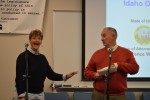
Open government workshop in McCall draws interested crowd of 80-plus

From Eye on Boise/The Spokesman-Review

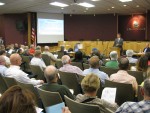
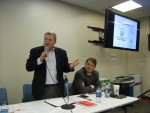
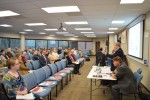
More than 80 people gathered in McCall on Monday for an open meetings/public records seminar led by Idaho Attorney General Lawrence Wasden and put on by Idahoans for Openness in Government; they ranged from city, county and fire district officials to clerks, reporters, citizen watchdogs and more. Deputy Attorney General Brian Kane told the public officials among the crowd that they can call him with open meeting questions, but noted, “Just know that when you call, our most likely advice is going to be to open it up. … The policy is openness.”

Among the points brought out at the workshop: Because two-thirds of a governing body must vote to go into executive session, that means on a five-member board, it takes four votes. Three aren’t enough – they’re just 60 percent. And if just three members of the five-member board have shown up at the meeting, they can’t go into executive session at all – the vote must be two-thirds of the board, not two-thirds of those present. They can still conduct business, though, Kane noted – in the open.

The crowd participated in interactive skits to learn about the open meetings and public records laws, with one casting local citizen watchdog Dennis Stewart as “Helpful, the Deputy City Clerk” and an animated Cascade City Councilor Judy Nissula as “Bluster, the Citizen,” who was initially highly suspicious as she contacted the clerk about a public records request. There were laughs, snacks, lots of questions and answers and lots of learning.

The seminar is the first of a series of three that IDOG is holding in the Treasure Valley area this year; the next will be on Oct. 7 at Nampa City Hall, co-sponsored by the Idaho Press-Tribune and the City of Nampa, and the third Oct. 20 at Boise State Public Radio in Boise, co-sponsored by the radio station and the Idaho Statesman.  There’s more info here on the sessions and how to RSVP; they’re free. Similar sessions were conducted last year in Moscow, Lewiston, Coeur d’Alene and Sandpoint; next year, they’ll head back to eastern Idaho.

IDOG (full disclosure here: I’m its president) is Idaho’s non-profit coalition for open government; its board members range from retired Idaho Secretary of State Ben Ysursa to prominent attorney-lobbyist Skip Smyser to CWI trustee and citizen activist Emily Walton. There’s more info at IDOG’s website, www.openidaho.org.

From Eye on Boise/The Spokesman-Review

Prosecutor: Transportation Group Broke Open Meeting Laws for 25 Years

From the Twin Falls Times-News

TWIN FALLS • A transportation committee may have been breaking open meeting laws for the past 25 years, the Twin Falls Prosecuting Attorney’s Office says.

The Greater Twin Falls Area Transportation Committee hasn’t posted an agenda or meeting notice as long as it has existed but will from now on, Chairman Gary Young said. The prosecutor’s office looked into it after Twin Falls County resident Jill Skeem contacted the office. She opposes a truck route the group has proposed to bypass Twin Falls to the south, which would run along her property.

County Prosecutor Grant Loebs sent Young a letter on Thursday, briefly explaining open meeting and public records laws and saying the committee appears to be a “public agency” as defined by the law and must follow both.

“There appears to have been some confusion about how this Committee was initially formed, and perhaps some confusion as well about how these laws apply to the Committee,” the letter says. “Please take any steps necessary to ensure that the Committee is in compliance with Idaho law.”

Young said Friday that, as far as he knows, the committee had never advertised the meetings or agenda. He said the group would now, and would have started to sooner, had members known they were required.

“To my knowledge, we have not done that, but we can start,” he said.

The committee was formed by county commissioners in 1990 to study and make recommendations on transportation issues in the greater Twin Falls area, and includes representatives from local government, highway districts and other interested stakeholders. It meets once a month at 7 a.m. at Idaho Joe’s.

The committee didn’t draw much public attention before, but it has been in the spotlight since this spring when it came out with recommendations for three potential truck routes, surprising residents and some local elected officials who weren’t aware the route was under discussion.

Keller Associates did the study that led to the recommended routes, working with a smaller steering committee that included Young and two other GTFATC members.

All three routes would go through some homes and businesses. After a presentation in May, the Twin Falls City Council preferred the option that followed 3600 North to 3300 East, which would affect 18 properties. The Kimberly City Council decided in July not to back any of the proposals.

Skeem said Friday she is glad the committee will follow the Open Meeting Law moving forward.

“To me, it’s clear that the committee should be following the state Open Meeting Law to begin with,” she said.

Skeem said people should have known about the proposed route while it was being developed, and that the steering committee’s meetings should also have been public.

“That’s why they have open meeting laws,” she said. “That’s why it’s so strict.”

Loebs told the Times-News Thursday that any violations appear to have been due to confusion as to whether the laws applied to the group, rather than malice.

“We’re investigating it and we’ll make sure it operates properly,” he said.

The idea of a route to steer truck traffic out of Twin Falls has been around for a while, and supporters say it is needed because of the area’s industrial growth.

There’s no funding for one lined up, or a route that has been decided on, and Young has said it could be several decades before it is completed, if it gets built. Before this, it would have to be added to the Twin Falls Highway District’s transportation plan.

At the moment, Young said, the transportation committee is reviewing some revisions to the study that would not choose a route but would call for further study by the highway district.

From the Twin Falls Times-News

Agency not being transparent

Editorial from the Coeur d’Alene Press

Editor’s note: Ignite cda’s public hearing on its 2016 fiscal year budget is today at 4 p.m. in the Coeur d’Alene Library Community Room. The public is invited to attend.

***
Tens of thousands of tax dollars don’t buy much goodwill when the public is treated like a pain in the tax increment.

In a letter to the editor Sunday, Coeur d’Alene resident Amy Lyons expressed her frustration with ignite cda – Coeur d’Alene’s urban renewal agency, formerly known as Lake City Development Corp. – when her request for specific information about the agency’s proposed budget was given the runaround. Amy learned something The Press and others, including City Councilman Dan Gookin, have known for a long time. LCDC/ignite cda is the region’s most reluctant public body when it comes to real transparency.

Last Friday, Press City Editor Maureen Dolan emailed Tony Berns, ignite cda’s executive director, and respectfully asked that the newspaper be provided a copy of the proposed budget for the coming fiscal year. Berns did not comply with the request but instead emailed a pdf of the agency’s public records request form and asked her to fill that out and return it.

Unlike most forms that go back and forth, the pdf had to be printed out and Dolan was then tasked with filling it out by hand. That’s not just inconvenient; it also precludes the records seeker from going into as much detail as is sometimes necessary to acquire the needed information. That detail is important because it generally saves the person fulfilling the records request time and energy, which ultimately is money. The more specific the request, the easier it is to narrow the search and serve the person asking for information.

Yesterday, when The Press still had not received the information it had initially requested Friday, Dolan contacted Berns to find out why. He replied that the information had been mailed – and by that he meant the U.S. Postal Service. Not email, which would’ve arrived in seconds and allowed the newspaper time to give readers a preview of today’s ignite cda budget hearing. While it would’ve shown exemplary public service, Berns also could have brought the records to The Press. His office and The Press are literally across the street from one another.

We wish this was simply a communication problem or personal dispute between a private business and a public entity or even a newspaper editor and ignite cda ‘s highly paid leader. But it is not. Just ask Amy Lyons or Dan Gookin. They’ll tell you that by any name, Coeur d’Alene’s urban renewal agency doesn’t understand who’s working for whom.

Editorial from the Coeur d’Alene Press

Former Gov. Andrus files appeal after DOE refuses to release documents on nuke waste under FOIA

From Eye on Boise/The Spokesman-Review

Former Idaho Gov. Cecil Andrus, who filed a Freedom of Information Act request in January for documents about the U.S. Department of Energy’s plans to seek a waiver from the 1995 nuclear waste agreement with Idaho to allow commercial spent nuclear fuel to be sent to the state, has formally appealed the DOE’s response, which he says took nearly six months and withheld much of the requested information.

“I’ve been dealing with the Department of Energy for a long, long time,” said Andrus, a four-term governor and former U.S. Secretary of Interior. “They have always been among the most secretive federal agencies. While I have become all too familiar with DOE’s historic refusal to truly engage the public in a discussion about its short and long-term plans for Idaho, it is simply not acceptable to withhold potentially critical information in this manner.”

Andrus said in response to his FOIA request, the DOE provided 41 documents, but 30 of them were “essentially completely redacted,” citing FOIA exemptions for “deliberative process, attorney-client and attorney work product” information. “Virtually the only unredacted documents provided by DOE were public news articles and limited correspondence that were already widely available,” Andrus said in his appeal.

The appeal comes as the federal government has turned up the pressure on Idaho to grant a waiver from the 1995 agreement, negotiated by then-Gov. Phil Batt, to accept two waste shipments to the Idaho National Laboratory in eastern Idaho. A recent letter from state Commerce Director Jeff Sayer to Gov. Butch Otter said the state’s been given a two-month deadline, and if it doesn’t grant the waiver by then, could lose millions in research projects. Idaho Attorney General Lawrence Wasden has been adamant that he will not consider a waiver of the 1995 agreement until the Integrated Waste Treatment unit at INL is operational, which was initially supposed to occur by 2012, then by this fall, but still isn’t up and running. That treatment unit, under the 1995 agreement, is supposed to convert liquid waste now stored above the aquifer into a powdery substance, reducing danger to the aquifer. Both Wasden and Otter must agree for a waiver to be issued.

Andrus said in a statement, “DOE’s long-time pattern, through both Republican and Democratic administrations, has been to tout the short-term benefits of a ‘research project,’ while never taking into account what eventually happens to the highly radioactive material for the next 25, 50 or 100 years.” He added, “Bottom line: Idahoans are entitled to know all of what is being proposed.”

Andrus, who is represented by attorney Laird Lucas of Advocates for the West, said he isn’t ruling out going to federal court over his records request.

From Eye on Boise/The Spokesman-Review

New Attorney General’s manuals out now include changes to Public Records, Open Meeting laws

From Eye on Boise/The Spokesman-Review

The Idaho Attorney General’s office has published new versions of its manuals on the Idaho Public Records Law, the Idaho Open meeting Law and the Ethics in Government law, to reflect changes enacted by the Legislature this year, including recodifying all three statutes into a new title of the Idaho Code entitled “Transparent and Ethical Government.”

“One of the most essential elements to a free and democratic society is government that honors, respects and promotes transparency,” said Attorney General Lawrence Wasden. “These manuals have always provided the tools and understanding of the laws designed to help the public hold government and its leaders accountable.” He added, “This recodification reflects the importance that lawmakers and I place upon transparent and ethical government all across this state.”

The recodification changes the Idaho Code numbers to reference all three laws; previously, the Public Records Law was deep in the section of Idaho Code dealing with evidence; the Open Meeting Law was under a “miscellaneous” section; and the Ethics in Government law was under a public officers section. Now, all are in Title 74, making all three easier to find and giving them more prominence.

However, the changes will require all those who reference the laws to change the statute numbers they cite, just as Wasden revised the manuals his office publishes. For example, public records requests that previously cited Idaho Code Sections 9-337 through 9-350, now will need to cite Idaho Code Sections 74-101 through 74-126, the new section numbers for the Idaho Public Records Law.

Wasden is recommending that local government leaders take time to update their own materials to reflect the changes. In addition to the recodification, the new manuals reflect this year’s increases in fines for violations of the Open Meeting Law. All the manuals can be found online here. The Idaho Public Records Law was first enacted in 1990; this year marks its 25th anniversary.

From Eye on Boise/The Spokesman-Review

Caldwell trustees mum on superintendent, assistant removal

From the Idaho Press-Tribune

CALDWELL — Residents of Caldwell packed the school district board room Monday night to address trustees with a host of questions and expressions of disappointment one week after the board removed Superintendent Tim Rosandick and Assistant Superintendent Luci Asumendi from active duty status.

Trustees remained silent as several individuals approached the podium during a designated period for public comment. The special meeting was held mostly to appoint Jodie Mills as the interim superintendent for the 2015-16 school year — a motion that passed by a unanimous vote — but it turned into an indictment of the board’s actions last week.

One week ago, trustees passed addendums to Rosandick and Asumendi’s contracts with the school district that relieved them of active duty in their roles. The two will stay on as “consultants” to the board and district officials until their contracts expire next June.

To date, the only explanation given for the move is the one Bill Gigray, attorney for the school district, continued to repeat Monday night.

“There are times unfortunately in the management of affairs of either a school district or other entities where there can be circumstances where the cohesive, or unified, or mutual supportive management just does not exist or is in a struggling situation,” Gigray said.

“As I recall the situation … there was a mutual agreement reached that there needed to be an action taken that all could agree to so this whole process could move on.”

There is no confidentiality clause in the addendums barring Rosandick, Asumendi or any of the trustees from giving more detail about the situation, but Rosandick and several trustees have declined to comment further. Board Chairman Chuck Stout and Trustee Leif Skyving both declined to comment again Monday night.

Chuck Randolph, who worked in the Caldwell School District for 16 years and said he had Rosandick as a student, had six questions for the board. First, he said he wanted a definition for the “situation” Gigray referenced and what happened that was so egregious, Rosandick and Asumendi had to be removed immediately. In the time he was employed by the district, Randolph said the only individuals who were removed from their positions immediately had broken the law in some way or acted inappropriately.

“None of that appears to apply, because the board — according to the (Idaho) Press-Tribune — thanked them for their service and kept them on as paid consultants,” Randolph said. “Please define the situation that was so egregious they could not only not fulfill an assigned 2015-16 contract, but not even finish the 2014-15 contract that would have gone through June 30.”

Randolph also asked what the new direction of the school district would be, and why it was so time sensitive that the action of removing the superintendents needed to be taken so quickly. He also wanted to know the plans for hiring a permanent replacement for Rosandick, addressing the expenditure of paying out the superintendents’ contracts, the apparent “self-imposed gag rule” on the part of trustees, and the “collateral damage” that would take place from the action.

Randolph was referring to the early retirement of Gini Rosandick, who is Tim Rosandick’s wife. Gini Rosandick has been the orchestra teacher at Caldwell High School for nearly 20 years, and her groups have received many awards for their accomplishments under her direction. Randolph said in the 49 years he has been involved in education, she is one of three of the best teachers he has ever seen.

Shelly McKee, who called herself a “regular parent” in Caldwell School District, also expressed sadness about Gini Rosandick’s early retirement.

“My son is just going into high school and was so looking forward to being in her orchestra. I just think it’s a huge loss, huge … that’s a gem in this district. It’s huge. And I just think it’s shameful that it’s over,” McKee said.

She added that she and other parents felt “stonewalled” by the board, and that there was no real way to find the answers to their questions.

From the Idaho Press-Tribune

Government seeks to shield terrorism witnesses from view

From the Idaho Statesman

Prosecutors want to hide two witnesses behind a screen in an upcoming terrorism trial to shield their identities from the public and allow them to testify using made-up names.

The measures are needed to protect both men and their families, prosecutors say. Revealing their identities could also compromise other ongoing criminal and intelligence cases involving national security, according to a filing in federal court.

Boise resident Fazliddin Kurbanov, 32, is accused of plotting to set off bombs at military bases and public areas where large groups of people could be killed. An Uzbek refugee who came to the United States in 2009, Kurbanov allegedly detailed his plans during a series of conversations with two FBI informants and in written communications with the website administrator for a terrorist group in Central Asia.

He was arrested in May 2013, after FBI agents found chemicals and bomb-making components at his apartment near Borah High School during a secret, court-authorized search. He is scheduled to go on trial July 13 in U.S. District Court in Boise.

The government is also asking that four FBI linguists from the Middle East and Central Asia be allowed to testify under pseudonyms. They are being called to translate into English various communications and videos. None has testified in court before.

“The linguists fear reprisal against family members and relatives living in these countries if it becomes known publicly that they work for the government and/or that they testified for the government in a criminal proceeding involving the Islamic Movement of Uzbekistan,” Assistant U.S. Attorney Aaron Lucoff wrote.

The IMU was originally formed in 1998 to overthrow the government of Uzbekistan. The group, which wanted to create an Islamic state, later allied itself with al-Qaida and the Taliban. More recently, it became a supporter of the Islamic State.

At the FBI’s behest, one of the two informants enrolled in a Salt Lake City truck-driving school that Kurbanov attended in January 2013. The man posed as someone who was sympathetic to what the government contends are Kurbanov’s extremist views.

The informant had frequent conversations during the two weeks the men were together about Kurbanov’s interest in explosives and holy war. Kurbanov allegedly spent hours with the man showing him videos dealing with terrorism and explosives.

Kurbanov also discussed potential explosive attacks he was planning in the United States, last week’s filing on the informants alleges.

The second informant briefly lived with Kurbanov in Denver in winter 2012. The discussions between that informant and Kurbanov were similar to those with the first, the government contends.

“There is a reasonable possibility that an IMU member or sympathizer might attempt to identify and harm the (informants) and their families in an effort to disrupt the case,” Lucoff wrote.

Kurbanov is charged with conspiracy to provide material support to the Islamic Movement of Uzbekistan; conspiring and attempting to provide material support in preparation for, or in carrying out, the use of weapons of mass destruction; and possession of an unregistered explosive device.

If convicted, he faces up to 20 years each on the conspiracy charges and up to 10 years for possession of an explosive device.

He also was indicted by a federal grand jury in Salt Lake City of one count of distributing information related to explosives, destructive devices and weapons of mass destruction. That case is on hold while the Boise case moves forward.

Authorities say that Kurbanov was planning an attack in the United States. During a secret, court-authorized search of Kurbanov’s residence in November 2012, authorities said they found bomb components and chemicals.

In a series of emails in fall 2012 between Kurbanov and a person who used the online name ahmadi9777 and who said he was the administrator of the Islamic Movement of Uzbekistan’s website, Kurbanov said he was gathering materials for hitting targets in the United States. He also indicated that he didn’t know a lot about assembling bombs.

“In just a regular store, you know, both, the ammonium nitrate and sulphate are available. Gunpowder is available as well. There are AK, M16, bullets, everything,” Kurbanov wrote in one of the messages. “But we need to know how to connect the wires, how much and what to do. Also, it would be great if we learn how to operate the remotely controlled ones. While some are operated remotely, others will be by ourselves.”

Lucoff has asked that a screen be placed to keep the two witnesses from being seen by observers sitting in the public section of the courtroom inside the James A. McClure Federal Building. Jurors, prosecutors, defense attorneys, Kurbanov and U.S. District Judge Edward J. Lodge, who is presiding over the trial, would be able to see the two men.

If Lodge rules against using a screen, Lucoff asked that the courtroom be closed to the public while the two men testify. If that happened, observers would be allowed to sit in an adjacent courtroom and listen to an audio-only broadcast.

Defense attorney Chuck Peterson has not filed responses to the motions.

Shielding witness IDs doesn’t violate Constitution, prosecutors say

Court rulings have balanced the right to confront one’s accuser with the need to protect investigations and informants

The right of a defendant to face witnesses in a criminal case is enshrined in the Bill of Rights.

The Sixth Amendment reads: “In all criminal prosecutions, the accused shall enjoy the right to a speedy and public trial, by an impartial jury of the state and district wherein the crime shall have been committed, which district shall have been previously ascertained by law, and to be informed of the nature and cause of the accusation; to be confronted with the witnesses against him; to have compulsory process for obtaining witnesses in his favor, and to have the assistance of counsel for his defense.”

But federal prosecutors in Boise say they can still meet the amendment’s terms when shielding witnesses. They cite several previous cases at which witnesses have been allowed to testify behind screens or use pseudonyms to hide their real identities.

In the government’s terrorism case against Fazliddin Kurbanov, Assistant U.S. Attorney Aaron Lucoff argues that shielding the true name of a witness is an approved method in certain instances to protect the safety of a person who testifies.

Two years ago, the 9th U.S. Circuit Court of Appeals ruled that Arizona drug dealer Jorge de Jesus Casteneda’s right to confront his accuser was not violated when a witness testified while wearing a wig and a fake handlebar mustache to shield his identity. Prosecutors argued the disguise was necessary to protect the man as he continued to collect evidence inside Mexico’s violent Sinaloa drug cartel.

In a 1991 case in Kansas City., Mo., a police detective was allowed to testify from behind a screen against five defendants in a drug case. The detective was one of only a handful of black female drug detectives in the city, and the court agreed her safety might be jeopardized.

In 2008, the 2nd U.S. Circuit Court of Appeals upheld the conviction of a man for selling crack cocaine to an undercover detective in New York City. Richard Hargett protested the use of a blackboard at trial to prevent members of his family from viewing the detective as he testified. The officer said he was still involved in undercover drug buys and he feared for his safety if the family members, who allegedly were also selling drugs in the neighborhood, could identify him.

The 9th Circuit instructs judges to weigh the defendants’ rights to confront government witnesses against the government’s interest in not compromising investigations and in protecting informants’ identities. Judges in Idaho and other states within the 9th Circuit must conduct an analysis before ruling that the name of a witness can be shielded.

John Sowell

From the Idaho Statesman

Open process to seek new Idaho Court of Appeals judge yields four finalists: Three women, one man

From Eye on Boise/The Spokesman-Review

Here’s an interesting contrast: While Idaho Sens. Mike Crapo and Jim Risch pursue a secret process to name a recommended replacement for longtime U.S. District Judge Edward Lodge, who will take senior status July 3, a much different and more open process is under way to replace the retiring state Court of Appeals Judge Karen Lansing.

The Idaho Judicial Council issued a notice and call for applications to be received by March 4, and on March 10, published the names of 12 applicants on its website, including state district and magistrate judges, prosecutors, and attorneys from around the state, and solicited comments on the applicants from all members of Idaho’s state bar.

On May 19, 10 of those candidates were interviewed by the Judicial Council. And on May 20, four names were forwarded to Gov. Butch Otter: Dennis Benjamin, a Boise attorney; Molly J. Huskey, a 3rd District judge and former state appellate public defender; Christine M. Salmi, a Boise attorney; and Jayme B. Sullivan, a magistrate judge in Nampa.

Otter will select the new Court of Appeals judge from among those four finalists, who include three women and one man. Lansing, who is retiring June 30 after 22 years on the bench, is currently the only woman serving on either Idaho’s Court of Appeals or its Supreme Court. After her retirement, she will continue to serve the courts part-time as a senior judge.

I reported on April 27 on Risch and Crapo’s secret process for naming a replacement for Lodge; at the time, multiple sources said just four candidates had been interviewed, all of them men, though at least five prominent female Idaho attorneys had applied. Idaho is the only state in the federal 9th Circuit that has never had a woman judge on the U.S. District Court bench; it’s one of just two in the nation. After my article appeared, Risch and Crapo issued a statement saying that both “men and women” were being interviewed and that the process was “ongoing.” “We want a confidential process,” the two senators said in their statement. The word is that now at least two women have been interviewed, but I’ve received no confirmation of that as yet from the senators.

From Eye on Boise/The Spokesman-Review

Idaho senators’ secret selection process for new federal judge raises questions

From The Spokesman-Review

by Betsy Z. Russell

BOISE – It seems that women need not apply to the federal district court bench in Idaho.

A secretive selection process that Idaho’s two senators have launched to find a replacement for U.S. District Judge Edward Lodge appears to be ignoring female candidates.

Idaho is the only state in the federal 9th Circuit that has never had a woman judge on the U.S. District Court bench. Lodge announced last September that he will take senior status on July 3.

“We are extremely concerned,” said Peg Dougherty, co-chair of the Judicial Recruitment Committee for Idaho Women Lawyers.

Multiple sources say Sens. Mike Crapo and Jim Risch have interviewed just four candidates – all men.

“Are the senators even aware that Idaho is the only state without a woman on the federal court bench at the district level?” Dougherty asked. “If they are aware, do they care?”

Neither Crapo nor Risch would comment.

“The judgeship application process is entirely confidential and remains ongoing,” said Risch’s press secretary, Suzanne Wrasse.

“The senators are working through their confidential process,” said Crapo’s press secretary, Lindsay Nothern. “That’s all I have.”

At least five prominent female Idaho attorneys, including one sitting judge and two high-ranking prosecutors, applied for the position, but have not been interviewed. They haven’t heard anything since their applications were submitted, they say.

“I submitted my judicial questionnaire in December, and was not contacted whatsoever at all, period,” said Boise attorney Terri Pickens Manweiler. “I heard through the grapevine that I was too progressive for the position, which is patently absurd. I’m about as middle-of-the-road as you can get, which is exactly what the position needs.”

Wendy Olson, U.S. Attorney for Idaho, said she, too, completed the questionnaire that Risch and Crapo made available to interested applicants via email. “I did that in January,” she said. “And that is the last I have heard. I got a reply email saying they received my application, but other than that, I’ve not been contacted, not heard anything from the senators.”

U.S. Magistrate Judge Candy Dale confirmed that she, too, submitted her application; she did so in December. She also hasn’t been contacted since then. Dale is widely considered to be a front-runner for the position due to her seven-year record on the court. But she’s also the author of the court decision that overturned a ban on same-sex marriage in Idaho, which Idaho Republicans decried.

Multiple sources say the four male finalists interviewed for the position include two state district judges, and two Idaho attorneys with strong GOP ties – one a Republican elected official, the other the general counsel and a member of the senior management of Melaleuca Inc. That eastern Idaho company contributed $1 million to a super-PAC backing Republican Mitt Romney’s presidential campaign.

All four men declined comment.

The Idaho senators are only making a recommendation – the nominee will be selected by President Barack Obama, a Democrat.

“The process is inherently political,” said Shaakirrah Sanders, a professor with the University of Idaho College of Law.

Russell Wheeler, a fellow with the Brookings Institution, former deputy director of the Federal Judicial Center and an expert on the selection of federal judges, said of the senators, “They’ve had plenty of time to get a nominee up there, if they were of a mind to.”

If the selection process were delayed beyond July because the senators put forth candidates that weren’t acceptable to the Democratic president, Wheeler said, “It’s really doing a disservice to the district. It’s the litigants in the district, especially the civil litigants, who are going to feel the brunt of this.”

Idaho is one of just three states with only two U.S. district judges; it hasn’t gotten an additional judgeship in 60 years, though caseloads have soared. If Judge Lodge takes senior status, only U.S. District Judge Lynn Winmill would be left. “Winmill is going to be working his head off,” Wheeler said.

Plus, he said, failing to consider female applicants is “just counter-productive. Idaho I know is a fairly conservative state. But that’s getting to be a black eye in this day and age, when a court is populated solely by white males.”

Judge Dale was the first woman appointed as a U.S. magistrate judge in Idaho, in 2008. Magistrate judges are appointed by district judges through a merit-selection process and serve eight-year terms; they don’t preside over felony trials, and can adjudicate civil cases only with the consent of the parties. U.S. district judges are lifetime appointees.

Dougherty said Idaho Women Lawyers has made a concerted effort in recent years to encourage qualified women to apply for judgeships, and bemoans the lack of female judges in the state, including an Idaho Supreme Court that’s currently all-male.

As for the U.S. District judgeship, Dougherty said the Idaho senators have provided no information about the selection process or what they’re seeking in a candidate.

Wheeler, at the Brookings Institution, said in about 20 states, senators have set up “vetting committees” to encourage and review applications for federal judgeships in an open, often bipartisan, process. That’s what Idaho did when it last got a new federal district judge, Judge Winmill, in 1996; he was appointed by Democratic President Bill Clinton.

The state’s current process is at the other end of the spectrum, Wheeler said. “I can’t say that what’s going on in Idaho is unique, but a lot of other states’ senators are on the face of it more transparent.”

In the past decade, home-state senators have taken an increasing role in selection of federal judges, Wheeler said. There’s an unwritten rule in the Senate Judiciary Committee requiring both home-state senators to complete “blue slips” saying they approve of nominees for federal judge in their state; without those slips, “there’ll be no further proceedings,” he said.

“It really gives home-state senators veto power over the president’s nominee,” he added.

But the process also can lead to big political battles, as occurred in Georgia last year, when the two senators insisted on candidates that weren’t acceptable to Democrats and the civil rights community in their state. One withdrew after the Senate refused to consider him; the other was confirmed, but only after a fight.

“They’re playing more hardball,” Wheeler said. “It’s not a pretty picture, but it’s a reality.”

From The Spokesman-Review

Fines to increase for violations of Idaho Open Meeting Law

From Eye on Boise/The Spokesman-Review

Gov. Butch Otter has signed HB 324 into law, sharply increasing fines for violations of the Idaho Open Meeting Law. Fines for regular violations would rise from $50 to $250; fines for knowing violations would rise from $500 to $1,500; and fines for knowing, repeated violations would rise from $500 to $2,500. Rep. Linden Bateman, R-Idaho Falls, proposed the bill, saying fines hadn’t been updated since the Open Meeting Law first was enacted in 1974, and the increases reflect inflation.

The bill had a bumpy ride, with a House committee initially rejecting a version with even higher fines. Then, the House passed the bill, but the Senate added technical amendments that turned out to have a serious drafting error, inadvertently repealing a portion of the existing law. Finally, a new version was introduced in the House, where it passed, 60-9, and then passed the Senate, 29-4. Otter had no comment as he signed the bill into law. It takes effect July 1.

It was one of 12 bills Otter signed into law yesterday and today; you can see the full list here. Among them were SB 1174, the Idaho Transportation Department budget for next year, which totals nearly $500 million, nearly half of it from federal funds; and SB 1098a, the bill to allow state parks to seek corporate sponsorships.

From Eye on Boise/The Spokesman-Review