Lots of lessons learned about open meetings, records at Nampa IDOG seminar

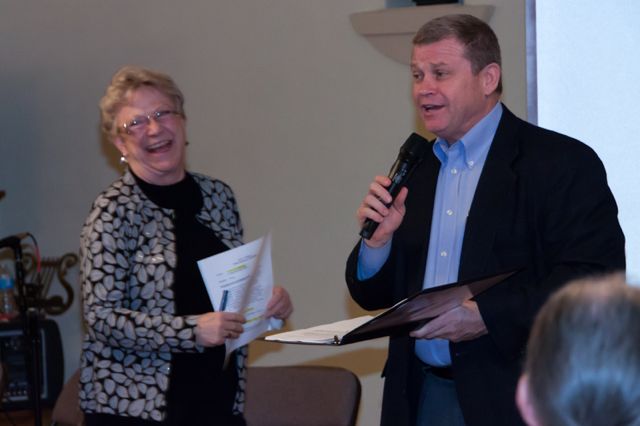
NAMPA, Idaho – It was a cold winter night in Nampa, but more than 75 people filled the Nampa City Hall Council Chambers for an open meeting/public records workshop Jan. 9 led by Idaho Attorney General Lawrence Wasden, along with Deputy Attorney General Brian Kane and IDOG President Betsy Russell.
Attendees ranged from citizens to elected officials, local district secretaries to newspaper reporters, and representatives of the cities of Nampa, Caldwell and Eagle, fire and irrigation districts, school districts, libraries, health districts, the Greater Middleton Parks & Rec Department, the Western Canyon Chronicle, the Messenger Index and more. The Idahoans for Openness in Government seminar was co-sponsored by the Idaho Press-Tribune.

“I learned how to request public records, which will help in my reporting,” wrote a reporter for a small newspaper in her evaluation of the session, adding that she learned, “Tons! This will make doing my job much easier.”

An elected official from a fire district called the session “extremely helpful and totally worth the time to help understand the laws.” Among things he learned that he’ll be able to put to use: “Open meeting laws, executive session rules, and documenting.”

A school board member reported learning, “Subcommittees are supposed to be OPEN,” and noted that is something that will be put to use in the school district.

Another reporter wrote of learning a surprise: “Attorney General Wasden has a sense of humor!” adding that the reporter came away “understanding open meeting laws much better.”

An elected official took away this lesson: “As a government-employed individual, remember everything is public.”

Wrote a citizen: “Every citizen should attend.”

The Nampa session was the 26th IDOG seminar held around the state since they started in 2004; it and the preceding sessions in December in Boise and Payette marked the first time the sessions have returned to the Treasure Valley since 2007.

Just in time for the Nampa seminar and hot off the press were newly updated copies of IDOG’s DVD, “Open Idaho: A User’s Guide to Idaho’s Open Meeting and Public Records Laws.” The DVD, which 35 of the evening’s attendees took home, contains much of the information presented at the seminars; it also includes a version of the interactive skits that audience members helped present at the seminar, presented this time with great flair by actors from the Idaho Shakespeare Festival.

The full content of the “User’s Guide” DVD – plus additional features – is available on IDOG’s website, www.openidaho.org.

The Nampa seminar went late into the evening, due to its 7 p.m. start time. There were lots and lots of questions, but it was all wrapped up by 10 p.m. The later start time for this session was due to legislative activities in Boise the presenters were involved in that day; Kane, for example, was training Idaho’s entire state Legislature on ethics laws for much of the afternoon.

Fortunately for all, a big snowstorm that snarled traffic and made travel conditions hazardous the next morning didn’t hit until long after midnight – well after all session attendees were safe at home.

IDOG’s seminars are funded by a grant from the John S. and James L. Knight Foundation through the National Freedom of Information Coalition. The three Treasure Valley sessions in December and January drew a total of nearly 200 people.

Learning about open meetings, records

From Eye on Boise/The Spokesman-Review


There was an excellent turnout last night in Payette, where more than 35 folks filled the historic Portia Club to learn about Idaho’s open meetings and public records laws at the latest IDOG seminar – that’s Idahoans for Openness in Government. Idaho Attorney General Lawrence Wasden was the featured speaker, along with Assistant Chief Deputy Brian Kane and myself as president of IDOG. Those attending ranged from local government officials to interested citizens to news reporters and editors. They participated in interactive skits to learn how to comply – and how not to comply – with the laws, received handouts including the Attorney General’s manuals on both laws, and had the opportunity to have all their questions answered after detailed presentations from Kane on how the laws work.

Among the questions from the audience: Is this meeting tonight legal under the Open Meeting Law? The answer: Yes, and it’s not a meeting under the law’s definitions – which define a meeting as the “convening of a governing body of a public agency to make a decision or to deliberate toward a decision on any matter.”

More than 60 people attended a similar session in Boise last week; the next one is scheduled for Nampa on Jan. 9th, at 7 p.m. at Nampa City Hall; there’s more info here and here.

From Eye on Boise/The Spokesman-Review

Our View, Dynamis: What is Ada County trying to hide now?

Editorial from the Idaho Statesman

Published: December 11, 2012

Question: Where are public comments not suitable for public viewing? Answer: In the alternative governing world of the Ada County commissioners.

The Statesman filed a public records request for 150 written comments on the controversial Dynamis waste-to-energy plant proposal. We haven’t received the comments, just a letter saying it will cost $110 to provide them.

Why? The county wants its lawyers to sift through the comments and black out any “protected information.”

Who are the lawyers trying to protect? The Ada County residents who finally got their say on this project — nearly 2-1/2 years after Ada County gave Dynamis $2 million in public money to design this plant? Doubtful.

In this case, it appears, the lawyers aren’t working for the taxpayers. Instead, they seem to be doing the bidding of two of their bosses at the courthouse, commissioners Sharon Ullman and Rick Yzaguirre, who have shown disdain for the public and disrespect for the public process throughout this long, sorry Dynamis saga.

Let’s remember, after all, that Ada County residents only got a chance to comment when the planning and zoning commission opted to hold a hearing last month. The hearing wasn’t the commissioners’ idea, so perhaps they’re so out of practice that they’ve forgotten the function of a public process.

Which is, of course, to let the public have a say about this unpopular and unproven plan to “gasify” Ada County landfill garbage into electricity. Ullman and Yzaguirre may be sold on Dynamis — but Ullman lost in the May GOP primary, and public outcry over the proposal was certainly a factor.

Instead of slowing down the process, and allowing a full and transparent review of the project, Yzaguirre and Ullman seem determined to push Dynamis through the bureaucratic pipeline before Ullman’s term ends in January — and before the balance of power shifts on the three-member commission.

So what does the county have to hide? Is there something in these public comments that Yzaguirre and Ullman want to conceal from public view, while they continue to railroad this dubious project? When elected officials squander their credibility, as Yzaguirre and Ullman have, their motives are subject to questions of this type.

There is at least some hope on the horizon.

On Thursday, the Statesman hosted a workshop, led by Attorney General Lawrence Wasden, to brief reporters, elected officials and the public about Idaho sunshine laws. Among those in attendance: commissioner David Case, the courthouse’s one steadfast Dynamis skeptic, and commissioner-elect Jim Tibbs.

Perhaps, when Tibbs joins Case, Ada County will again have a quorum of commissioners who believe the public has a right to know what’s going on in the courthouse.

Now there’s a concept.

“Our View” is the editorial position of the Idaho Statesman. It is an unsigned opinion expressing the consensus of the Statesman’s editorial board. To comment on an editorial or suggest a topic, email editorial@idahostatesman.com.

Editorial from the Idaho Statesman

Judge orders Idaho school district to open records

From the Associated Press

An eastern Idaho judge has ordered the Blackfoot School District to release all documents surrounding a separation agreement and a consulting fee by mid-week.

Sixth District Judge David Nye issued the order Friday afternoon in response to an open records lawsuit filed by former Blackfoot teacher Joyce Bingham and the Post Register in Idaho Falls. Bingham and the newspaper sued after the district refused to make public a separation agreement between the school board and former Superintendent Scott Crane, as well as details of a contract payout worth more than $105,000.

Attempts to reach Blackfoot School Board chairman R. Scott Reese for comment were unsuccessful. The school board announced that it would hold a meeting Monday to discuss an issue related to the case.

The payment and the district’s handling of Crane’s exit have raised questions about who received the $105,428 check that the district made to an unnamed source the day after Crane’s June 30 retirement. When they declined to release the documents, school district officials cited protections in state law for personnel matters.

But in his ruling, Nye rejected that stance.

“Everything about this case smacks of a public agency trying to hide its decision-making from the public,” Nye wrote. “Parties cannot exempt a public record from disclosure and hide it from the public simply by placing it in a personnel file and declaring the personnel file exemption to be applicable to it.”

Bingham said she just wanted the school board to be honest with patrons about the July expenditure of $105,248.

“Ms. Bingham is pleased the judge decided the public has a right to this information,” said Bingham’s Blackfoot attorney, Jared Harris. “I felt the information had to be disclosed, especially with this kind of money.”

Crane started a new job as superintendent for the Grand County School District in Moab, Utah in July.

Crane’s attorney, Justin Oleson, said Crane has no problem with the public knowing the agreement, but he couldn’t reveal it himself because he was bound by a nondisclosure agreement with the board.

Oleson said he was unsure if the judge’s ruling would affect the nondisclosure agreement, and that he needed to discuss matters with Crane before he can make a comment about the agreement.

From the Associated Press

Crowd at Boise seminar learns how laws apply

BOISE, Idaho – More than 60 people attended the IDOG open government seminar held Dec. 6, 2012 at the Idaho Statesman, from school board members to newspaper reporters, journalism students to city and county officials, lawyers to firefighters, high school students to interested citizens.

Idaho Attorney General Lawrence Wasden led the program, which also included Powerpoint presentations from Deputy Attorney General Brian Kane, comments from IDOG President Betsy Russell and Statesman Managing Editor Bill Manny, and interactive skits to help drive all the points home – about how to comply with Idaho’s two key open government laws, the Idaho public records law and the Idaho open meeting law.

“I’m on a few small boards and now understand how the laws apply or don’t,” wrote a citizen volunteer who attended.

“Citizens have more rights to get info from public agencies than I thought,” wrote another in an evaluation of the evening, and another said she learned “how to proceed if I’m denied access.”

A reporter dubbed the session “solid information” and particularly appreciated learning about deadlines for responding to records requests. A college student newspaper staffer wrote that she appreciated learning about her rights as a journalist.

“Be aware of the statutes!” wrote a retired public official, who said that was his take-away from the evening.

Another participant, who also gave high ratings to the evening’s refreshments, said the lesson he learned was, “Consider that everything is public. Keep yourself covered.”

Commented a district fire chief, “We were here to assure our compliance.” He said he particularly appreciated the handouts, and definitely learned things he can put to use right away in his agency.

The IDOG seminar was co-sponsored by the Idaho Statesman and Boise State Public Radio, and recommended by the Office of the Attorney General, the Association of Idaho Cities, the Idaho Association of Counties, and the Idaho Press Club. The seminars are supported by a grant from the John S. and James L. Knight Foundation through the National Freedom of Information Coalition.

IDOG, which stands for Idahoans for Openness in Government, is a non-profit coalition for open government whose mission is to promote open government and freedom of information. IDOG and Attorney General Wasden have been holding these sessions around the state since 2004; this was the first time they returned to the Treasure Valley since 2007. After the Boise seminar, additional sessions were set for Payette on Dec. 12, and in Nampa on Jan. 9, 2013.

Supreme Court Must Be a Defender of Public Records

Editorial from the Twin Falls Times

Effective July 1, the Idaho Supreme Court adopted a new court rule that seals an entire class of public records in the name of protecting children. On the surface, who could argue with that?

Recent changes to Idaho Court Administrative Rule (“ICAR”) 32 exempt from public disclosure all court cases involving child custody, child support and paternity.

Good intentions aside, the rule change is written with broad enough brush strokes to be dangerous. It’s time for the Idaho Supreme Court to revisit and reject the rule change.

One of the more important tenets of our society is an open government. Want to know what pollutants exist in your tap water? The city is obligated to tell you. Imagine if that weren’t the case, if someone could keep important information from you.

A new Idaho court rule threatens to do just that. It presumes to seal an entire classification of court cases from the public eye.

The rule, Idaho Court Administrative Rule 32(a), was implemented with good intention, namely to protect children. It orders all child custody, child support and paternity cases automatically sealed, meaning you would have to convince a judge before you could access them. That’s unnecessary. Court rules already require that Social Security numbers, financial accounts and names of minors be redacted from the record, essentially rendering ICAR 32(a) moot.

Then why implement the rule? One reason given was that court clerks complained the redactions were making them work more. Our sympathies, but they were hired to be stewards of our records, not the gatekeepers. We’re sure a little extra effort to protect minors is worth it.

The potential pitfalls of sealing records are many. For starters, judges could act with impunity. Without oversight from the community, judges would be free to act as they please in all cases concerning a child’s well-being.

The rule, to date, has been poorly executed. Already it has been used to seal away divorce records where the couple has children. That may seem like a private matter, but let’s say someone owes you money. If that person were to receive a large divorce settlement, but has a child, you would have no way of knowing without going before a judge.

In a letter of protest to the Idaho Supreme Court dated Nov. 16, 2012, Debora K. Kristensen and Betsy Z. Russell wrote, “Problems already are surfacing around the state with reporters and members of the public being denied access to files in cases that previously were open. … Since the enactment of this law, the provisions of ICAR 32 have been erroneously applied to cases filed before the rule’s effective date and to cases not even in the categories mentioned in the rule. For example, in a Kootenai County civil case filed over management of a trust fund for crime survivor Shasta Groene, Steve Groene vs. Brandy Hoagland, Judge Lansing Haynes told a reporter the case was sealed entirely for a month under the new rule while it was gone through for redaction (it later was unsealed with redactions). The rule has caused confusion and denials of public records throughout our state.”

ICAR 32(a) is a dramatic shift for Idaho. Rather than being custodians of our legal records, the rule change turns judges and clerks into jailors, allowing us to visit our locked-up records only when they see fit. We encourage the Idaho Supreme Court to reconsider the rule, to welcome oversight of court decisions. We encourage them to do everything they can to ensure an open government.

Editorial from the Twin Falls Times

Seminars explain public records, meeting laws

From the Idaho Press-Tribune

Seminars this month and in January will part the veil over the Idaho Open Meeting Law and the Idaho Public Records Law.

Presenters will include Idaho Attorney General Lawrence Wasden, Deputy Attorney General Brian Kane and Idahoans for Openness in Government (IDOG) President Betsy Russell. Government employees, members of the media and interested citizens are all invited. To attend the free seminars, please R.S.V.P. at least two days in advance of the seminar. For Boise, R.S.V.P. to Bill Manny at bmanny@idahostatesman.com. For Payette or Nampa, R.S.V.P. to Vickie Holbrook at vholbrook@idahopress.com or 870-2782.

From the Idaho Press-Tribune

Judge scolds attorney in records case

From the Idaho Falls Post Register

By Nate Sunderland

BLACKFOOT — A judge chided Blackfoot School District 55 and attorney Dale Storer on Friday for failing to provide him with documents about a $105,428 contract payment and an agreement with former Superintendent Scott Crane.

“I have never had this kind of a public records case before where prior to the hearing I haven’t at least received a sealed envelope with the documents in it,” Sixth District Judge David Nye said. “How come I don’t have them?”

Storer didn’t answer Nye’s question directly.

Instead, the former Idaho Falls city attorney said he would hand over the documents following the late-afternoon hearing.

“I would have appreciated you giving them to me earlier so I could have ruled today, but that’s going to be tough to do because I haven’t seen the documents,” Nye said.

As a result, Nye said his decision would be delayed — possibly for several weeks.

Storer declined comment after the Friday hearing.

The case centers on the contract payment District 55 made to an unnamed individual July 2.

Former Blackfoot school teacher Joyce Bingham sued the school district to force disclosure of the unnamed individual. The Post Register joined in the legal action.

Details of the separation agreement with Crane, apparently reached during the school board’s April 24 executive session, also are sought. Crane announced his retirement after that meeting, effective June 30.

Bingham’s attorney, Jared Harris, and the Post Register are seeking documents related to the payment, as well as the agreement with Crane.

Both parties are acting on the assumption that the issues are related.

District 55 has refused to release any documents pertaining to the payment or the Crane agreement.

During the Friday hearing, Harris and attorney Steve Wright, representing the Post Register, argued that the documents because “clearly fall under the purview of public records.” They also questioned the agreement with Crane.

“These documents are presumed open to the public for a very good reason, imagine what could transpire if this kind of conduct (during an executive session) can be permitted,” Wright said. “Hypothetically … two board members could execute an agreement behind closed doors … approve it, hide the payment for it and the public would never know.

“That is not appropriate conduct.”

Storer countered that the documents are protected by Idaho law governing personnel matters. Once the judge reviewed the documents, Storer said, it would be clear that the documents sought are protected “personnel records” and not available for public review.

Some new information did come out during the hearing, however.

Storer said the agreement with Crane was to “wrap up various matters of his employment,” and not to hire Crane to do work for the district.

That contradicts the board meeting minutes, which stated that board members convened the 8-minute executive session for the purpose of hiring an employee. The minutes then state that the board reached an agreement with Crane.

“The purpose of the meeting was not to hire Crane because he was already an employee,” Storer said. “There were other discussions about the hiring of an employee.”

When Nye questioned why those discussions were not mentioned in the minutes, Storer repeated that hiring Crane was not the purpose of the meeting.

Nate Sunderland can be reached at 542-6763.

From the Idaho Falls Post Register

Attorney General Wasden hits the road to advance transparency

From the Idaho Statesman

Idaho got a shout-out Thursday at a meeting of the nation’s attorneys general about a cooperative effort to make government more accessible and accountable.

Attorney General Lawrence Wasden touted the efforts of IDOG — Idahoans for Openness in Government — as a model for transparency.

“One of the great strengths of our political system is that people are involved,” Wasden said Thursday after his talk on open records and open meetings. “But the only way it is meaningful is if they have an understanding of how their government operates. They have to have access to this information and they have to be able to be at these meetings.”

It’s one thing to advise colleagues in National Association of Attorneys General in balmy Ft. Lauderdale, Fla.

It’s quite another to commit to helping IDOG put on annual seminars, which Wasden has done since IDOG’s founding in 2004.

On Thursday, Wasden will be here at the Idaho Statesman from 6:30 to 9 p.m., schooling reporters, public officials and ordinary citizens about the public’s rights. Two more meetings follow, Dec. 12 in Payette and Jan. 9 in Nampa.

Wasden is Idaho’s longest-serving attorney general, at 10 years. He says he plans to run for a fourth four-year term in 2014, though the ember of his boyhood dream to represent Idaho in the U.S. Senate still burns.

“If the opportunity availed itself, I would be very interested,” Wasden said. “And I’m not going to cut out anything else, either. I don’t know where we’re going to end up down the road.”

Partnering with the Idaho Press Club, the Association of Idaho Cities and Idaho Association of Counties doesn’t hurt Wasden’s prospects. After squeaking by in a four-way GOP primary by 2,000 votes in 2002, Wasden has had an easier time. He won the 2002 general election with 58 percent of the vote; carried 62 percent in 2006; and was unopposed in 2010.

Having covered Wasden since his time as chief of staff to Attorney General Al Lance, I think it’s fair to say he’s not just cozying up to the media and local officials.

He takes seriously his duty to be the people’s lawyer. That’s meant prosecuting errant public officials, pressing for release of records, tangling with an ex-governor over toughening campaign finance disclosures, and fighting his GOP colleagues to boost income from state endowments.

An English minor in college, he says his favorite American novels are “Grapes of Wrath” and “To Kill a Mockingbird.”

“There is a connection,” Wasden said. “They bring to the forefront the common man, what government is supposed to do and how we’re supposed to interact. It’s incumbent on leaders to see that that happens.”

For Wasden, educating local officials, reporters and the public is a core duty.

“To be honest, sometimes local officials just didn’t want to release the records,” Wasden said. “We had to improve their knowledge level.”

Meanwhile, reporters can be too aggressive and confuse records laws in other states or the federal Freedom of Information Act with Idaho law.

“What we tell reporters is if you just talk to people, they’ll give you the stuff,” Wasden said. “With the local officials, we say this is public, you oughta give it to them. And with the public, we’re saying that sometimes what you think the law says isn’t necessarily so.”

Explaining the limits of the laws is a big part of the seminars, coupled with Wasden’s print and online publication of open meeting and public records manuals.

“There is a sheet of music from which we all have to sing,” Wasden said. “We get the press and local government and the public at large together in one room and we get one answer to the question.”

From the Idaho Statesman

Since when did driving become a state secret?

Editorial from the Lewiston Tribune

By Marty Trillhaase

It’s not so much the Idaho Transportation Department – and every transportation outfit in the other 49 states – is selling off information it gleans from driver’s licenses and vehicle registrations.

It’s not even that ITD makes about $5.4 million – most of which is net profit – although there is something unseemly about the government using public data as a business model.

What ought to have you steamed is this notion that erstwhile public documents – a driver’s license and automobile registration – are off-limits to ordinary citizens and even most businesses.

For that, you can thank Congress. Almost 20 years ago, it declared that only a handful of privileged groups could obtain driver’s licenses and vehicle registrations.??If you’re a data collection outfit that helps automobile manufacturers locate owners of cars during a product recall, fine.

If you’re an insurance company looking to verify that a policy holder owns the car in question and is licensed to drive, go ahead.

Same goes if you’re engaged in labor market research and you want
to compare the relative youth of a region’s work force.

But if you are trying to sell parts to everyone who drives a Corvette or accessories to Jeep owners, forget it.

If you are simply curious about who was driving a car in your neighborhood last week, you’re also out of luck.??It’s been decades since Idaho naively listed anyone’s Social Security number on a driver’s license. So what’s the big deal? Is the listing of your address, your age, a physical description or the kind of car you drive any more sensitive than:

  • The number of times you’ve been married and divorced – and to whom?
  • The house you own, where it’s located, what it’s worth and how much you pay in property taxes?
  • The last time you skipped an election?
  • Whether you’re registered as a Republican or a Democrat? (That’s on file because Idaho’s lawmakers closed the state primary election to non-registered voters at the GOP’s insistence.)
  • Which candidates for political office you’ve helped with a check?
  • Anytime you signed a petition to recall an elected official, repeal a law or pass a new one?
  • Whether you have a lead foot?

That’s not government invading your privacy. That’s the individual entering the public arena – a wedding, the filing of a deed, participating in the political process or getting a speeding ticket – and creating a public document in the process.

To say nothing of the information you give away to for-profit businesses. Your magazine subscriptions. Where you shop and what
you buy. Much of that information ends up on a list.

Truly private stuff remains private. Your income tax return is confidential. So is your banking information. As well as any health history.

But in this Internet age, a few keystrokes will kick loose a passel of facts on people – to say nothing of the information they volunteer on Facebook.

Getting a driver’s license is a public act. We live in an open society where what the government does is subject to public inspection – whether it’s a company looking to make a profit or an individual who wants to satisfy his curiosity.

Whatever the fallout – and it’s usually nothing more serious than getting more junk in the mail – it certainly beats the alternative where every public document is treated as a state secret. – M.T

Editorial from the Lewiston Tribune