Learning the ins and outs of Idaho’s open meeting law

From Eye on Boise/The Spokesman-Review

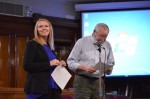
Moscow’s historic, wood-paneled City Council chambers was the scene of some hilarity last night, as City Councilman Walter Steed, left, played the part of a lucky reporter overhearing his local county commissioners illegally conducting public business over breakfast at a local café – while Latah County Prosecutor Bill Thompson, second from right, played the county commission chairman, throwing in some zingers at Steed while he was at it. The skit was part of a workshop on Idaho’s open meeting and public records laws that drew nearly 30 people last night; additional sessions are set tonight in Coeur d’Alene and Thursday afternoon in Sandpoint.

In the skit, the fictional county commissioners ended up with $500 apiece fines for knowingly violating the Idaho Open meeting Law. “An important note with the penalties,” Deputy Idaho Attorney General Brian Kane told the crowd, “Those are to you as a person, meaning that your government entity doesn’t pick up the tab for you violating the open meeting law.”

Idaho Attorney General Lawrence Wasden was the lead presenter at the workshop, sponsored by Idahoans for Openness in Government and co-sponsored by the Moscow-Pullman Daily News. Wasden said all sides need to understand what the rules are. Lee Rozen, Daily News managing editor, said, “These laws are often misunderstood in the details and in the intent – either by the public, by the press, by government staff and by elected officials.” That’s why all those groups are invited to the IDOG sessions.

There’s more info here about IDOG and the workshops, which Wasden and the group have been holding around the state since 2004; the Moscow session was the 31st.

From Eye on Boise/The Spokesman-Review

Moscow workshop: ‘It’s the public’s business’

Moscow, Idaho’s historic, wood-paneled City Council chambers was the scene of some hilarity on Tuesday night, Dec. 9, 2014, as City Councilman Walter Steed played the part of a lucky reporter overhearing his local county commissioners illegally conducting public business over breakfast at a local café – while Latah County Prosecutor Bill Thompson played the county commission chairman, throwing in some zingers at Steed while he was at it. The skit was part of a workshop on Idaho’s open meeting and public records laws that drew nearly 30 people, ranging from local elected officials to reporters, records clerks, lawyers, civic volunteers and interested citizens.

In the skit, the fictional county commissioners ended up with $500 apiece fines for knowingly violating the Idaho Open meeting Law. “An important note with the penalties,” Deputy Idaho Attorney General Brian Kane told the crowd, “Those are to you as a person, meaning that your government entity doesn’t pick up the tab for you violating the open meeting law.”

Idaho Attorney General Lawrence Wasden was the lead presenter at the workshop, sponsored by Idahoans for Openness in Government and co-sponsored by the Moscow-Pullman Daily News. Wasden said all sides need to understand what the rules are. Lee Rozen, Daily News managing editor, said, “These laws are often misunderstood in the details and in the intent – either by the public, by the press, by government staff and by elected officials.” That’s why all those groups are invited to the IDOG sessions.

Moscow’s session was the 31st that IDOG and Wasden have presented around the state since 2004, visiting all parts of the state on a three-year cycle; the sessions last came to North Idaho in 2011.

Attendees in Moscow gave the session high marks. “Should have done this 12 years ago,” commented an elected official. “Good material.”

“Thanks for doing this,” wrote a member of a state commission. She said she learned something she’ll put to use right away: “How to handle executive sessions.”

A government employee said he came away with a “much better sense of what I need to pay attention to in my job.”

A local attorney offered this as the takeaway: “Proceed cautiously – serve the public.” Wrote another attendee, “As a newly elected legislator, a great overview of the process as well as explanation of the history and background for the open meeting and public records laws.”

Wrote a reporter: “It is the public’s business.”

The IDOG sessions are funded in part by a grant from the John S. and James L. Knight Foundation through the National Freedom of Information Coalition.

Crowd turns out for open government workshop in Lewiston

From Eye on Boise/The Spokesman-Review

More than 45 people gathered at Lewis-Clark State College in Lewiston last night for the first of four open-government workshops in North Idaho this week featuring Idaho Attorney General Lawrence Wasden. The free sessions, sponsored by Idahoans for Openness in Government, or IDOG (full disclosure – I’m IDOG’s president), cover how to comply with Idaho’s two key open government laws, the Idaho Open Meeting Law and the Idaho Public Records Act, and are for local and state government officials and employees, reporters, editors and photographers from all media, and interested citizens.

Monday night’s session, co-sponsored by the Lewiston Tribune included interactive skits in which audience members took on roles, including the one pictured above, in which Doug Bauer of the Tribune portrayed a county prosecutor and Jaynie Bentz of the Port of Lewiston a county commissioner, helping illustrate the do’s and don’ts and generating laughs along the way. Lewiston Tribune Publisher Butch Alford, at left, guaranteed the session would be worth the price of admission, or he’d refund double the price.

Among the issues that came up during the session: Chief Deputy Attorney General Brian Kane noted that members of public boards shouldn’t be texting one another during meetings. “We’ve actually had cases of folks texting during a meeting and not having the discussion,” he said. “If you’re texting during the meeting, you’re robbing the public of the purpose of the Open Meeting Law.” Plus, he noted, those texts become public records and the public’s entitled to see them.

He also emphasized a line in the Open Meeting Law that says the “mere presence of legal counsel” does not justify a closed executive session; the law requires more than that. “The corollary to that is folks will send an email and copy it to their attorney, and claim it’s attorney-client privilege” to evade the public records law, Kane said. “It doesn’t work that way.”

When an audience member asked where notice should be posted if a board meeting is held at a board member’s home, the answer was: That’s not advised. A public meeting means anyone can come in, even to that home. But if that’s the place, notice must be posted somewhere prominent, like on the front door or the mailbox out front.

Additional IDOG workshops will be held tonight in Moscow; Wednesday night in Coeur d’Alene; and Thursday afternoon in Sandpoint. There are details here on locations, times and how to RSVP.

From Eye on Boise/The Spokesman-Review

Yes, we can cooperate for the public good

Editorial from the Coeur d’Alene Press

Those of us in the news media often think public officials are clueless or worse when it comes to open meeting and public record laws.

Some of those public officials have a pretty good idea what they’d like us media lunkheads to do with our opinions about their diligence.

Outside of a courtroom or a dark alley, how do the two sides settle their differences so the laws are obeyed, the citizens have government information they’re entitled to, and the media and public official camps can work respectfully with each other?

Betsy Russell and Lawrence Wasden have your answer. And it will all be revealed this Wednesday evening at 6 at the Best Western Plus Coeur d’Alene Inn.

Going back several years, Russell, the Boise-based star reporter for the Spokesman-Review, and Wasden, Idaho’s esteemed attorney general, devised a great way to increase understanding of the state’s public records and open meeting laws, while magically improving mutual respect and even compassion at the same time. How? Through skits, of course.

Through engaging role-playing and other devious methods, journalists and public officials will see how the public records/open meetings world looks from the other side’s perspective. It’s not just enlightening; it’s entertaining.

Invitations went to Kootenai County-area public officials already, but we’re reminding them to please RSVP right away to Camie Wereley if they can attend. Also, though space is limited, there will be some room for members of the general public also to attend. If you’re interested, please RSVP to cwereley@cdapress.com, or leave a message at 664-8176, ext. 2016.

Thanks go to AG Wasden, a good sport if ever there was one; to Betsy Russell, who also serves as president of Idahoans for Openness in Government; and to Jerry Jaeger, JJ Jaeger and the crew at Coeur d’Alene Inn, who were kind enough to donate the banquet room for the evening.

Editorial from the Coeur d’Alene Press

Four IDOG seminars set for December

The public is invited to attend any of four upcoming free seminars on Idaho’s key open government laws, the Idaho Open Meeting Law and the Idaho Public Records Law, Dec. 8-11 in North Idaho, led by Idaho Attorney General Lawrence Wasden.

It’s a chance to learn what is covered – and what is not – by these important laws, in a fun and accessible format. Presenters in addition to Wasden will include Deputy Attorney General Brian Kane and IDOG President Betsy Russell. Government agency employees, public officials, reporters from all media, and interested citizens all are invited.

These sessions are recommended by the Office of the Attorney General, the Association of Idaho Cities, the Idaho Association of Counties and the Idaho Press Club. The sessions are free and include refreshments; because space is limited, attendees are asked to RSVP.

Here are the locations and RSVP information:

  • MON. Dec. 8 – LEWISTON: Lewis-Clark State College, Room SAC 112, 6-9:30 pm. Co-sponsored by the Lewiston Tribune. RSVP to Butch Alford, (208) 848-2250 or alajr@lmtribune.com


  • TUES. Dec. 9 – MOSCOW: Moscow City Hall, Council Chambers, 6-9:30 pm. Co-sponsored by the Moscow-Pullman Daily News. RSVP to Lee Rozen, 882-5561 ext. 4638, or lrozen@dnews.com


  • WED. Dec. 10 – COEUR D’ALENE: Coeur d’Alene Inn, 506 W. Appleway Ave., 6-9:30 pm. Co-sponsored by the Coeur d’Alene Press and The Spokesman-Review. RSVP to Camie Wereley, 664-8176, ext. 2016 or cwereley@cdapress.com


  • THURS. Dec. 11 – SANDPOINT: Sandpoint Library, Community Room, 1407 Cedar St., 3-6:30 pm. Co-sponsored by the Bonner County Daily Bee. RSVP to Caroline Lobsinger, 263-9534 ext. 259, or clobsinger@bonnercountydailybee.com


IDOG and Wasden have been holding these sessions around the state since 2004; most recently, seminars were held last fall in eastern Idaho, the Wood River Valley and the Magic Valley. They are funded in part by a grant from the John S. and James L. Knight Foundation through the National Freedom of Information Coalition.

Consider joining us, and please don’t forget to RSVP!

Revealed: St. Luke’s hospital antitrust trial documents made public

From the Idaho Statesman

Hours of court testimony that took place behind closed doors a year ago are now open to the public.

The documents describe, among other things, emails in which local hospital executives talk about a “monopoly model.”

A group of news organizations, led by the Idaho Statesman, sued last year to get access to court proceedings and exhibits from the trial, which is now before a federal appeals court.

The trial pitted St. Luke’s Health System against its main competitor — Saint Alphonsus Health System — and the federal and state governments, who accused St. Luke’s of violating antitrust laws when it bought Nampa’s Saltzer Medical Group, creating a near-monopoly over primary care in Nampa.

U.S. District Judge B. Lynn Winmill ruled against St. Luke’s and ordered it to divest Saltzer. His ruling is now before a federal appeals court.

THE ‘M’ WORD

Among other things, the documents show lawyers questioning St. Luke’s executives Randall Billings and Geoffrey Swanson about emails they exchanged in 2011.

From the Swanson deposition:

Q: Further down, “No. 3. Scenario Planning,” reads, “A monopoly model.” What is that in reference to?
A: I don’t know.
Q: And below that, romanette number 4, “FTC risk”? Do you have an understanding of what that means?
A: I’m not sure if that has enough context for me to understand what that might mean or what we were talking about at that particular point in time.

Billings in his deposition tells lawyers he does not remember the email or know of any conversations about a “monopoly” at St. Luke’s.

During the trial, lawyers vaguely referenced an “M word” document while the courtroom was open to the public.

MORE BECOMES PUBLIC

Reporters and the public, including hospital employees, were ushered out of the courtroom for long segments of the trial and weren’t allowed to see or hear much of the evidence.

District Judge B. Lynn Winmill said he wanted to protect trade secrets and signed off on the closed-door testimony and sealed documents. He later heard arguments from the news organizations, then agreed to review each piece of the trial that had been kept from the public.

He ordered everyone involved in the lawsuit to release documents months ago. The release has been delayed as businesses asked Winmill to reconsider small parts of his order.

The Idaho Attorney General’s Office filed the documents into the federal court record this week, after the news organizations pushed once more for access.

“We take openness and transparency in government and the courts seriously, and we’re pleased to help make available for public consumption the transcripts and testimony from this important case,” said Todd Dvorak, spokesman for Idaho Attorney General Lawrence Wasden.

From the Idaho Statesman

Prosecutor: No meeting law violations

From the Coeur d’Alene Press

COEUR d’ALENE – Kootenai County Prosecutor Barry McHugh determined the Mica Kidd Island Fire District commissioners didn’t violate open meeting law when they conducted an executive session this summer.

Commission President Chris Shelton said Friday that the district’s elected board does the best it can with the resources and staff it has available. Shelton is facing a recall election in a few days. Another fire district commissioner, Larry Mundt, didn’t respond to a request for comment.

“I have made every effort to make sure that we’re complying with any applicable law related to open-meeting law and Idaho code,” Shelton said.

Fire district resident James King alleged that Shelton in particular was responsible for not following the law in calling for an executive session which took place on July 25.

King said in an emailed statement to The Press that he “firmly” stands by his assertion that there was never a valid open meeting, regular or special, from which the executive session was conducted.

“I challenge Mr. McHugh and (the fire district) to provide the actual documents, in accordance with the Idaho open meeting laws, that demonstrate there was a regular or special meeting noticed, held, and recorded in the minutes, from which this executive session was held,” King wrote.

King alleged that an executive session can only be “motioned for” during a regular or special meeting.

McHugh addressed the allegations Friday in a letter to King.

“I do not see anything that would indicate that the public was excluded from the portions of the meeting before or after the executive session was held,” McHugh wrote.

King also alleged that an email exchange is not an appropriate means of calling an executive session and taking a roll call vote.

“I agree with you that the roll call vote must take place in an open meeting, and cannot come about through email communication outside of a meeting, but find that the roll call vote to enter into executive session occurred during the meeting on July 25th as reflected in the minutes,” McHugh wrote.

King also alleged that proper notice was not posted on the door of the district’s firehouse.

“Our affirmative duty would be to prove that no posting occurred, and we cannot prove that with the evidence I have reviewed,” McHugh wrote.

Finally, King accused the commissioners of conducting fire district business following the executive session, again in violation of open meeting law.

“An investigation of what was discussed revealed that the discussion that took place after the executive session didn’t involve issues pending before the commissioners,” McHugh wrote. “Rather, the discussion was about existing friction between the commissioners and some members of the public, and other non-(district) matters.”

The recall against Shelton involves, in part, the allegation of an illegal executive session. Community members also say he has lost touch with residents’ “desires and wishes,” and they complained about a fee schedule that was developed to charge people for services provided by the fire district.

From the Coeur d’Alene Press

Open public records key to limiting government

Editorial from The Spokesman-Review

Idaho typically elects conservative officeholders with skeptical views of government and then allows them to lower the blinds on public information.

One would think voters would want the government closest to them to be the most open, but that’s not how it works in the Gem State.

Last spring, Gov. Butch Otter named an ombudsman for public records so more transparency and accountability would be brought into the process. After four months on the job, Cally Younger has some ideas for improvement, but she will need the Legislature’s help with statutory changes. It would help if the public pushed for reforms, too.

The Idaho Statesman published a package of articles last Sunday in which Younger discusses what she’s learned and what actions might be needed.

For starters, her office needs a broader mandate and an enforcement mechanism. She has jurisdiction over state agencies only, which puts school boards, law enforcement agencies, city councils, county commissions and other local entities out of reach. Plus, enforcement of the state’s public records law is weak. Neither the attorney general’s office nor the ombudsman can compel compliance. It is solely up to citizens to make sure agencies are following the law, and that means hiring legal counsel and taking the matter to court – a step many people can’t afford.

Other states offer less onerous avenues of dispute resolution. Utah has an admirable setup: a public records commission made up of people from the public and private sectors. It settles disagreements and can enforce its findings.

Although imperfectly realized, a voter-approved initiative in Washington public records law states the goal nicely: “The people insist on remaining informed so that they may maintain control over the instruments that they have created.”

But keeping tabs on Idaho agencies can be a chore because of the welter of exemptions and inconsistent policies. The state tells local governments what records they must retain and for how long, but the law doesn’t do the same for state agencies. For instance, the governor’s office lets each employee decide how long to keep emails, while the Department of Correction has a blanket six-month rule. So a request that involves both agencies is up against different rules.

To say the least, this isn’t customer-friendly. It certainly violates the spirit of open government.

Younger says she is surveying agencies to pinpoint irregularities so she can formulate reforms to take to the Legislature. Otter deserves credit for creating a position that embraces the perspective of record requesters, but the state has a long way to go.

Lawmakers can show they embrace open government by giving the ombudsman leverage over all public institutions – not just the state-level ones – and a way to compel compliance. This will give the office the stature it needs to push for other needed changes.

Conservative lawmakers say government can’t be trusted. Let’s see if they help raise the blinds.

Editorial from The Spokesman-Review

Idaho ombudsman needs to take charge

Editorial from the Idaho Statesman

In Idaho and the Treasure Valley there is no shortage of public information officers, public affairs officers, communications directors and specialists.

There are more combinations of these words – and we didn’t even mention the platoons of lawyers who pore over information requests. Dozens and dozens of people throughout the state are paid millions of dollars collectively to broker and serve as information conduits to media and citizens. The proliferation of this class of public employee would lead one to expect the utmost transparency and access to public information, right?

Well, that’s not always the case, as the package of stories published Sunday by the Statesman’s Cynthia Sewell made clear. Though we all welcomed Gov. Butch Otter’s appointment of an ombudsman at the state level earlier this year – and we can note progress amid disappointments – there is room for improvement in providing access to the public and the media when it comes to getting records and information which, with few exceptions, citizens have a right to obtain on demand.

Though Idaho has a public records law, Otter’s ombudsman, Cally Younger, does not have jurisdiction or sway over all levels of government in the state.

Too often the default for the media and the public to obtain information has to pass through a tunnel of litigation or face a gantlet of gates and variable processes and costs to obtain records. That doesn’t seem to square with the transparency that all of these Idahoans running for office in November seem to embrace.

Rather than dwell on what’s wrong with the system, one set of rules and hoops should apply to all state, county, local and school district information requests – with an independent ombudsman’s office providing oversight.

How do we get there? By focusing on best practices used in certain corners of Idaho state government, and by adopting a structure similar to Utah, which follows the Government Records Access and Management Act.

The Idaho Legislature would have to give authority over all levels of government to its state ombudsman’s office. But that burden could be lessened if more Idaho agencies adopted practices already being used at places like the Idaho Department of Environmental Quality and the State Controller’s Office.

DEQ’s streamlined policies make accessing records easy. The Controller’s Office offers transparent.idaho.gov for anyone interested in information on such things as the state workforce, expenditures, the budget and other financial reports.

Other things that need fixing include uniform pricing for attaining information and adopting consistent procedures for record retention. Some agencies hold on to supporting records, such as emails, longer than others.

All new transparency initiatives must respect privacy issues. Idaho can do that while empowering an ombudsman to establish organizational norms and responsibility.

Editorial from the Idaho Statesman

Idaho’s public records process reviewed

otterFrom the Idaho Statesman

Four months as Idaho’s public records ombudsman has taught Cally Younger that more work needs to be done to clarify and strengthen Idaho’s public records process.

Q&A WITH THE OMBUDSMAN

What’s been your biggest surprise? What didn’t you know before you started that you wished you had?

I wasn’t really sure what to expect at all when I started, but I think I was most surprised at how interested the public was in the creation of the new position and office. I’ve had a lot of time to learn and get familiar with Idaho’s public records law since we created the position, so I don’t think there’s anything I wished I’d known before starting.

What don’t people know about Idaho public records they should know?

The Idaho Public Records Act is different than the Freedom of Information Act. FOIA requests are made to federal agencies. So when people reference FOIA to apply to a state agency they are referencing the wrong law. The applicable code is the Idaho Public Records Act. Also, some people have confused this act with articles of the state constitution. There is no provision governing public records in the state constitution.

What should public officials know that they don’t?

Public officials can be proactive by making commonly requested public information available on their website. This can help the agency cut down on duplicative requests and also save taxpayers money, because it takes staff time to research, retrieve, copy and provide that information.

What is the most common request you get?

Most of the requests I get vary greatly. Requests to review denials generally involve a similar theme – individuals seeking public records pertaining to issues that have personally affected them, their loved ones or their employment. In contrast, the public records requests we receive in this office are usually broader in scope.

Based on your experience, what do you think is the best way to handle local public records conflicts? Do you think it’s realistic that counties and cities will adopt the same model? Is there a statewide approach Idaho needs to be looking at?

I think it depends on the volume of requests that a particular agency or local governing body receives. My goal this year is to update the public records request process. I strongly encourage counties and cities to follow the state’s example to the extent practicable. We certainly don’t want to dictate how they should proceed. … We’d definitely want to see more accountability in responding to public record requests at all levels of government, and I think updating the process is an important part of that.

Have you identified or implemented any changes in the way the governor’s office and other offices under its authority process public records requests and retain public records?

Yes. We are currently working on making it easier to make public records requests to our office. Soon, the public will be able to make public records requests straight from our website. There will also be a few technology updates internally that will make it easier to complete records requests. DEQ (Department of Environmental Quality) receives roughly 100 requests a year and they’ve really streamlined their system, so despite the volume of the requests they receive, they still respond to nearly every request in three days. My goal is to have all state agencies implement something similar. For some, it won’t be practical due to too few requests, but for agencies that receive lots of requests, it could make a huge difference.

In some states, the public records ombudsman assists all state agencies. Do you think Idaho could benefit from having a statewide ombudsman?

I think I could definitely be a resource to state agencies as they encounter new issues with requests.

In April, David Hensley, the governor’s chief of staff, told Jeremy Pisca of the Newspaper Association of Idaho that he would “commit to working with you on legislation for the next session to codify a review process for state agencies and local governments prior to and/or in lieu of litigation.” Is the governor’s office still committed to introducing this legislation in the next session?

Yes. We actually had our first meeting last month to talk about our goals for this session. I am hopeful that we can add that review process and also clear up some ambiguities in the law.

Are you considering any legislation to clarify or strengthen Idaho’s public records laws?

Yes, particularly after the confusion our office encountered recently about what types of records in our office are actually public. For instance, our office was recently criticized for not releasing records (the applications for a State Board of Education appointment) some in the media assumed were public, when in fact they contained personal information that we legally weren’t allowed to disclose. So balancing the public’s right to know with an individual’s right to privacy is where we probably need to focus next.

More than 20 State Board of Education applications were destroyed. Have any changes been made in policy or procedure following that?

Yes and no. The request for the applications allowed us to go back and look at what the relevant statutes actually said. Our internal policy for all board positions was to keep applications only until that candidate was eliminated from consideration. Idaho Code 9-340C actually says that personal information, including applications, cannot be released without written consent of the applicant. Further, that statute only requires that we release the names of the top five finalists for each board position. So despite some media reports to the contrary, we actually went above and beyond what the law required. We released that additional information because of our commitment to transparency.

We also made this clearer on our website in our notice to potential applicants, so that they will know their personal information is safe and will not be kept in our office any longer than required by code. So while our office strives to be as transparent as possible … we have to balance that desire with protecting personal information of private citizens.

UTAH’S OMBUDSMAN PROGRAM

Utah is one of several states with a public records ombudsman. But unlike Idaho, which has litigation as the remedy for disputes over public records, Utah has a state records committee that hears appeals.

The Legislature created the position in 2012 to help the public and government employees understand and comply with the law.

The program has one employee: Rosemary Cundiff, who is appointed by the state archivist.

During the 2012-2013 fiscal year, Cundiff provided 1,100 consultations. Of these, 585 were queries from the public and 515 were queries from government entities.

Since Cundiff began mediating disputes, the number of appeals heard by the Utah records committee has decreased from 26 in 2012 to four in the first six months of 2013, according to the ombudsman’s most recent annual report.

Cundiff is compiling her 2013-14 report. She said the number of consultations increased to about 1,600, a 45 percent increase over the program’s first year.

“If being busy is a measure, it was a good idea,” Cundiff said.

The state is now working on creating an online portal for filing public records requests. The Legislature funded the effort, which includes all state agencies. Eventually it could be expanded to include all local governments as well, Cundiff said.

Cynthia Sewell

Cynthia, a Statesman reporter since 2005, has been named reporter of the year by the Idaho Press Club, largely for her watchdog reporting. She’s a graduate of Capital High School and the University of Oregon. Her family has lived in Idaho since the late 1800s.

Most of her time is spent answering questions by phone – she’s received just two written complaints – and trying to figure out what needs to happen to the state’s public records law to make it work better. She’s surveying state agencies and meeting with stakeholders in advance of the 2015 Legislature, and recommending potential changes to her boss, Gov. Butch Otter.

She’s found examples of what works really well, such as the Idaho Department of Environmental Quality’s streamlined process. But she’s also found shortcomings, such as vague statutes and a lack of modernization and enforcement.

Citizens are supposed to have unfettered access to the records of public agencies in Idaho, but the reality is that navigating exemption rules, privacy laws, retention guidelines and individual agency policies can make accessing public records an onerous endeavor.

And the law’s only enforcement mechanism is a citizen-initiated lawsuit. If a journalist or other citizen disagrees with the government’s denial of a record, it’s up to that citizen to go to court to enforce the law.

“I think the biggest shortcoming is that litigation is the only remedy for a requester, which in many cases can be cost-prohibitive to pursuing withheld records,” Younger said.

LIMITED AUTHORITY

In April, Otter took a step to improve Idaho’s public records process by creating the ombudsman position, which he called “a kind of relief valve for the process.”

Otter worked with the Newspaper Association of Idaho to create the position. But before Otter announced it, the plan was revised to limit the ombudsman’s powers. Additionally, Younger may not order a state agency to release records. And her oversight does not extend to city or county governments.

Changing the public records laws to give an ombudsman power to review denials by state agencies or other levels of government would require legislative action, Otter’s advisers concluded.

Otter tapped staff attorney Younger to fill the role, which she said has been taking about a fourth of her time. In addition to ensuring that public records policies and practices are consistent, she is surveying state agencies to identify issues and ways that legislation could reduce conflicts and improve transparency.

Younger is compiling concerns and complaints from individuals about agency policies, processes and decisions, and will report that information to the governor annually.

“It is the first step in the right direction,” said Jeremy Pisca, lobbyist for the Newspaper Association of Idaho.

OUTSIDE HER JURISDICTION

The two written complaints Younger has received came from a citizen trying to obtain records from a Boise charter school and a citizen seeking records from the Clearwater County sheriff’s and prosecuting attorney offices.

She told the complainants that those agencies were outside her jurisdiction.

“Your situation highlights the need to examine this process and work towards improving access and transparency to public records,” Younger wrote to one in May.

But Younger said she benefits from learning about the public’s experiences with other agencies.

“It gives me insight into things that may need to be changed legislatively,” she said.

CITIZENS’ UNFUNDED MANDATE

In Idaho, citizens are solely responsible for enforcing the state’s public records laws. If an agency wrongfully denies access to a public record, the Attorney General’s Office does not have the authority to prosecute violations. If a state, county, city or other local government denies access to public records, a citizen’s sole remedy is a lawsuit, which can be a costly and intimidating process. And if the court determines that a request or a refusal to provide public records was frivolously pursued, it can award costs and attorney fees to the prevailing party – another risk a citizen takes.

The deck is stacked in favor of agencies that want to deny or censor records, said Bill Manny, the editor who supervises the Statesman’s government coverage. While a citizen has to hire a lawyer and go to court to get a government agency to comply with the law, the government controlling access to information usually has a lawyer – or a team of lawyers – on staff, at public expense.

“So the newspaper or the citizen has to decide which battle is worth fighting – and paying for,” said Manny, who noted that the Statesman has been denied records as basic as county telephone numbers and contracts for landfill garbage-burning plants.

The newspaper also has been denied draft city ordinances based on lawyer-client privilege, he said. And he said information released on crimes, victims and accidents varies widely from police agency to police agency, depending on department policies.

Manny pointed out that most records conflicts originate at the city and county level, where even an ombudsman with broad state agency authority would have no say or sway.

Younger said she’s aware of the concerns over enforcement and would like to investigate an alternative to litigation, including possible legislation to establish an independent review process.

“That is one of the biggest issues that I am going to look into,” Younger said. “I think it is important.”

KEEPING RECORDS

Record retention is another gray area. State law says which records cities, counties and other local governments must retain and for how long. But there is no umbrella law that dictates state agencies must retain certain records for a specific amount of time, said Idaho State Historical Society Executive Director Janet Gallimore.

Each agency sets its own guidelines, which are not compulsory or enforceable.

For example, the Idaho Department of Correction keeps emails for six months, but the governor’s office lets each employee decide which emails to archive. The attorney general does not have a time-driven policy for keeping general correspondence in that office, but it does for correspondence related to legal work with clients.

SAME LAW, DIFFERENT OUTCOMES

All state, county, city and other local governments operate under the Idaho Public Records Act, but flexibility within the law means policies vary.

“So if a citizen makes requests across several agencies, the prices, the response time and the way in which the records are provided may be different,” Younger said.

“Many citizens making requests get confused about what types of records they can actually obtain and what types of records agencies realistically keep.”

The principle behind the law is that processing requests is part of the public business and already funded by taxpayers, according to the attorney general’s office and its Public Records Law manual.

Agencies may not charge for the first 100 pages of copies or for the first two hours of labor processing a public record request. For copies or labor in excess of these limits, agencies set their own fees – and those vary. The city of Boise and the governor’s office charge 5 cents per copy; Ada County charges 1 cent. Some agencies charge per page even when providing documents via email or disc.

Labor fees also vary. The law says they must be charged at the per-hour pay rate of the lowest-paid employee qualified to process the request.

Some agencies, such as the state controller’s office, charge rarely if at all for public records.

“It is the citizens’ information. It is their money,” said Chief Deputy Controller Dan Goicoechea.

Controller Brandon Woolf noticed that many of the public records requests his office was getting were for state employee salary information. So shortly after taking office in 2012, his office created a website – transparency.idaho.gov – with all state employee salary information.

A TRANSPARENT ENVIRONMENT

Younger, too, wants to modernize the public records process, making it easier to request and receive records electronically. She and Pisca cite the Idaho Department of Environmental Quality process as a possible model for other agencies.

“It is all automated, so if somebody made a record request, it got routed to appropriate agency personnel, and most of them were responded to within three days,” Pisca said. “Because it is all automated, the charges are minimal to nonexistent.”

Younger recently sent a 20-question survey to all state agencies and met with members of the Newspaper Association of Idaho to identify potential problems and any necessary legislative tweaks.

“We are in the preliminary stages of trying to identify what all those problems are and the best way to go about correcting them,” said Pisca.

“Rome wasn’t built in a day,” he cautioned. Any changes would need to be incremental and the process could take years.

“My hat is off to the governor’s office for taking this step,” he said, “because they certainly did not need to do it.”

From the Idaho Statesman