What do Idaho insurers pay their CEOs? The law says that’s secret

From the Idaho Statesman

To hear Gregory Ferch tell it, the meeting was a moment of clarity. He discovered what he didn’t know. What he couldn’t know. Because the law would not let him.

Ferch, a Boise chiropractor, had received notice from Regence BlueShield of Idaho that the health insurance company was cutting back its payments for “adjustments” — his most common procedure — to 1990s levels.

Ferch and a handful of fellow chiropractors met with the medical director for Regence. Ferch asked whether the medical director’s salary was the same as it had been in the 1990s. The room went silent, Ferch says, and he decided to track down exactly how much Regence paid its leadership.

I’m a capitalist, and I think people should be paid, and be paid well, if they’re doing a good job. So I don’t begrudge the executives for being paid right, but what I don’t like is them being paid bonuses on the backs of other people. Gregory Ferch, Boise chiropractor

But Ferch learned that health insurers in Idaho do not have to follow the same rules as nonprofit health organizations such as the St. Luke’s and Saint Alphonsus systems, or for-profit publicly held health insurers such as Aetna.

When Regence and Blue Cross of Idaho say they are nonprofit, they do not mean they are the kind of federally tax-exempt charities most people think of as nonprofits. They are mutual insurance companies beholden to policyholders instead of profit-seeking shareholders.

Unlike nonprofit hospitals, Idaho’s nonprofit insurers pay taxes on property, and they are not exempt from federal taxes. They also do not have to take all customers regardless of ability to pay.

But, like charitable nonprofits, they get a large share of their money directly or indirectly from government support. And they get what can amount to a large tax break: paying premium taxes of 1.5 percent instead of any other state or local tax except for property. (The premium tax is not a guaranteed break: If the insurer loses money, it still must pay premium taxes.)

In Idaho, mutual insurance companies also differ from federal tax-exempt nonprofits in that they do not tell the public what they pay their leaders. Idaho law forbids regulators from divulging that information.

The companies file reports to the Idaho Department of Insurance each year showing what they pay their top executives and board members. The department has denied the Idaho Statesman’s request for the documents each year for at least three years, saying they are specifically exempted from public records laws — and have been for decades.

But most of Idaho’s neighboring states do release those forms. So any member of the public can find out what CEOs make at four of the five insurance companies that sell policies on the Your Health Idaho exchange. Blue Cross of Idaho — the only Idaho-based insurer on the exchange, the largest insurer in the state, and the company Idaho pays to manage its government-employee health benefits — is the lone exception.

Health insurer executive and board of directors pay is a public record in Montana, Oregon, Utah and Washington. It is not a public record in Nevada or Wyoming, according to the states’ insurance regulators.

Those four Idaho exchange insurers paid as much as $760,000 in salaries and bonuses to CEOs in 2014. Most did not pay board members. Disclosures have not yet been filed for 2015.

In neighboring states, insurance companies paid CEOs up to $2.1 million and board members up to $122,000 in 2014.

If the insurance form was public in Idaho, it would reveal how much Blue Cross of Idaho and Regence BlueShield of Idaho paid their top executives and board members in recent years. Current board members include hospital CEOs, physicians and executives in charge of some of Idaho’s largest employers.

Blue Cross and Regence BlueShield declined to voluntarily give the Idaho Statesman copies of their forms.

“As a private, not-for-profit, taxpaying company, we do not share salaries or our compensation ranges for any employees or advisers,” said Josh Jordan, a spokesman for Blue Cross of Idaho.

Regence and its sister company that sells on Idaho’s exchange, BridgeSpan, pays its employees and executives compensation that “is rigorously reviewed and market appropriate,” said spokesman Lou Riepl. “Any incentive compensation is based on performance to ensure we’re achieving our mission of providing high-quality, cost-effective care for our members.”

But he said the company would not release compensation records.

“For market competitiveness reasons and out of respect for the privacy rights of our employees — as well as our executives and board members — we keep compensation information confidential,” he said.

TRANSPARENCY THE GOAL

Some lawmakers over the years have made attempts to pry open that information in Idaho.

Advocates say the companies should be accountable for how they spend policyholders’ money. They also point to other taxpayer-supported sectors where paychecks are a public record, such as government. Idaho’s largest nonprofit hospitals and its publicly traded companies each year file public reports showing what they pay top executives and employees.

Shortly after Ferch learned of the public records exemption, he reached out to state Rep. Thomas Dayley, a Republican. Ferch had an ax to grind, but his complaint still resonated with Dayley.

“It’s not necessarily that it’s right or wrong what they’re doing; it’s just that it’s useful to have that information available to the public,” Dayley told the Statesman. “If they want it, they can go and look at it. … It fits the scenario of transparency that most people like.”

Dayley, then in his first two-year term representing Southwest Boise and part of Meridian, introduced legislation in 2014 to make compensation records available to everyone. It survived a committee vote but died after that.

This legislation would delete the confidentiality language … and thus make available to the public the information regarding compensation of officers, directors, trustees and employees of any health carrier offering policies … on the Idaho Health Insurance Exchange or any nonprofit health carrier. Legislation introduced in 2014 by state Rep. Thomas Dayley, R-Boise

“It didn’t get an overwhelmingly positive response,” Dayley said, noting that he did not market the bill aggressively to colleagues in the Legislature. “As a matter of fact, it was printed with only one vote — it was a one-vote margin.”

He was not the first to pitch the idea. Former Sen. Charles Coiner, a Twin Falls Republican, introduced a similar bill in 2009. Coiner told the Statesman that he, too, had not pushed the bill as hard as he should have.

The lack of disclosure “doesn’t seem fair to me,” Coiner said.

He also questioned whether nonprofit insurers merited that status.

“My contention was: If it looks like a duck and it quacks like a duck, then it’s a duck,” he said. “If it looks like a for-profit and it acts like a for-profit, then it is a for-profit. Then the question becomes: For whose profit? We should know.”

Why did Blue Cross need to raise rates every year when their carry-overs and reserves grow every year? Former state Sen. Charles Coiner, R-Twin Falls

Dayley has not decided whether to reintroduce a bill in this session, but he has heard from people who support the idea.

One supporter is Steve Ackerman, a professor of economics at the College of Western Idaho.

“The goal is not to reveal the salary. The goal is to demonstrate whether the salary brings the value it should,” Ackerman said. “(We need) some kind of disclosure.”

DISCLOSURE CAN PROMPT ACTION

Idaho’s insurance regulators cannot limit executive compensation. The federal Affordable Care Act introduced a cap on administrative overhead but not on salaries and bonuses.

In states where compensation is a public record, critics have accused insurers of overpaying their CEOs.

The parent company of Blue Cross and Blue Shield of Montana was sued in 2014 over allegations of hoarding profits and overpaying its executives.

The Boston Globe reported that former Liberty Mutual CEO Ted Kelly had been paid $200 million over four years, based on the same types of disclosures that are sealed from the public in Idaho.

After the Globe’s investigation, Kelly stepped down as chairman in 2013, and the Massachusetts insurance department launched a wide-ranging review of how insurers paid their executives, among other changes.

PUBLIC RECORDS EXCEPTION

In the mid-1990s, the health insurance industry was going through changes, and Idaho revamped its statutes. Then-state Sen. Dean Cameron, a Rupert Republican who owned an insurance agency, was involved in that process. He helped cement the exemption in Idaho’s law books.

Blue Cross of Idaho backed legislation then to convert its legal status to what it is now — a “mutual insurance company.” The Legislature in 1995 approved that change.

Cameron was the floor sponsor for legislation in 1996 that, he recalls, simply made a technical correction by carrying over a law that already made secret any documents about what insurance companies paid top leaders.

While the House Business Committee was considering that legislation and others related to the legal conversion, a representative of Regence BlueShield of Idaho “thanked the Idaho Legislature for helping to create and foster a positive business environment in the state and for promoting a collaborative relationship between government and industry,” according to minutes from the January 1996 committee meeting.

Now that he is director of the state’s Insurance Department, Cameron told the Statesman that he cannot offer opinions about whether compensation should be a public record.

Coiner, the former senator, is happy to offer his.

“If you’re holding yourself out as a nonprofit, there should be daylight and clarity on how you’re operating,” Coiner said. “It bothered me that Blue Cross — I have no idea what they were paying their board, I have no idea what they were paying their executives. … We shouldn’t have these little enclaves of special privileges for certain nonprofits. It should be a level playing field for all nonprofits.”

From the Idaho Statesman
Judge Orders Special Prosecutors in Cassia Open Meeting Violation Case

From the Twin Falls Times-News

BURLEY | A Cassia County judge has ordered two special prosecutors to be appointed in the case of a joint law enforcement committee over allegations it violated state open-government laws.

The law enforcement committee was a panel of citizens appointed by the city and county to study the police services contract after negotiations between the two government entities broke down. The committee also developed a cost model for the controversial contract between Burley and the county.

The Times-News called for the investigation after obtaining the committee members’ emails through a public records request. The newspaper found evidence the committee violated the state’s open records laws, which require public bodies to operate with transparency.

Cassia County District Judge Michael Crabtree signed an order Thursday morning appointing deputy attorneys general Steven Olsen and Carl Withroe to investigate open meeting law allegations brought by the Times-News.

The order was based on a request Cassia County Prosecutor Doug Abenroth made asking that special prosecutors be appointed because of a conflict of interest.

Emails obtained by the newspaper show the committee colluded to keep information from the public if media was present at the committee meetings.

Committee chairman Bill Parsons said he was trying to keep the report out of the hands of Jay Lenkersdorfer, co-owner of the Weekly Mailer and a candidate for Burley City Council. His email continued: “Linkensdorf (referring to Lenkersdorfer) is moving around and I do not want him to have any information until we present to both bodies. We will not turn on computer until we see who is there.”

Emails received in the public records request showed a pattern of similar behavior by Parsons.

The emails also revealed that the committee may have held an illegal meeting in February at Parsons’ office, which was never publicized.

At least one member of the committee, Robert Squire, questioned whether the group was violating the law.

The Times-News filed records requests with each committee member on Oct. 24 after Parsons accidentally sent the email advising committee members to lie about their progress on the contract if the media showed up. In a Times-News story about the incident, Parsons took responsibility for sending the email but fell short of apologizing.

The paper reviewed hundreds of pages of emails, which included typical items like plans on what the committee would have for lunch and who would present information to the committee. But the review also turned up emails detailing how information would be withheld from the public if media were present.

“While we applaud the work of the committee, we’ve reviewed the group’s emails and found evidence it broke the law,” said Times-News Editor Matt Christensen. “It was our obligation to share that evidence with prosecutors, and we’re confident an investigation will serve as a warning to other governments that public business must always be done in the open.”

On Nov. 18, Times-News attorney Benjamin Cluff formally asked Abenroth to investigate and alerted the Attorney General’s Office. The letter asked Abenroth to seek the appointment of a special prosecutor because he serves as the county’s attorney and the joint committee was formed by the county and the city.

“I am currently seeking the appointment of a special prosecutor to investigate the Times-News’ allegations that the joint law enforcement committee violated Idaho’s open meeting laws,” Abenroth said in a prepared statement in December. “After receiving the Times-News’ letter, I requested the Idaho Attorney General to agree to the appointment as special prosecutor, but the Attorney General’s office declined the appointment.”

Thursday, Abenroth said emailed the Times-News saying the Attorney General’s office reversed their initial decision declining the request.

No hearings have been set in the case.

From the Twin Falls Times-News

Blaine School Board acknowledges open meeting law violation, will fix

From the Twin Falls Times-News

HAILEY – Blaine County school trustees were slated Tuesday night to fix two Idaho Open Meeting Law violations they made while renewing Superintendent GwenCarol Holmes’ contract.

The board received a notice last week from the Blaine County Prosecuting Attorney, said district spokeswoman Heather Crocker.

In a closed session Nov. 17, trustees talked about Holmes’ contract. Then, they moved back into open session to approve a three-year renewal. But the item wasn’t properly listed on the agenda, officials say.

The board planned Tuesday night to withdraw its action, declare it void and vote again on the contract, Crocker said. “It’s certainly the board’s desire to do everything properly.”

Former board member Kathy Baker notified the prosecuting attorney after reading a statement from district leaders in the Idaho Mountain Express saying they didn’t think they made a mistake.

“I felt strongly that they violated Open Meeting Law,” she said. The board didn’t act in a transparent manner, she said, adding that the violations are “very concerning” and unfortunate.

She resigned from the board in July since she moved out of state. But she still follows Blaine County School District meeting agendas and minutes closely.

The agenda for the Nov. 17 meeting states the board was going into closed session to “consider the evaluation, dismissal or disciplining of, or to hear complaints or charges brought against, a public officer, employee, staff member or individual agent, or public school student.”

It wasn’t appropriate to discuss a contract during that session, according to the prosecuting attorney. And the second violation was failing to include an item on the agenda about the Holmes’ contract.

At the time, the board received opinions from its attorney and the Idaho School Boards Association that the item was properly noticed, Crocker said.

But the decision to renew Holmes’ contract “seemed rushed and not properly vetted,” Baker said.

Meeting minutes show the board wasn’t planning to conduct the evaluation until January, she said. “I think it’s important the school board does what they tell the public they’re going to do.”

The board went through a four-hour training last year about how to effectively evaluate a superintendent, she said. And they planned to get feedback from employees as an important part of the evaluation process, Baker said, but that hasn’t happened.

Holmes’ new contract was slated to go into effect July 1, 2016 and run through 2019. She’s Idaho’s highest-paid superintendent, Idaho Education News reported, and currently earns a $168,000 salary.

Her contract isn’t the same as previous superintendents, Crocker said, but she couldn’t provide details about the differences.

In September 2013, the school board agreed to buy out former superintendent Lonnie Barber’s contract for $600,000 in cash and benefits. The decision came just six months after renewing his contract.

Officials cited differences in “leadership style” as the reason for his departure. After a search and interview process, Holmes was offered the job in April 2014.

From the Twin Falls Times-News

Records requests pricey at the University of Idaho

From Murrow News Service/The Spokesman-Review

When Tom Blanchard wanted to learn more about controversial murals at the University of Idaho, he filed a public records request. The university responded that the records were available.

But first, Blanchard would have to pay a bill: $18,078.11.

“They discouraged me from gaining access to public records, and it worked,” said Blanchard, chairman of the board of trustees for the Idaho State Historical Society and a former history teacher.

Blanchard is not alone in facing daunting fees in order to gain access to public information from the university. From January to October this year, the university received 57 public records requests; 10 of those resulted in fees that ranged from $64 to nearly $90,000.

Idaho’s public records law is more restrictive than Washington’s and the University of Idaho appears to take maximum advantage of the law’s restrictions.

University officials declined interview requests, but sent an email citing when charges can be issued for public records requests.

Among the fees charged:

  • $64 to retrieve security camera footage to the student newspaper.
  • More than $1,100 to a law student seeking documents for his thesis.
  • $1,080 billed to the Moscow-Pullman Daily News for emails regarding an alleged theft at the VandalStore.
  • $89,717.80 billed to John Bradbury, a lawyer and retired judge. He submitted a public records request about a client who was a tenured professor in the university’s College of Agricultural and Life Sciences. The request asked for 10 years’ worth of emails, phone logs and other means of communication between faculty members in the college that mentioned the tenured professor.

“It was a very broad request, but I have to say I was shocked,” Bradbury said.

Public records law seen as a financial barrier

Under Idaho’s Public Records Act, agencies can charge individuals for public records if the request is predicted to be time-consuming – exceeding 100 pages or two hours in labor. But agencies are not required to do so.

In Washington, the law does not allow fees for accessing public records, only for copies of the records.

“Most government agencies have tight budgets,” said Mike Hiestand, legal consultant at the Student Press Law Center, a nonprofit that works with college journalists. Some agencies “are making up for that shortfall by looking at the public records provisions as kind of a money-making thing, and that’s never what they were intended to do.”

Not all requests resulted in fees at the University of Idaho. A reporter with Bloomberg News in New York was provided – without charge – employee contracts and a breakdown of the UI athletic department’s Student Assistance Fund spending. The Idaho Federation of Teachers was able to receive the salaries of specific UI faculty members at no cost. And the university did not charge the Murrow News Service for records on the university’s response to record requests.

But fees can pile up for requests that are deemed time-consuming, and if the university needs an attorney to redact information or if the agency has to sift through archival information, these totals can be significant.

“It becomes a financial barrier,” said Bradbury, the lawyer.

After Bradbury received his initial bill, he narrowed his request twice. The fees were reduced from nearly $90,000 to $12,000 and eventually $4,000.

“I understand there are two sides to these records requests,” Bradbury said. “Anyone can make them and sometimes they take a lot of work.”

In 2011, the Idaho Press Club collaborated with legislators to improve access under the state’s public records law. For the majority of requests, there are little to no fees, said Betsy Russell, president of the Idaho Press Club and a Boise-based reporter for The Spokesman-Review.

Russell has submitted many public records requests in her journalism career, most of which cost less than $50.

“On the other hand, these are very tough times for the newspaper business,” Russell said. “If an agency says, ‘pay $5,000,’ chances are good that the TV station or newspaper can’t afford it.”

This fall, Joshua Babcock, a reporter for The Moscow-Pullman Daily News, requested video footage of an alleged theft by UI football players at the University of Idaho’s VandalStore, as well as emails related to the incident.

The request for the security footage was denied with the university citing a federal law that protects student education records. The request for the emails was granted, but the university said access to the documents would cost $1,080.

“We thought it was far too much,” said Lee Rozen, the newspaper’s managing editor. “We didn’t understand how they’d calculated a fee that high.”

The fee was eventually reduced to $700, but The Moscow-Pullman Daily News did not pay it and did not get the records.

In Washington, a requester can visit agencies to look through documents and narrow their request. UI requires advance payment of the estimated cost before requesters can schedule an inspection.

A chilling effect

When Blanchard, the retired history teacher, heard about controversial murals at the University of Idaho, he wanted to learn more. The murals depict settlers hanging Native Americans.

“I was curious how our university handled things,” Blanchard said. “I think that’s a reasonable thing to look at in terms of a public agency.”

But when he saw the fees for records relating to the murals exceeded $18,000, he dropped the issue.

Justin Kover, a UI law student and a public records specialist, filed a request for documents to use in his law thesis and was told it would cost $1,145.85. He asked to schedule an in-person review of the documents to narrow his request, but was told to pay the fees first. Kover ended up abandoning the request and changing his thesis topic.

Bradbury, the attorney, said he doesn’t mind paying fees for public records, as long as they don’t jeopardize the public’s ability to access information.

“If (the charges) become a barrier, they should be eliminated altogether,” Bradbury said. “And by accessible, I mean to the average citizen, not to Daddy Warbucks.”

The Murrow News Service provides local, regional and statewide stories reported and written by journalism students at the Edward R. Murrow College of Communication at Washington State University.

From Murrow News Service/The Spokesman-Review

After violations, Cassia commissioners vote to tape meetings, share online

From the Twin Falls Times-News

BURLEY • Cassia County Commissioners voted Monday to improve government transparency by approving audio recordings of their weekly business meetings.

Commissioners had first balked at taping their meetings, which the county clerk had begun to do after the board was caught violating government transparency laws at least three times in the past year.

But their concerns about added costs were assuaged Monday, and commissioners voted to embed links to the recordings in the minutes of their meetings on the county’s website, www.cassiacounty.org.

The move will help save the clerk time, since he won’t have to provide such detailed meeting minutes to accompany the recordings.

“I like the new format and I like the simplicity and directness to the point,” Commissioner Paul Christensen said.

The commissioners had criticized Clerk Joe Larsen’s minutes, which were 15 or 16 pages long, and the time it took the commissioners to read them.

Last week, the commissioners questioned the costs of storing the files and whether recording the meetings was going over the statutory minimum required. The discussion came after the commissioners admitted to open meeting violations earlier this year.

Larsen, who was out of the country during last week’s meeting, said the storage costs are irrelevant. For $220 he can buy a hard drive that will store 68 years worth of audio minutes.

“My reason for changing up the minutes was for transparency and accountability,” Larsen said.

The clerk said he was producing “voluminous” minutes since last summer because the public had asked him to do it and that he often spent his own time on the weekends performing the task.

Larsen said the minutes by law are an official record and can not ever be destroyed.

“I can’t answer what the lifetime of the recording would be. But what would be the point of destroying records like that?” Larsen said.

“If you are worried about something you said, maybe it was inappropriate to say it in the first place,” Larsen said.

The clerk is required to sign off on the minutes, and the audio provides him with a way to satisfy that statutory obligation. Larsen said he would continue to record the meetings unless the commissioners signed a resolution that forced him to stop.

Christensen questioned whether the storage format could be updated as needed.

“In the 1970s and 1980s floppy discs were popular. Technology changes over 65 years,” Christensen said.

Larsen said the storage can be migrated to other methods of storage and could even be burned to double-sided Blu-ray discs.

“Storage is becoming less and less significant all the time,” he said.

From the Twin Falls Times-News

Lewiston police chief mum about accident; two officers injured when gun goes off at station

From the Lewiston Tribune

By RALPH BARTHOLDT OF THE TRIBUNE 

The Lewiston Police Department and the city of Lewiston will not release the names of two officers injured in the accidental discharge of a firearm at the police department last month – or any details surrounding the incident.

Citing privacy issues, the department and the city denied public information requests filed by the Lewiston Tribune to release the information.

Lewiston Police Chief Chris Ankeny said the accidental discharge was the result of a policy violation and that the incident was still under investigation.

“To discuss the outcome of the investigation before we have the opportunity to review what actually happened, we’re not at liberty to discuss it,” Ankeny said. “A policy violation occurred during a training exercise.”

The gunshot report Oct. 21 in the basement of the police department resulted in the injury of two police officers who were transported to the St. Joseph Regional Medical Center emergency room for treatment and later released with minor hand injuries.

The incident at about 4:30 p.m. happened in the department’s special weapons and tactics team room in the lower level of the department following a training exercise. Immediately following the incident, the department said in a news release that the matter was a personnel issue and would be investigated.

Once the investigation, which may take two weeks, is concluded the case will be reviewed and preventative measures will be considered, Ankeny said.

“We’ll determine what we can do as an agency to mitigate future incidents from happening,” Ankeny said.

The incident will be logged in the officers’ personnel file and will remain sealed from public scrutiny, he said.

Although the discharge of the handgun involved two city employees and occurred in a public building, Ankeny said it will be regarded as a private work-related issue.

“It is being treated as any other personnel matter,” he said.

Lewiston City Attorney Jana Gomez said the newspaper’s two public records requests were denied because the names of the officers requested were contained in a private personnel record. City Manager Jim Bennett, in a letter, said “the information that you seek is not a ‘public record’ or ‘writing,’ as defined by (Idaho Code).” In addition, Bennett said the matter is under investigation and exempt from disclosure under federal and state law and, per state code, releasing the information requested would constitute an unwarranted invasion of personal privacy.

Although it first appeared that the shot occurred while a firearm was being cleaned, Ankeny said after the incident that the officer may have been attempting to clear the firearm of ammunition when it discharged.

From the Lewiston Tribune

Cassia panel planned open meeting violation, accidentally emailed reporters about plan

From the Twin Falls Times-News

BURLEY • A high-profile police committee accidentally copied reporters on an email this week instructing its members to mislead the media if journalists or a city council candidate came to its next meeting.

The panel was appointed last year by Cassia County and the city of Burley after bitter negotiations broke down between the two governments over policing. The county sheriff’s department has policed Burley for the past 30 years, but city leaders have complained recently about the cost.

The committee was tasked with playing peace-maker and recommending a deal that would work for both the city and county.

The committee was set to review its final recommendations in a public meeting Friday. But Wednesday, Chairman Bill Parsons sent the rest of the panel a note saying “If any newspaper is there we will say someone is not ready and then we can handle by email.”

It’s a violation of state law for committees to collude by email or plan what’s to be said in meetings ahead of time.

Parsons said he was trying to keep the report out of the hands of Jay Lenkersdorfer, co-owner of the Weekly Mailer and a candidate for Burley City Council. His email continued: “Linkensdorf (referring to Lenkersdorfer) is moving around and I do not want him to have any information until we present to both bodies. We will not turn on computer until we see who is there.”

On Friday, Parsons took full blame for sending the email but fell short of apologizing.

“I had a poor choice of words in that email, but that guy who is stirring around, Mr. Lenkersorfer, would have seen the report, would have blown it up before the election.”

Lenkersdorfer said he was “astounded” to be copied on the email. “I wasn’t surprised they wanted secrecy,” he said, “but I was surprised they put it in an email and sent it to the media.”

He noted that Parsons, who sent the note, is an attorney in the firm that represents the city.

There’s no question Parsons broke the law and conspired in advance of the meeting, said Benjamin J. Cluff, a Twin Falls attorney who occasionally represents the Times-News.

“The fact that the committee would plan, in advance, to violate the open meeting laws in the event members of the media are present is highly unusual and, in my opinion, particularly egregious,” he said.

City and county leaders have been waiting months for the group’s findings. The police contract and the city’s rancorous relationship with the county have been top issues for City Council candidates this campaign season. Most are hopeful the committee’s report could help salvage the relationship and bring long-term stability to the region’s policing.

The committee was appointed by the city and county in 2014 after city-county negotiations collapsed. Members were briefed on the state’s open meeting laws and directed to follow them, said Mark Mitton, Burley’s city administrator.

Among the panel’s members, only retiree Harold Blasius lacks a background in either the law or city government. In addition to he and Parsons, other committee members are Rob Squire, an attorney for D.L. Evans Bank; Clay Handy, a business owner and former city councilman and county commissioner; and Dennis Dexter, former jail administrator, city police officer and county deputy.

Reporters attended the board’s meeting Friday, and the committee did not discuss the substance of its final report, as it had indicated in its agenda. Instead, the group focused on details of how the report would be presented jointly to the city, county and reporters at a meeting tentatively scheduled for noon Nov. 6.

Handy admitted the committee had “kind of dodged” questions about its findings to date from city and county officials, and he said they deserved “candid answers” going forward.

“It’s for the good of all the citizens,” Handy said, “and we are all citizens.”

The Times-News filed public records requests Friday seeking any other email exchanges by committee members. Handy said the newspaper won’t find much. Besides the email Wednesday, the only discussions the committee had over the police contract via email was to discuss the minutes and agenda time, he said.

Parsons offered to sign an affidavit swearing that the committee made no “substantive decisions” by discussing the issue in emails, rather than satisfy the Times-News‘ records request. The newspaper declined and insisted the committee turn over its emails. Members have until Tuesday to say whether they’ll comply.

Meanwhile, Parsons said he would hate for an email scandal to taint the hard work of the committee on such an important issue.

“It’s the hard work of citizens,” he said of the report. “And they had a chairman who screwed up.”

From the Twin Falls Times-News

Scrutiny of government safeguards freedoms

Editorial from the Idaho Statesman

What good is a government if it carries out its agendas and business in secret and never allows citizens to examine its books or question its decisions? Answer: no good.

Fortunately, we live in a nation where we have recourse in the form of open-meeting and public-records laws. The only limits to our level of participation in government are those (with some exceptions) we place on ourselves. The people have a right and the press has a duty to advocate for an open and transparent government.

In Idaho we have the statutory tools necessary to observe and question what is going on behind the dais at a meeting. We have a right to be informed when and why some matters are discussed behind the closed doors of executive sessions. We have a right to ask for information kept behind the counter at our government agencies. All we need is more awareness, practice and resolve to use those tools.

Tuesday evening another 50 people in the Treasure Valley participated in an Open Meeting/Public Records Workshop sponsored by IDOG (Idahoans for Openness in Government), the Idaho Statesman and Boise Public Radio. This group included interested citizens, members of the media, government workers and a number of elected officials — all of whom came away with a higher level of understanding and empowerment.

That’s because the “faculty” included experts such as Idaho Attorney General Lawrence Wasden, Deputy AG Brian Kane and Betsy Russell, president of IDOG and a seasoned Statehouse correspondent for The Spokesman-Review in Spokane.

This week’s workshop was the 37th Wasden has presented around the state over more than a decade, during which 2,500 people have attended. Wasden, a tireless champion of open government, discussed the ground rules for open meetings and public records access while Kane answered questions and Russell gave a reporter’s insight.

During the three-hour seminar, Kane delivered analogies that sum up the powers of transparency that are at the public’s disposal, and the guidelines for a government agency’s cooperation: “Open-meeting law is your ticket to the government to observe,” he said. “Public-records law is your fishing license (to search for documents).”

Though the topic can be dry, the presentation is jazzed up at different points with skits that stimulate discussion. One of the better examples of this can be accessed in the archives at Idaho Public Television on the occasion when professional actors performed the sketches: idahoptv.org/dialogue/openidaho/.

Your city council, school board, irrigation district, Legislature or whatever — they are all bound by law to present timely and detailed agendas so you will know when, where and what is being discussed. All of their policy decisions are designed to be public — though there are narrow circumstances for when a body can retire to executive session (for instance, to discuss certain personnel matters).

The second part of the workshop (a continuing series offered at several locations around the state in the future) is devoted to public records. One nugget to remember: The keepers of the information can ask what you are looking for, but not why. Their job is only to comply, and they may ask questions to that end.

If you love government in the open and you missed Tuesday’s gathering, don’t miss an opportunity to join or reference materials at IDOG . You can also secure explanatory booklets about Idaho’s laws on open meetings and public records at the Attorney General’s Office, 700 W. Jefferson St. , Boise, or by going to ag.idaho.gov.

Editorial from the Idaho Statesman

‘Ticket to the Show’: Boise crowd learns about Idaho’s open meeting, public records laws

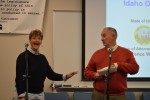
Deputy Idaho Attorney General Brian Kane held up a copy of the light-blue Idaho Open Meeting Law Manual. “This is your ticket to the show, the show being government,” he told a crowd of nearly 60 people gathered at Boise State Public Radio’s riverfront public meeting room on Tuesday evening. “It doesn’t give you the ability to participate in the meeting,” he noted.

So if a board or council has 50 angry people show up at its meeting wanting to say their piece, “That’s not an open meeting problem. You might have a pretty significant customer-service problem.” But the Open Meeting Law guarantees all those folks the chance to be there and watch their government in action, he said. “That oversight is important – we’re here to do the public’s business in public.”

Tuesday’s Boise session was the latest in a round of free public workshops on Idaho’s open meetings and public records laws organized by Idahoans for Openness in Government, or IDOG; recent sessions have been held in Nampa and McCall. Idaho Attorney General Lawrence Wasden has led all the sessions, along with Kane and IDOG president Betsy Russell. The audience participated in interactive skits that helped highlight how to comply with the laws – and how not to. There were stories, laughs, lots of questions and plentiful refreshments, thanks to co-sponsors Boise State Public Radio and the Idaho Statesman.

Among the issues that came up at the Boise session: Idaho Statesman Managing Editor Bill Manny asked, “So going into an executive session is not a vow of secrecy?” If a board member thinks the closed session was inappropriate or feels the topic is too important to keep secret, there’s no penalty in the Open Meeting Law for that member speaking out? The answer was no. “You could be subjecting your entity to some significant legal liability,” Kane said, so a board member would want to think carefully before doing that. “It could be a pretty expensive blab.” But, he said, “The First Amendment is probably your best protection for your right to blab.”

Idaho’s public records law is “content-based,” Kane explained to the group. “The test is not whether or not you made the record on a public machine. The test is whether you transact the public’s business.”

In addition, public agencies can’t ask a requester why they want the information – they can only ask what the requester is looking for, in an effort to help them find it. Kane said some government agencies complain that people are just on “fishing expeditions,” but holding up the bright-red Idaho Public Records Law Manual, he said, “The public records law is your fishing license.”

When the group discussed the “sole remedy” for challenging an improper denial of a public records request – going to court – audience members said there should be some easier, less costly way to appeal. “We’ve got a great law, however I think it’s a boon for attorneys,” said one member of the audience. “We need help from our elected officials. … Help citizens be able to implement and use this law without being stonewalled.”

Several elected officials were in the audience, and Kane noted that Gov. Butch Otter’s public records ombudsman, Cally Younger, has been looking at just that; she’s convened a stakeholders group to examine that issue on which both Kane and Russell serve, along with representatives of cities, counties, courts and more. That work still is ongoing.

“You have raised a valid governmental criticism,” Kane said. “We’re working on it. Unfortunately, government work moves slowly sometimes.”

Wasden said, “Most agencies are really trying to do the right thing. There are some that are recalcitrant.”

In their evaluations of the session, attendees gave it high marks. One elected official summed up what he learned as: “Conduct public business in public.” Others noted specific points, from needing to post meeting agendas at the agency or place of meeting as well as on the internet; to how to make minutes better; to a reporter’s comment she learned useful information about public records requests including “what I can ask for and how to ask.”

“Great job and fun evening!” wrote a state employee. “It’s a great knowledge base for anyone regarding public records and open meeting laws,” wrote another. Wrote a local elected board member, “I think now I’ll keep out of jail,” noting that he’ll avoid Facebook discussions of items pending before his agency to keep from starting a “serial meeting” that could run afoul of the Open Meeting Law. Another elected official wrote of learning “how watchful we need to be, and that we should just review our practices.”

Wrote a citizen, “It’s nice to know the public’s rights.”

Sun Valley city attorney: Council broke open meeting law, approved contract in executive session

From the Idaho Mountain Express

The Sun Valley City Council violated Idaho’s open-meetings law at a meeting Oct. 5 by authorizing changes to a contract in executive session, according to City Attorney Adam King.

Another meeting will be held Friday, Oct. 16, at 4 p.m. so the council can acknowledge the violation and void the motion that authorized the contract changes. King told the council in an email last week that under state law, it had two weeks to fix the violation.

The Oct. 5 meeting was contentious, and marked by sharp words exchanged between Mayor Dewayne Briscoe and the City Council. Their disagreements related to payments that council members Keith Saks, Jane Conard and Michelle Griffith received to purchase their own health plans, outside the city’s group plan.
Saks called the violation “inadvertent,” and easily fixed by acknowledging it at Friday’s meeting and voiding the motion.

“This was an oversight,” he said. “We’ll remedy it the way the statute says to remedy it.”

The city’s insurance carrier, Regence BlueShield of Idaho, has notified the city of its intent to cancel the plan because the payments conflict with the plan’s underwriting assumptions. But that leaves a 90-day window for the city to rectify the situation.

After getting an opinion from outside law firm Hall Render, Saks, Griffith and Conard stopped the payments. They said they believed that was sufficient at the Oct. 5 meeting.

But based on conversations she had with Regence, City Treasurer Angela Orr said the company also wanted the city to go one step further and repeal Ordinance 475, passed in August, which affirmed the system of payments.

The practice dates to 2007, but came into question earlier this year because of recently enacted federal guidelines that were part of the Affordable Care Act’s implementation.

“This was nothing this council created,” Saks said.

According to Briscoe, the opinion from Hall Render stated that the practice is in conflict with the federal law.

At the Oct. 5 meeting, Briscoe had included repealing Ordinance 475 on the agenda. But after tensions boiled over at one point, Briscoe recused himself before the council addressed that item.

He did not return, and Saks, the council president, took over running the meeting. Griffith also left to attend a Ketchum City Council meeting that was happening at the same time.

Saks, Conard and Councilman Peter Hendricks addressed more routine city business such as finding an architect to renovate the Elkhorn Fire Station, among other issues, until Griffith returned shortly after 7 p.m. About a half hour later, the council took up the item related to Ordinance 475. Conard said she felt the item had been placed on the agenda prematurely, and wanted to discuss the matter in executive session.

Several council members felt it was necessary to consult with Hall Render further, and to get the law firm to reach out to Regence’s legal department to determine what needs to be done to bring the city into compliance.

Griffith also said she felt it necessary to discuss that in executive session. Before doing so, the council heard a briefing from Community Development Director Jae Hill on efforts to address unpermitted encroachment into city rights of way.

Shortly after 8 p.m., the council voted 4-0 to enter executive session, and recording of the meeting ceased.

That’s when “procedural irregularities” occurred, King wrote in the email.

After the vote to go into executive session, the council backtracked and “realized that it was appropriate to first amend the contract with Hall Render.” The council wanted to add $1,000 to the contract to cover any additional work. The original contract was capped at $3,000.

The recording was turned back on, and after short discussion, the change was approved, King wrote. Saks then said the council was back in executive session, which lasted about an hour. No other action was taken, aside from adjourning the meeting.

King wrote that the “Hall Render motion was effectively made while the City Council was in executive session. After the motion to enter executive session, there was no talk of exiting executive session before the Hall Render motion.”

Saks said King, the council and city staff present weren’t aware of the violation. He said King reviewed the situation after Briscoe called to notify him, and his email went out to the council members Oct. 8.

Under Idaho’s open meeting law, the council was not permitted to take that action in executive session, King wrote.

To fix the situation, King wrote, the council will have to acknowledge the violation, void the motion and then take up the Hall Render contract again.

The agenda will also include repealing Ordinance 475.

From the Idaho Mountain Express