Federal magistrate weighs arguments in Idaho news groups’ execution access lawsuit

From the Associated Press

BY  REBECCA BOONE

BOISE, Idaho (AP) — A federal magistrate judge heard arguments Tuesday morning in a lawsuit brought by three news organizations that say Idaho prison officials are unconstitutionally hiding parts of lethal injection executions from public view. 

The Associated Press, East Idaho News and The Idaho Statesman filed the lawsuit against the director of the Idaho Department of Correction in December. They are asking U.S. Magistrate Judge Debora K. Grasham to temporarily stop the state from restricting media witnesses from viewing the actual injection of lethal chemicals in any executions that may occur before the lawsuit is resolved. 

Wendy Olson, the attorney representing the news organizations, said media witnesses play a significant role in the public’s understanding of executions. The U.S. has a history of protecting public access to executions, whether they are carried out by hanging, electrocution or other means, she said, and the 9th U.S. Circuit Court of Appeals has said that access right includes the steps that are “inextricably intertwined” with the process of putting someone to death.

Idaho officials allow media witnesses to see the first step of lethal injection executions — placing an inmate on a gurney and inserting the IV lines — as well as the third step of the process, which is watching the impact the lethal drugs have on the inmate and seeing a coroner declare the inmate dead.

But Olson said the state is wrongly barring the public from seeing the second step, which is the process of actually drawing the lethal drugs into syringes and then pushing those drugs into the IV lines connected to the condemned person. Those steps are carried out in a separate room, she said, and the state has refused media witness requests to view the process via closed-circuit television. 

Tanner Smith, the attorney representing prison officials, told Grasham that when it comes to analyzing Idaho history, lethal injections shouldn’t be compared to hangings. There is no “historical right of access” to the work done in the “medication team room,” including the administration of lethal drugs, he said.

The pushing of the drugs is a “minute detail,” and the public can rely on prison officials to accurately tell them whether that process was successful, Smith said. Keeping the medication team room hidden from public view helps protect those volunteer team members from being identified and subjected to harassment or threats, he said.

Grasham seemed skeptical.

“It’s a minute detail?” she asked, later continuing, “How can the administration of the drug be anything but inextricably intertwined?”

Grasham also asked why the people in the medication team room couldn’t simply wear the same surgical garb that other execution team members use to hide their identities. Smith said they could, but they might have unique characteristics like their stature that would stand out despite face masks, gloves and head coverings. 

Grasham said she would issue a written ruling on the preliminary injunction request, but did not say when the ruling would be issued. 

Twenty-seven states authorize the death penalty, according to the Death Penalty Information Center, though some have paused executions or do not have anyone on death row. The states also vary widely on how many media witnesses they allow at executions, as well as how much of the execution process witnesses are allowed to see. 

This is not the first time The Associated Press and other news organizations have sued Idaho officials in an attempt to increase execution access. In 2012, the 9th U.S. Circuit Court of Appeals ordered prison officials to allow the news organizations to view the first part of lethal injection executions, including when a condemned person is brought into the execution chamber, secured to the execution gurney and the IV is inserted.

Idaho has attempted four lethal injection executions since the 1970s. Three of them were completed, but the most recent attempt, involving Thomas Eugene Creech, was aborted last year after execution team members were unable to successfully establish an IV line after eight attempts in Creech’s arms and legs. 

Lawmakers passed a new law this year that will make firing squads the state’s primary method of execution, starting next year.

From the Associated Press

Idaho will have journalism shield law, after Gov. Little signs bill

From the Idaho Capital Sun

Idaho will become the 41st state with a media shield law, protecting sources who provide confidential information or documents to journalists.

Gov. Brad Little signed House Bill 158 into law Thursday morning, the governor’s office’s Communications Director Emily Callihan told the Idaho Capital Sun. The governor’s office plans to hold a signing ceremony with partners involved in the bill, she said. 

The Idaho Legislature unanimously passed the bill this year, following a rise in legal threats that sought to force journalists to reveal their sources

Idaho is one of 10 states without a journalism shield law, according to the Reporters Committee for Freedom of the Press

Idaho’s new media shield law takes effect July 1.

Idaho Press Club President Melissa Davlin wrote the bill based on language in laws in Kentucky and Alabama.

“Too many Gem State newsrooms have had to spend time and resources fighting subpoenas that would force them to betray their sources’ trust under threat of fines or jail time,” she told the Idaho Capital Sun in a written statement after the Legislature passed the bill. “The Idaho Press Club is grateful that lawmakers saw the need for this change, and we thank our legislative sponsors for their help getting this to the governor’s desk. Idaho, like the rest of America, needs a strong press corps, and this shield law will help reporters focus on their work instead of costly and stressful legal proceedings.”

The bill states: “No person engaged in journalistic activities shall be compelled to disclose in any legal proceeding, trial before any court, or before any jury the source of any information procured or obtained and published in a newspaper, print publication, digital news outlet, or by a radio or television broadcasting station with which the person is engaged or employed or with which the person is connected.”

Disclosure: The Idaho Capital Sun’s journalists are members of the Idaho Press Club.

From the Idaho Capital Sun

Idaho officials push for greater transparency in the Gem State

From KTVB-TV

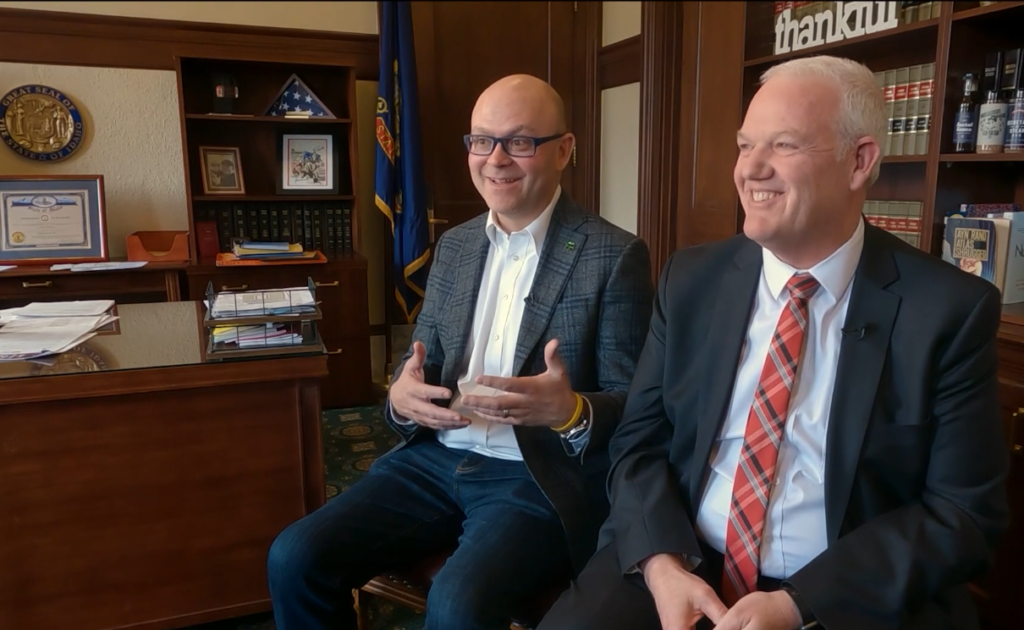
As Sunshine Week opened in Idaho and nationwide on Monday, March 18, 2025, Idaho Secretary of State Phil McGrane and State Controller Brandon Woolf talked with KTVB-TV about the importance of open public records and making public information in Idaho easily accessible to the public.

“You have a right to know what your government’s up to,” McGrane told KTVB reporter Joe Parris on the station’s “The 208” show.”

Said Woolf, “Obscurity is the best friend of conspiracy.” When people are left wondering what their government is hiding and what’s really going on, trust erodes and conspiracies rise, he said. Woolf advocated for “changing that culture, that mindset, to say: We’re open.”

His office does that in part through its “Transparent Idaho” (LINK: https://transparent.idaho.gov/ ) transparency site, where large amounts of state and local government financial data is available to anyone who cares to look it up. McGrane’s office is in charge of the state’s Sunshine Laws on campaign finance and lobbying registration, and is working to make that data easy to access through new tools, data visualizations, and more through the office’s Campaign Finance Sunshine Portal. (LINK: https://voteidaho.gov/campaign-finance-portal/ )

Said McGrane, “That’s what our role is, is to make this easy for the public.”

You can watch the full interview here at KTVB.com. (LINK:

https://www.ktvb.com/video/news/local/208/idaho-officials-push-for-greater-transparency-in-the-gem-state/277-bf4086d7-e7bd-400a-8521-87ab7084736f )

Sunshine Week, first launched as a national event in March of 2005, helps educate the public, journalists, lawmakers, and others on the right to know in the U.S. states and federal government. There’s more information about Sunshine Week at sunshineweek.org.

From KTVB-TV

Idaho House unanimously passes media shield law bill protecting journalists’ sources

From the Idaho Capital Sun

BY: CLARK CORBIN

The Idaho House of Representatives on Tuesday threw bipartisan, unanimous support behind a bill that would create a media shield law protecting sources who provide confidential information or documents to journalists.

Without any debate, the Idaho House voted 69-0 to pass House Bill 158

The bill states, “No person engaged in journalistic activities shall be compelled to disclose in any legal proceeding, trial before any court, or before any jury the source of any information procured or obtained and published in a newspaper, print publication, digital news outlet, or by a radio or television broadcasting station with which the person is engaged or employed or with which the person is connected.”

Supporters said the bill would help combat frivolous lawsuits and provide protections similar to whistleblower protections available in existing state and federal laws. 

Rep. Barbara Ehardt, an Idaho Falls Republican who co-sponsored the bill, said without a media shield law, journalists could be forced to reveal the identity of confidential sources or risk being found in contempt of court, fined or even jailed. 

“The only thing right now protecting or stopping a journalist from revealing their sources is their own personal ethics,” Ehardt said. 

“Many have gone to jail,” Ehardt added. “They’ve been sent to jail, and they sat there at their own (volation) trying to protect the sources. And at some point, that’s not right.” 

The bill’s other co-sponsor, Rep. Marco Erickson, R-Idaho Falls, said Idaho is one of 10 states without a shield law protecting sources who provide confidential information to journalists.

House Bill 158 heads next to the Idaho Senate for consideration. If a majority of members of the Idaho Senate vote to pass the bill, it would head to Gov. Brad Little for final consideration. Once a bill reaches his desk, Little may sign it into law, veto it or allow it to become law without his signature.

Disclosure: Idaho Capital Sun journalists are members of the Idaho Press Club, which drafted and advocated for the passage of the media shield law bill.

From the Idaho Capital Sun

House committee backs shield law bill, sends to full House

From the Idaho Statesman

By Carolyn Komatsoulis

An Idaho House committee on Wednesday advanced a bill that would protect journalists from having to identify sources or turn over notes and other unpublished material during legal proceedings.

Idaho is one of 10 states that doesn’t have a so-called shield law on the books, according to the Reporters Committee for Freedom of the Press. House Bill 158, which now heads to the floor with a do-pass recommendation, could change that.

“What we have in front of us is a suggested law that would protect sources. Sources, not journalists,” said co-sponsor Rep. Barbara Ehardt, R-Idaho Falls. “Idaho’s media outlets are facing an increasingly growing number of subpoenas.”

The U.S. Supreme Court, in Branzburg v. Hayes, ruled that requiring journalists to testify to grand juries and reveal confidential information wasn’t a First Amendment infringement on freedom of the press, according to Oyez, an archive of cases.

Ben Olson, the co-owner and publisher of the Sandpoint Reader, has personal experience with subpoenas, he told the House Judiciary, Rules and Administration Committee. In 2018, he published an article identifying a man who was distributing racist propaganda. Olson said there were robocalls calling him a cancer, he said, amid a campaign of harassment.

The FCC wanted to fine Scott Rhodes millions of dollars for the malicious robocalls, according to previous Statesman reporting. One of the calls that mentioned Olson was included in the FCC’s complaint, and he was then subpoenaed by Rhodes, he said.

“It was an attempt to further harass me and potentially harass the sources that spoke with me,” Olson said. “We have a staff of three people, myself included, and we don’t have the means or the time to fight frivolous subpoenas.”

He was lucky, Olson told the committee Wednesday. A lawyer represented him pro bono and the subpoena was quashed.

Others haven’t been so fortunate.

Nate Sunderland, the editor of East Idaho News, said he was forced by subpoena to testify in a defamation case between an attorney and a businessman. The attorney had provided a quote about a criminal case to the outlet, Sunderland said, and the businessman assumed it was about him.

East Idaho News spent almost two years and a lot of money fighting the subpoena, but ultimately lost.

“As journalists, we believe the conversations between sources and reporters are private, until the decision is made to publish on-the-record statements in an article or broadcast,” Sunderland said. “We need to ensure that our sources and our conversations are inherently private.”

From the Idaho Statesman

Idaho Legislature introduces bill to protect confidential sources for journalists

From the Idaho Capital Sun

A new bill introduced in the Idaho Legislature on Wednesday afternoon seeks to protect sources who provide journalists with confidential information.

On Wednesday afternoon, the House Judiciary, Rules and Administration Committee voted unanimously to introduce the new bill, which would create a media shield law in Idaho.

Reps. Marco Erickson and Barbara Ehardt, both R-Idaho Falls, sponsored the bill. 

Erickson said Idaho is one of 10 states in the United States that do not have a shield law protecting sources who provide confidential information to journalists. 

“No person engaged in journalistic activities shall be compelled to disclose in any legal proceeding, trial before any court, or before any jury the source of any information procured or obtained and published in a newspaper, print publication, digital news outlet, or by a radio or television broadcasting station with which the person is engaged or employed or with which the person is connected,” the bill states.

The bill also applies to unpublished information, notes or communications obtained through the newsgathering process.

Idaho Press Club President Melissa Davlin said the bill protects news organizations and sources alike. 

“The First Amendment protects the right to a free press – our ability to report and hold the powerful accountable, but it is much more difficult to do so if our sources cannot trust that information they give us off-the-record or anonymously or all of our communications are going to be secure and safe,” Davlin said in an interview Wednesday. 

Last year, EastIdahoNews.com was subpoenaed and forced to play a private, off-the-record conversation between a reporter and a source in court. Erickson and Ehardt approached the news organization looking to help, and Davlin got involved as president of the Idaho Press Club.

Also last year, Boise attorney Steven Wieland attempted to subpoena BoiseDev for access to an email referenced in a 2023 story about a lawsuit involving ownership of a hotel. Wieland, on behalf of his client, threatened to ask a judge to hold BoiseDev in contempt of court. Contempt charges can carry fines up to $5,000 and jail time of up to 30 days.

After serving the subpoena, Wieland sent an email to BoiseDev reporter Margaret Carmel on the matter.

“Everything is okay, we’re just looking for your communications with Hitendra Chokshi, his son, and others who might have been working with them,” Wieland wrote. “That includes call recordings. We think it’s relevant to determining (sic) what their purpose was in bringing this lawsuit in the first place. We don’t need your communications with me (for obvious reasons).”

After more than a month of wrangling, BoiseDev’s legal counsel in the matter illustrated to Wieland that he could obtain the email sought from other parties, and he eventually tabled the matter. Fighting the subpoena cost BoiseDev several thousand dollars and extensive staff time.

Idaho Press Club president says there’s been increase in subpoenaing news organizations in the Gem State

Davlin reached out to the nonprofit Reporters Committee for Freedom of the Press for resources and support, and she based Idaho’s bill on media shield laws that have been in place in Alabama and Kentucky for decades.

Davlin has been involved with the Idaho Press Club for 12 years, and said she has seen a significant recent increase in people and organizations subpoenaing news organizations in an attempt to gain access to private, confidential information that sources share. 

Davlin also said she has had personal experience with anonymous sources who sought to provide documents for a news story but backed out after becoming worried their confidentiality might not be guaranteed. 

“In the last year I have had more newsrooms and more reporters ask me for help quashing subpoenas than the entire time (I have served on the Idaho Press Club board of directors),” Davlin said. “It has come up in multiple parts of the state and multiple newsrooms, so it’s not like there’s one bad actor who is sending out subpoenas.”

Often, Davlin said it is small, independent local news organizations that are hurt the most by subpoenas seeking the disclosure of confidential information because they do not have the budget to go to court or have an attorney on staff.

Although no legislators voted against introducing the new media shield bill, several legislators asked questions Wednesday about how the bill works or whether it is necessary. 

Rep. Chris Mathias, D-Boise, said he would like additional information about whether the bill would protect illegitimate organizations that are set up to look and act like legitimate news organizations.

Introducing the bill clears the way for it to return to the House Judiciary, Rules and Administration Committee for a full public hearing. 

The new media shield bill will be assigned a number and publicly posted on the Idaho Legislature’s website after it is read across the desk on the floor of the Idaho House, likely on Thursday.

Disclosure: The Idaho Capital Sun’s journalists are members of the Idaho Press Club.

Editor’s note: This story was updated at 11:48 p.m. on Feb. 7, 2025, to include information on a subpoena received by BoiseDev.

From the Idaho Capital Sun

 Amid secrecy, judge weighs genetic evidence and search warrants in UI murder case

From the Associated Press

by REBECCA BOONE

BOISE — Attorneys for a man charged with murder in connection with the killings of four University of Idaho students are asking a judge to throw out most of the evidence in the case because they say it all hinges on an unconstitutional genetic investigation process.

Bryan Kohberger’s defense team also contends that the search warrants in the case were tainted by police misconduct. A two-day hearing on the matter started Thursday morning, and much of it has been closed to the public. If they are successful, it could throw a major wrench in the prosecution’s case before trial starts in August.

Kohberger is charged with four counts of murder in the deaths of Ethan Chapin, Xana Kernodle, Madison Mogen and Kaylee Goncalves, who were killed in the early morning of Nov. 13, 2022, at a rental home near campus in Moscow, Idaho. When asked to enter a plea last year, Kohberger stood silent, prompting a judge to enter a not-guilty plea on his behalf. Prosecutors have said they will seek the death penalty if Kohberger is convicted.

Kohberger’s attorneys say law enforcement violated his constitutional rights when they used a process called Investigative Genetic Genealogy, or IGG, to identify possible suspects.

“There would be no investigation into him without that original constitutional violation,” attorneys Jay Weston Logsdon and Ann Taylor wrote in a court filing. They later continued, “Without IGG, there is no case, no request for his phone records, surveillance of his parents’ home, no DNA taken from the garbage out front. Because the IGG analysis is the origin of this matter, everything in the affidavit should be excised.”

The IGG process often starts when DNA found at the scene of a crime doesn’t yield any results through standard law enforcement databases. When that happens, investigators may look at all the variations, or single nucleotide polymorphisms, that are in the DNA sample. Those SNPs, or “snips,” are then uploaded to a genealogy database like GEDmatch or FamilyTreeDNA to look for possible relatives of the person whose DNA was found at the scene.

In Kohberger’s case, investigators said they found “touch DNA,” or trace DNA, on the sheath of a knife that was found in the home where the students were fatally stabbed. The FBI used the IGG process on that DNA and the information identified Kohberger as a possible suspect.

Latah County Prosecutor Bill Thompson and the rest of the prosecution team say there is nothing unconstitutional about the use of IGG, noting that Kohberger’s relatives voluntarily provided their own DNA to a genetic genealogy service. They’ve also argued in court filings that case law is clear: Defendants have no reasonable right to privacy for DNA that is left at the scene of a crime.

The defense team also says that once Kohberger was identified as a possible suspect, law enforcement officers either purposely or recklessly lied or omitted crucial information when they asked the court to issue search warrants for his apartment, his parents’ house, his car, his cellphone and even for his own DNA. They want all of that evidence kept out of the trial as well.

Specific details about the alleged police misconduct are hidden from public view, however; 4th District Judge Steven Hippler has kept most of those court filings, along with many of the court documents on the IGG evidence, under seal. Hippler ordered part of the hearing to be held behind closed doors and said the privacy was necessary to prevent potential jurors from being “tainted” by hearing about any evidence that might not be allowed in trial.

On Wednesday, a coalition of news organizations including The Associated Press asked the judge to reconsider the secrecy.

“In any criminal case, I would submit that it’s of extreme public interest to know whether a law enforcement officer sworn to tell the truth … made reckless or false statements” during an investigation, the news organizations’ attorney, Wendy Olson, said during a hearing on Wednesday. The U.S. Supreme Court has found that the public and the press have a First Amendment right to open court proceedings, she said, and that open courts also help to protect the rights of the accused.

“Openness and transparency are more important than ever in maintaining and restoring confidence in our government institutions,” Olson said.

The judge was unswayed.

“I don’t think much has changed in terms of the need to protect the jury pool here, given the intense media scrutiny that has and continues to follow this case,” Hippler said. “We will be challenged under the best of circumstances in obtaining a jury that has not been overly exposed to this … and in particular, exposed to evidence that may not come into this trial.”

The judge said no one would be allowed into the courtroom but that the open portions of the hearing would be livestreamed from the court’s YouTube page.

From the Associated Press

More on the lawsuit: News groups sue for increased witness access to lethal injection executions

From the Associated Press

By REBECCA BOONE Associated Press

BOISE, Idaho (AP) — The Associated Press and two other news organizations are suing Idaho’s top prison official for increased access to lethal injection executions, saying the state is unconstitutionally hiding the actual administration of the deadly drugs from public view.

 The AP, The Idaho Statesman and East Idaho News filed the lawsuit against Idaho Department of Correction Director Josh Tewalt in Boise’s U.S. District Court on Friday.

 The news organizations contend the public has a First Amendment right to witness the entire execution process, including when execution team members push the lethal injection medications into the IV lines connected to a condemned person. Idaho’s prison officials have kept that part of the execution concealed behind screens or walls in each of the three executions completed in the last half-century.

“At its core, this case involves the press’s ability to fulfill its ‘significant role in the proper functioning of capital punishment’ by providing independent public scrutiny of the State of Idaho’s execution process,” attorney Wendy Olson wrote in court documents. She noted the 9th U.S. Circuit Court of Appeals has repeatedly found that the public has the right to view executions from start to finish— including in a similar lawsuit brought by AP and other news organizations against Idaho officials in 2012. In that case, the appellate court ordered prison officials to allow media witnesses to watch as the IVs are inserted.

“The Ninth Circuit has not minced words,” Olson said, quoting from another 9th Circuit ruling from 2002: “An informed decision by the public is critical in determining whether execution by lethal injection comports with ‘the evolving standards of decency which mark the progress of a maturing society.'”

 Idaho Department of Correction spokeswoman Sanda Kuzeta-Cerimagic said the department had not yet been formally served with the lawsuit. But she wrote in an email that “our execution practices have been repeatedly upheld, including meeting or exceeding the requirements under the First Amendment to provide an opportunity to observe the processes integral to an execution. “

 “IDOC is committed to transparency in the execution process and will continue to provide one of the most transparent execution processes in the country,” Kuzeta-Cerimagic wrote. 

Tewalt and other prison officials have told lawmakers in the past that anything threatening the confidentiality of execution team members or the source of the state’s execution drugs could put Idaho’s ability to carry out capital punishment at risk, in part because it would be difficult to find qualified volunteers willing to put someone to death.

The news organizations point out in the lawsuit, however, that media witnesses can already see other execution team members, though their identities are concealed by medical masks, head coverings and other devices. The same solution could be used for the execution team members tasked administering the lethal drugs, the news organizations said.

Idaho has only attempted four lethal injection executions since the U.S. Supreme Court lifted a moratorium on executions in the 1970s. When Keith Eugene Wells was executed in 1994, IV lines ran from his arm to a screen, behind which execution team members used a device to deliver a cocktail of lethal drugs. In the 2011 execution of Paul Ezra Rhoades and the 2012 execution of Richard Albert Leavitt, the IV lines ran through an opening in the wall of the execution chamber, into another area that was hidden from view.

 The same setup was used in February, when the state attempted to execute Thomas Eugene Creech. But that execution was called off after the execution team members were unable to successfully establish an IV line despite trying eight different locations in Creech’s arms and legs.

 In October, the state announced it would begin using central venous lines — threading a catheter through a large, deep vein until it reaches the condemned person’s heart — for lethal injections if attempts to insert standard IV lines fail. Prison officials also remodeled the execution chamber to add a special “execution preparation” room for the central line procedure, and installed closed-circuit cameras so that media witnesses can watch.

 The news organizations want a federal judge to order the state to allow media witnesses the same closed-circuit camera access to the “Medical Team Room,” where the lethal drug preparation and administration occurs.

“There is no logical reason why the events that will take place in the Medical Team Room should fall outside the scope of the well settled First Amendment right to view an execution in its entirety,” Olson wrote. “Simply put, there is nothing more ‘intertwined’ with the execution process than the preparation and administration of the very drugs that will effectuate Idaho’s most severe punishment,” she said. 

From the Associated Press

Idaho news media sue state prison system over execution secrecy

From the Idaho Statesman

By Kevin Fixler

A group of news outlets, including the Idaho Statesman, sued the Idaho Department of Correction in federal court Friday, alleging that the state’s execution practices do not meet federal public transparency requirements while carrying out the death penalty.

Led by The Associated Press, the three outlets, which also include East Idaho News in Idaho Falls, seek to force the Idaho prison system to grant additional access to media witnesses, who act as a proxy for the public during executions. They ask that a U.S. District Court judge require prison officials to provide the media with the ability to view a concealed area at the state’s maximum security prison where members of the execution team administer lethal injection drugs.

As part of the lawsuit, the news outlets requested that a judge issue a preliminary injunction to prevent the prison system from barring public access to the area in any future executions until the legal matter is resolved.

Former U.S. Attorney for Idaho Wendy Olson, now a partner at private law firm Stoel Rives in Boise, is representing the three news outlets. She asserted a violation of First Amendment rights of the press in the filing, because media witnesses in Idaho are limited in what they can report about the prison’s “medical team room” before, during and after a lethal-injection execution. 

In that room, the execution team prepares and labels syringes with the lethal injection drugs, and also monitors the execution process when team members depress the syringes and inject the drugs into the prisoner, the lawsuit said. Media witnesses are unable to see into the room from the public observation area because it is obscured by a wall.

“IDOC’s practice, procedure, protocol, and policy prevent execution witnesses from observing the entirety of the execution process both visually and audibly, so that the purpose behind witnesses’ attendance at executions is severely impaired,” the legal filing read. “IDOC excludes witnesses from observing fundamental aspects of the execution process that occur within the medical team room in violation of the First Amendment.”

AP reporter has history as Idaho execution witness

Rebecca Boone, a Boise-based correspondent with the Associated Press, acted as a media witness during Idaho’s most recent attempt to execute a prisoner earlier this year. In February, prison officials called off the lethal injection of death row prisoner Thomas Creech, 73, after nearly an hour of trying to find a suitable vein for an IV.

Boone, a journalist of 26 years, most of that with the AP, previously acted as a witness to the state’s most recent executions: Paul Rhoades in 2011 and Richard Leavitt in 2012.

In a sworn declaration filed with the lawsuit, Boone said she sought visual access to the medical-team room during the Leavitt and Creech executions but each time was rebuffed by IDOC leaders, including current Director Josh Tewalt. The lawsuit names Tewalt as the case’s defendant, in his official capacity tasked with setting and overseeing the state prison’s execution policies.

The Idaho Department of Correction and the Attorney General’s Office, which represents Tewalt and the state prison system in legal matters, did not immediately respond Friday afternoon to separate requests for comment from the Statesman.

Based on her experiences as an execution witness, Boone said the IV lines carrying the lethal injection drugs arrive through a small opening in the wall from another room, where the execution team is obscured, and into the execution chamber, where witnesses can view the prisoner strapped to the gurney.

“I have never seen the medical team room, but based on my interviews with IDOC officials and IDOC policy documents, I believe it is where the lethal injection chemicals are administered into the IV lines attached to the condemned person,” Boone wrote in her signed declaration.

Not allowing media witnesses the ability to see all aspects of an execution conflicts with legal precedent set by the 9th U.S. Circuit Court of Appeals, Olson wrote in the lawsuit. In that 2002 decision, the court ruled that “independent public scrutiny — made possible by the public and media witnesses to an execution — plays a significant role in the proper functioning of capital punishment.”

In 2012, the AP — backed by 13 other news outlets, including the Statesman — sued IDOC ahead of Leavitt’s execution because a separate portion of the state prison system’s lethal injection process was kept behind a curtain. They cited the 9th Circuit’s prior decision. The same court sided with the news outlets, and the prison system revised its policy in the days leading up to Leavitt’s lethal injection to provide media witnesses greater visual access to his execution.

IDOC recently revised its execution policies

Friday’s lawsuit comes after IDOC revised its execution policies in October, almost eight months after the failed attempt to execute Creech. The prison system paid to renovate a portion of the execution chamber to create an “execution preparation room,” where the prisoner will first be assessed by the execution team for what kind of vein access will be necessary to carry out a lethal injection.

The upgrades cost $314,000 and also included the addition of live closed-circuit video and audio feeds to broadcast what IDOC officials called the entirety of the execution process to witnesses to meet federal requirements. But Tewalt told Boone in an interview that IDOC did not add the cameras to the medical-team room and did not plan to, she wrote in her declaration.

“As it stands, anything that happens in the medical team room during an execution will be done in complete secrecy and free from any public scrutiny,” Olson wrote in the lawsuit.

The Federal Defender Services of Idaho, a legal nonprofit that represents Creech and several other members of Idaho’s death row, declined to comment.

Chadd Cripe, editor of the Statesman, added in a sworn declaration filed with the lawsuit that news media are unable to accurately report on the whole of Idaho’s capital punishment system without being able to see what happens in the prison’s hidden room during an execution.

“Without access to the medical team room, designated media representatives will not be able to fully and accurately inform the public about the functioning of capital punishment and whether execution by lethal injection comports with the evolving standards of decency which mark the progress of a maturing society,” Cripe said in the filing.

The three news outlets now ask that a federal judge step in to force IDOC to add the closed-circuit video and audio to the medical team room — or alternatively to add a viewable window — to meet the federal requirements for uninterrupted viewing of an execution. They also seek attorneys fees from the state.

From the Idaho Statesman

State Controller’s Office Unveils New City Page with Enhanced Transparency Features

From Idaho State Controller Brandon Woolf

NEWS RELEASE

FOR IMMEDIATE RELEASE

October 18, 2024

(Boise, ID) – Transparent Idaho continues to add to its data offerings by launching an updated city page, giving citizens unprecedented access to financial and salary data from Idaho’s 198 cities. This update underscores the State Controller’s Office’s dedication to increasing transparency and making citizen’s access to public data even easier.

Transparent Idaho is revolutionizing how citizens access information, allowing them to quickly explore data from all cities in one convenient location; eliminating the cumbersome process of visiting 198 different websites and submitting lengthy public records requests to each individual city.  This also allows citizens to easily view data across multiple cities on a single website.

“A government’s foundation is the trust of its citizens. This new city page is a game-changer, making city data more accessible than ever. In the past, citizens had to navigate a complex public records request process to gain insights. Now, this user-friendly interface empowers everyone to easily compare data across cities and see exactly how their tax dollars are spent,” said Brandon Woolf, State Controller.

The updated page offers key insights into city expenditures, departmental budgets, fund balances, audits, and salaries. This level of transparency allows citizens to better understand how local governments function and allows our citizens to engage with their local government like never before.

The State Controller’s Office partnered with In Time Tech, headquartered in Idaho, to develop the new interface, ensuring that city data is displayed in a clear, easy-to-use and navigate manner on Transparent Idaho.

“Transparency isn’t just about providing data; it’s about partnering with every level of government in building trust with our citizens,” said John Iasonides, Deputy Controller. “We’re grateful to the Association of Idaho Cities and the city leaders who contributed their efforts toward bringing this vision to life.”

For more information, visit the newly launched city page on our Transparent Idaho website.

# # #

CONTACTS:

Mackenzie Reathaford, Communications Manager | 208-334-3100 | mreathaford@sco.idaho.gov

From Idaho State Controller Brandon Woolf