Archives for 2008

Washington, Idaho rank far apart on openness

From The Spokesman-Review

Betsy Z. Russell
Staff writer

BOISE – A new national survey ranks Washington fourth in the nation for governmental integrity, openness and accountability – and Idaho 44th.

The survey, conducted by the Chicago-based Better Government Association, compared open records laws, open meeting laws, whistleblower laws, campaign finance requirements and conflict-of-interest laws, to create a government “integrity index.”

Idaho scored particularly poorly for its open meeting and conflict of interest laws. As one of just four states with no requirement for state legislators to disclose their personal finances, Idaho tied for last place with a zero score in the conflict-of-interest category, while Washington was ranked first in the nation.

Idaho state Sen. Mike Jorgenson, R-Hayden Lake, said, “I think we need to stop and do a little introspective, and ask ourselves what’s going on.”

State Sen. Kate Kelly, D-Boise, who has sponsored ethics legislation, said, “It doesn’t come as a surprise. It’s just one more indication that this is an area we need to focus on.”

Though Washington fared well in the 50-state survey, Jason Mercier, director of the Center for Government Reform in Olympia, said, “This is a good survey of who’s got the best practices out there, whose laws are worth taking a look at. But the more interesting question to me is how are states actually implementing the laws they have on the books.”

Washington has strong open meetings and public records laws, Mercier said. “The problem: There are violations constantly.”

The state is involved in litigation over violations of the public records law, he said. “Just because you have a tool in place, that’s half the battle. Now you have to have elected officials overseeing those tools who’ll execute them properly.”

Washington has set up a Sunshine Committee to review the numerous exemptions in its public records law; Mercier said that committee just decided this week to recommend reversing two state Supreme Court decisions limiting public access to documents due to attorney-client privilege and work product rules.

The Washington Legislature will receive the committee’s first report of recommendations this year.

Idaho Attorney General Lawrence Wasden said he’s less concerned over national rankings than over how Idaho’s laws are working for Idaho. “The open meeting law ought to meet the needs of the respective states – we don’t do business the same way they do in Washington or Illinois or other locales, we do business the way we do it here in Idaho,” he said. “I do think we have an affirmative open meeting law. We are working to refine it.”

The survey ranked Idaho 44th in the nation for its open meeting law, and tied for last on conflict-of-interest laws in the form of legislative financial disclosure requirements.

Wasden investigated the State Board of Education in February for possible violation of the state’s open meeting law but concluded that while the board may have violated the law, he couldn’t prove, under a recent state Supreme Court decision, that they’d “knowingly” done so.

“We’re working on some improvements” to the law, Wasden said. “That’s an issue that we’re trying to address right now. … We’re wrestling with exactly that.”

Jorgenson said he’s also interested in legislation to improve Idaho’s law. “I think there is too much gray area in open meetings,” he said.

Wasden said he’s also working to promote compliance with Idaho’s open government laws. “It’s very important that government in this state operate under the statutes as they’re written, and it’s important in terms of maintaining the integrity of our governmental systems and our citizens’ ability to interact with their government.”

Though Idaho was ranked low in the survey for its open meeting law, the state ranked highly for its whistleblower laws – 9th in the nation – and was in the middle of the pack for open records laws, at 24th, and campaign finance rules, at 29th.

Washington ranked 16th for its open records law, 15th for its whistleblower laws, 28th for campaign finance requirements, 15th for its open meeting law, and first for conflict-of-interest laws.

The top-ranked state was New Jersey; the worst was South Dakota.

Betsy Z. Russell can be reached toll-free at (866) 336-2854 or bzrussell@gmail.com

From The Spokesman-Review
IDOG bucks World Series

Draws 100+ in Idaho Falls

By Dean Miller

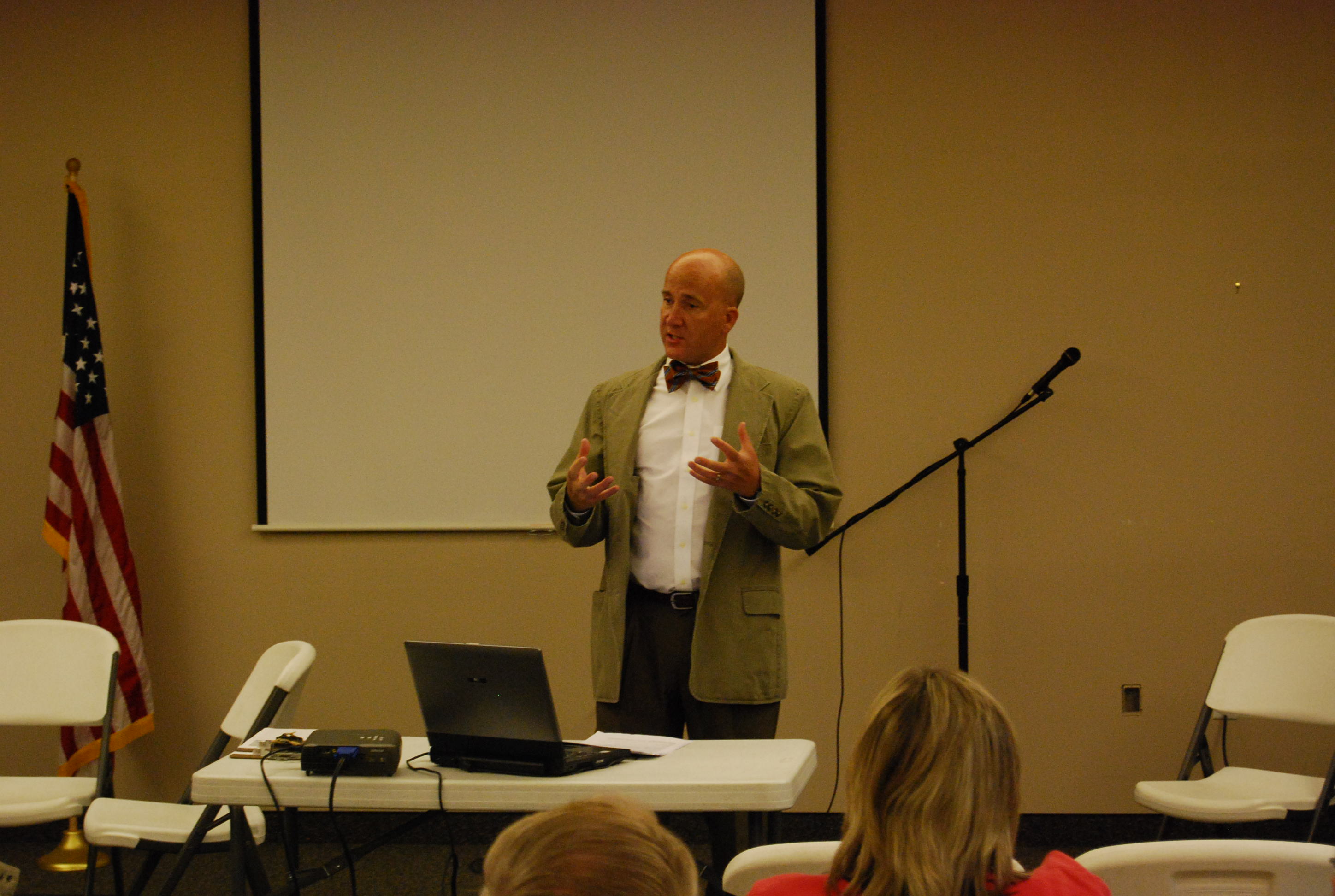
IDAHO FALLS – Reporters and public officials pored over Idaho’s open meetings and open records law together at an Oct. 27 workshop even as the World Series was under way.

Organizers had booked a single meeting room in the Health Sciences building of the Eastern Idaho Technical College and had to call in janitors to move a curtain wall to open up seats for the overflow crowd.

Workshop sponsor Roger Plothow, publisher of the Post Register, noted that he began working on these issues when he was but an Editor and serving as Idaho Press Club President. At that time, in the late 1990s, the Press Club organized a major revision of Idaho laws to protect the public’s right to see government records and attend government meetings.

Plothow expressed happy surprise at the size of the crowd, which included TV and print reporters, dozens of citizen activists and elected state and local officials.

IDOG’s roadshow writers were tickled to observe Post Register reporter Sven Erik Berg in the front row, taking notes shoulder-to-shoulder with Bonneville County Commissioner David Radford. When those two need to work out a public access issue, IDOG’s training ensures they’ll have a shared vocabulary and tools in common with which to address it.

Attorney General Lawrence Wasden reminded participants that his office, which operates as the referee, has observed that both reporters and public officials are wrong about the open meetings, open records act about half the time. Though that would make a great batting average, he said, we can do better. The purpose of the IDOG roadshow is to get people to at least recognize there are standard rules, even if each party reads them slightly differently.

Evaluations from the participants were glowing. The skits, one elected official wrote, were “super,” and the lasting lesson learned: “Assume it’s public unless there’s a specific exemption.” Wrote another: “Great job – better than what I was expecting.” A public employee who attended praised the “pertinent info for my particular job,” and a sewer district board member wrote, “The best thing to do is always have open meetings and only discuss and deliberate there.”

“The info was well covered,” wrote a citizen who attended, while an elected official dubbed it “good preventative medicine.” “We have the tools to maintain our state government’s transparency,” wrote a city attorney. A reporter who attended wrote, “I learned process, order and rights regarding public information.” Wrote another, “I’m a journalist. Now I have a better idea of what I have the right to know. I’ll also be able to differentiate between the truth and getting the run-around.”

Preston seminar draws top reviews

PRESTON, Idaho – “I learned to be a better custodian of public records,” said one state employee who attended the IDOG open meetings and public records seminar in Preston, Idaho on Tuesday, Oct. 30, 2008.

“Great job,” wrote a city clerk, who noted in her evaluation of the session that she learned that the agendas she’s been preparing for city meetings need more information. “I see that I am not specific enough,” she said.

And though the session ran a full three hours – from 6:30 to 9:30 p.m. – one elected official had just one complaint – he’d have liked “a little longer Q & A.”

“I learned a lot,” declared a local appointed board member, who said executive session rules were among the new information.

A county commissioner said he’d gladly recommend the session to others with similar jobs.

And all those who filled out evaluations at the end of the session, held in the Larsen-Sant Public Library in Preston, gave it top marks for the skits, the handouts, the slide show, and for how the session compared to other workshops they’ve attended. Even the refreshments earned top reviews.

Nearly two dozen people attended, and this in a town whose population at the 2000 census was less than 5,000. Preston is the county seat of Franklin County. Located in the far southeastern corner of the state of Idaho, the town gained national fame with the release of the 2004 film “Napoleon Dynamite,” which was filmed and set there and is the hometown of the film’s creators.

For the IDOG seminar, Idaho Attorney General Lawrence Wasden and Deputy Attorney General Bill von Tagen, along with public information officer Bob Cooper, traveled from Boise, and Idaho Falls Post Register Editor Dean Miller traveled from Idaho Falls.

Pocatello Seminar

From the Post Register

By Dean Miller
POCATELLO – A code of ethics is just words on a page, until you act on it.

KPVI, Channel 6 walked the talk last week.

Anchor/News Director Brenda Baumgartner and a half-dozen staffers spent the night of Oct. 14th at Highland High School putting on a series of skits that are the background of a successful public workshop on open records and open meetings.

The standard American code of newsroom ethics challenges journalists to work for openness in government and KPVI staffers did it.

They played the part of helpful and not-helpful courthouse clerks, secretive county commissioners, obnoxious reporters, grumpy citizens and earnest voters.

The audience, a mix of staffers from government offices around the region laughed, nodded heads and scowled. But the audience did not sleep, and that’s the key.

Sponsored by a non-profit group called Idahoans for Openness in Government, the workshops have been performed in 16 cities around Idaho over the last three years.

The marquee name that gets the audience in the door is Idaho Attorney General Lawrence Wasden, who signed on to the idea shortly after taking office.

He was having a hard time convincing the Legislature to fund the printing of small booklets on open meetings and public documents. Newsrooms were tired of fighting the same old fights for access to clearly public documents and meetings.

Sparked by our common goal, the idea was hatched to write a mildly amusing series of skits to educate people about the correct resolution to the most common conflicts between the public and government about openness.

Although I have yet to convince him to wear a referee shirt, Attorney General Wasden steps in to referee each conflict, explaining who is right and wrong. Deputy Attorney General Bill von Tagen amplifies the skits with a short talk about public records and a short talk about public meetings, giving teeth to the arguments forming in audience members’ heads. It works.

According to comment forms we’ve collected from the hundreds of people who have attended the workshops from Sandpoint to Preston, it’s one of the better public workshops government and media staffers have attended.

And it works best when the local media participate, the way KPVI did. Kudos to KPVI reporters Ashli Kimenker, Nisha Gutierrez and Tammy Scardino.

The next local performance of the IDOG workshop is October 27th at 6 p.m. at EITC. If you’d like to attend (it’s free) help us make space for you by RSVPing to Bonnie Hansen at bhansen@postregister.com

This article first appeared at The Uneasy Chair, the editor’s blog by Post Register editor Dean Miller.

From the Post Register

Nothing to see here, move along, move along…

From the Post Register

The Uneasy Chair – Editing the Post Register
By Dean Miller

A dead body lay on the steps of the church adjacent to Temple View Elementary School in Idaho Falls Friday morning. It was in plain view of kids who were walking to school and being dropped off behind the church. Principal Natalie Peters saw fit to send out a letter to parents alerting them to what their kids might have seen. It’s hard to imagine a more public spot, but the Idaho Falls Police Department decided this was nobody’s business and released no report. As I write this, all we’ve been told is that it was a male. So, if you live near Temple View, should you worry about the neighborhood your kid walks through? Do police know for sure if it’s a suicide or a murder? Are they the least bit interested in what the public may have observed in the area leading up to the death? Nothing to see, here. Move along, folks. None of your business.

Saturday night, Rexburg police suppressed information about a pedestrian killed by a car. Witnesses and neighbors confirmed somone had been killed, but the police dummied up, refusing to provide even the basics. It turns out two women were hit: one killed, one badly injured. If your son walks that street to get to classes at BYUI, wouldn’t you want to know what happened? If you drive that street, would you want to know how to avoid a similar tragedy? Tough. Rexburg’s police department has decided none of it is any of your business.

A car badly injured a Rexburg pedestrian in June. And a year ago, a driver killed a pedestrian in Rexburg. So, one would have to be monumentally indifferent not to wonder if there’s a public safety problem with Rexburg’s street design. As of this morning, the Rexburg Police Department would only say “It’s common knowledge” someone died. Which is sort of like saying, “Believe what you want. This is none of your business.”

In neither case, did we insist on knowing or printing the names of the deceased. We understand that notification of next of kin is the first priority. We simply sought verification or clarification of what callers were telling us. But the area’s police have a retentive turn of mind when it comes to involving the public in the public safety work that is carried out at public expense and under the laws and constitution of the land, which give the American public the responsibility to oversee public servants.

Stay tuned. We’ll continue searching for alternate sources of credible information and report appropriate details to the public.

While it’s true that some readers have a prurient interest in public deaths, the vast majority simply want to be accurately informed about fatalities in their neighborhood.

Our ethics code places the privacy of a suicide victim’s family ahead of the public’s right to know, except when the suicide somehow endangers the public or occurs in a public place. The applicable section reads:

  • Show compassion for those who may be affected adversely by news coverage. Use special sensitivity when dealing with children and inexperienced sources or subjects.
  • Be sensitive when seeking or using interviews or photographs of those affected by tragedy or grief.
  • Recognize that gathering and reporting information may cause harm or discomfort. Pursuit of the news is not a license for arrogance.
  • Recognize that private people have a greater right to control information about themselves than do public officials and others who seek power, influence or attention. Only an overriding public need can justify intrusion into anyone’s privacy.
  • Show good taste. Avoid pandering to lurid curiosity. We don’t print the names of people who commit suicide, unless they commit suicide in a public place, are involved in a murder/suicide, or are public officials or public figures.

What’s notable is that Idaho’s pros, the Idaho State Police, take a vastly different approach. When they investigate a death, they promptly release appropriate information, which is a service to the public and also encourages the public to call in with useful information. Police departments would do well to emulate their example.

Dean Miller is the editor of the Post Register in Idaho Falls. This article first appeared on his blog, “The Uneasy Chair – Editing the Post Register.”

From the Post Register

‘Top 10 Tips’ for Idaho judges

At the recent 2008 Idaho Judicial Conference, more than 100 Idaho judges from around the state participated in a session on media/court issues, ranging from cameras in the courtroom to access to court records to handling high-visibility cases.

As part of the program, Betsy Russell, president of IDOG and president of the Idaho Press Club, and Marc Johnson, former reporter, former chief of staff for Gov. Cecil Andrus and now with Gallatin Public Affairs, presented a list of “Top 10 Tips” for judges to keep in mind when dealing with reporters. Here they are:

10) Always, always return a call from a reporter

9) Understand deadlines

8) Give cameras in the courtroom a try – in Idaho it’s been a great success and leads to greater public understanding

7) Be willing to explain, educate and inform – some reporters need it and you can offer it

6) If you can’t comment, direct the reporter to someone who might comment

5) Point reporters to the Media Guide and use it yourself

4) Courts and court records need to be open – exceptions should be rare and subject to established procedures

3) Know the rules – when talking to a reporter you are always on the record unless you both agree otherwise in advance

2) Campaigns are news – even for judges. Expect and answer questions.

And the No. 1 tip for judges to keep in mind when dealing with reporters:

1. It’s not an accident that it is the “First” Amendment – think “first” before sealing a document or closing a proceeding.

The presentation was well-received, and the judges were thoughtful, engaged and constructive in their comments and questions. In addition to the “Top 10 Tips,” the panel included a discussion of the Idaho State Judiciary Media Guide, an online guide that includes extensive information for reporters about how Idaho’s court system works, how to submit a Cameras in the Courtroom request, which records are open and how to get them, etc.

The media guide, as Judge Ralph Savage told the assembled members of the judiciary, also can be highly useful for judges, with such features as tips from other states on how to handle high-visibility cases and successfully coordinate plans to meet the needs of the media. The presentation also included the airing and discussion of taped “interviews” Johnson conducted with three Idaho judges, playing the role of an aggressive reporter as each was put on the spot to respond to a fictitious, but likely, scenario.

Other members of the panel included Trial Court Administrator Burt Butler, who discussed cameras in the courtroom and other media issues, and Judge Jeff Brudie, who discussed recent changes to Rule 32, the rule that governs when court records can be sealed. The rule strictly limits the circumstances under which records can be sealed, but the change allows a temporary sealing to preserve the right to a fair trial, such as when a confession is sealed prior to jury selection. Those documents then would be unsealed when that’s no longer an issue, such as once jury selection is completed.

Check out the Idaho State Judiciary Media Guide online at https://www.isc.idaho.gov/mguide/.

Ketchum works to furnish records request

From the Idaho Mountain Express

Mountain Express seeks waiver of $1,000 fee

By GREG STAHL
Express Staff Writer

The city of Ketchum agreed Monday evening to work with Idaho Mountain Express staff to furnish a records request made by the newspaper on Aug. 6. It was unclear, however, whether or to what extent the city would waive the $1,000 fee it proposed to charge for the labor involved in providing the records.

The topic was part of the Ketchum City Council’s discussion agenda at its regular Monday meeting.

The Express is seeking e-mails sent and received among members of the City Council and mayor on the topic of the Warm Springs Ranch Resort hotel proposal in the 12 months preceding the records request.

The city promptly responded Aug. 7 and said it could provide the e-mails by Aug. 20. However, wrote City Clerk Sandy Cady, pursuant to a 2006 city resolution regarding records requests, the city estimated the cost of providing the records to be $1,000.

Idaho Mountain Express Editor Shea Andersen wrote a letter on Aug. 29 seeking to have the $1,000 fee waived.

Idaho Code provides that a public agency must waive fees when the requester demonstrates “that the public’s interest or the public’s understanding of the operations or activities of government or its records would suffer by the assessment or collection of any fee.”

In a dialogue between Andersen and the City Council on Monday, Councilman Larry Helzel said his understanding of that provision was that if an applicant could prove economic hardship, then the fee would be waived.

“I’m not sure that the newspaper could demonstrate hardship,” he said.

Mayor Randy Hall said the point of the fee is so taxpayers don’t have to pay for public records requests.

Nevertheless, the city agreed to have its computer tech talk with the newspaper’s computer tech in a good-faith next step in providing the records.

From the Idaho Mountain Express

Public access to evidence a constitutional right

From KTVB-TV

BOISE — NewsChannel 7 talked to a well-known local attorney about the public’s access to a trial or hearing like Joseph Duncan’s despite the victim’s request that they not be allowed.

Steve Groene did not hide the fact that he didn’t want the public to see a graphic videotape of his young son Dylan being tortured and raped.

But against his requests, the Constitution says the public has the right to be there and see all evidence.

Enraged, Groene targeted two women — the only two members of the general public who chose to watch the disturbing video. Moments before the tapes were played, he rushed into the courtroom and made a profane hand gesture toward the women and verbally gave them a piece of his mind.

Groene was upset that U.S. District Judge Edward Lodge did not keep the courtroom closed from the public when the tapes were played, except to those pertinent to the hearing.

Boise attorney David Leroy says his actions were fitting for an outraged parent, but according to the law, his emotions could not be considered.

“We have in this country a constitutional right for a defendant to have a public and open trial, we have strong rights for the media and the public to see what is going on in our courts,” said Leroy.

The former Idaho attorney general and current defense attorney, David Leroy, says our constitutional rights stem from our founders who fled a king that decided a man’s fate behind closed doors. And when the Constitution was written it deemed that if life, liberty or property were at risk, then it was going to happen in a public arena — no matter how the victim felt.

“Idaho has very strong victim’s rights statues, we recognize that it’s terribly important for the sensitivity of victims to be considered in the courtroom and the sentencing process, even the parole process when people are being released from custody, however none of those victim’s rights, those statutes, control the outcome and the conduct of a case,” said Leroy.

With the outcome of the case being life or death, Leroy says the evidence for all to see must be in the bounds of reality, materiality, and relevance.

“This is a dreadful, dreadful case and a horrible set of allegations it’s probably among the worst 10 cases in the last 100 years in terms the abuse of children and those who have to sit and look at the evidence whether they’re trained police officers or whether they’re jurors drawn from the public, nevertheless the question is – what shall we do with this man? And it’s important to follow the procedure and look at the evidence objectively,” said Leroy.

The two women that Steve Groene made obscene gestures at did not want to go on camera, but quietly told us that they understood why he was mad.

They said they were in court to see the judicial process unfold and mean no disrespect toward the case and the Groene family.

From KTVB-TV

Appeals court rejects move to keep courtroom open

From the Spokesman-Review

Betsy Z. Russell
Staff writer

The 9th Circuit U.S. Court of Appeals on Tuesday rejected an appeal from The Spokesman-Review of a federal judge’s decision to close the courtroom for key testimony in Joseph Duncan’s federal sentencing trial.

A three-judge panel of the court wrote that it could not reverse U.S. District Judge Edward Lodge’s order unless the district court “clearly erred” in ordering the courtroom closure, and they ruled, “It did not.” The ruling did not elaborate.

Lodge had ordered the courtroom closed for any testimony by Shasta Groene, the 11-year-old surviving victim of Duncan’s crimes.

Gary Graham, managing editor of the newspaper, said, “We’re obviously very disappointed in the court’s ruling.” He added, “We believe that the public and the news media have a right to know and see the same things the jury will hear and observe in the courtroom. … It’s critical that reporters be allowed to observe important testimony in order to produce a detailed account of the proceedings.”

Lodge had held that the 1st Amendment interests of the public were outweighed by the “compelling interests in protecting the minor victim from further harm and embarrassment.”

James Cohen, a law professor at Fordham University, said he was surprised the appeals court applied the strict “clear error” standard of review to a 1st Amendment case. “It sounds as if the 9th Circuit is giving the 1st Amendment short shrift,” he said.

From the Spokesman-Review

Courtroom closure appealed

Link to document: 9th Circuit appeal

From the Spokesman-Review

BOISE – The Spokesman-Review has submitted notices to the parties in the Joseph Duncan case saying it will file an appeal (8/7/08) today with the 9th U.S. Circuit Court of Appeals opposing closure of the courtroom for any proceedings in Duncan’s death penalty sentencing trial.

U.S. District Judge Edward Lodge ruled Tuesday that the courtroom will be closed for the testimony of Duncan’s surviving victim, 11-year-old Shasta Groene. He’s considering a request to have her testify via closed-circuit television, so she wouldn’t be in the same room as her attacker.

Spokane attorney Duane Swinton, who represents the newspaper, said in the notice that the appeal will include an emergency motion for writ of mandamus to keep the courtroom open, and if the testimony is by closed-circuit TV, to permit the public in the courtroom while the girl testifies from another room.

From the Spokesman-Review